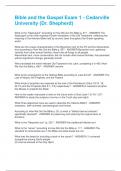
Bible and the Gospel Exam 1 - Cedarville
University (Dr. Shepherd)
What is the "Septuagint" according to How We Got the Bible p. 61? - ANSWER-The
Septuagint is the most important Greek translation of the Old Testament, reflecting the
meaning of the Hebrew Bible held by ancient Jews throughout the Greek-speaking
world
What are the unique characteristics of the Byzantium text of the NT and the Alexandrian
text according to How We Got the Bible p. 65? - ANSWER-Byzantium text: gathered
variants from other textual families; tried to be all things to all people.
Alexandrian text: more conservative; did not include other textual families; has persisted
without significant change; generally shorter
Who translated the entire Hebrew Old Testament into Latin, completing it in 405 (How
We Got the Bible p. 66)? - ANSWER-Jerome
What is the arrangement of the Hebrew Bible according to Luke 24:44? - ANSWER-The
Law of Moses, the Prophets, and the Psalms
What kinds of prophets are expected at the end of the Pentateuch (Deut 18:15, 18;
34:10) and the Prophets (Mal 3:1; 4:5) respectively? - ANSWER-A messianic prophet
like Moses or prophet like Elijah
How is the reader instructed to wait on the future work of God (Josh 1:8; Ps 1:2)? -
ANSWER-to study the scripture (murmur in the Torah day and night)
What three adjectives have we used to describe the Hebrew Bible? - ANSWER-
messianic, faith-oriented, eschatological (end-times)
According to How We Got the Bible p. 20, to what is "biblical textual criticism"
specifically devoted? - ANSWER-to preserving and restoring the original texts of
Scripture
What is the "Masoretic text" (p. 22)? - ANSWER-the traditional Hebrew text
What is the "canon" according to How We Got the Bible p. 11? - ANSWER-The
standard for what books are in the Bible and what books are not
What was the basis for including a book in the canon? - ANSWER-(1) universal
acceptance among God's people
(2) internal witness of the Holy Spirit
University (Dr. Shepherd)
What is the "Septuagint" according to How We Got the Bible p. 61? - ANSWER-The
Septuagint is the most important Greek translation of the Old Testament, reflecting the
meaning of the Hebrew Bible held by ancient Jews throughout the Greek-speaking
world
What are the unique characteristics of the Byzantium text of the NT and the Alexandrian
text according to How We Got the Bible p. 65? - ANSWER-Byzantium text: gathered
variants from other textual families; tried to be all things to all people.
Alexandrian text: more conservative; did not include other textual families; has persisted
without significant change; generally shorter
Who translated the entire Hebrew Old Testament into Latin, completing it in 405 (How
We Got the Bible p. 66)? - ANSWER-Jerome
What is the arrangement of the Hebrew Bible according to Luke 24:44? - ANSWER-The
Law of Moses, the Prophets, and the Psalms
What kinds of prophets are expected at the end of the Pentateuch (Deut 18:15, 18;
34:10) and the Prophets (Mal 3:1; 4:5) respectively? - ANSWER-A messianic prophet
like Moses or prophet like Elijah
How is the reader instructed to wait on the future work of God (Josh 1:8; Ps 1:2)? -
ANSWER-to study the scripture (murmur in the Torah day and night)
What three adjectives have we used to describe the Hebrew Bible? - ANSWER-
messianic, faith-oriented, eschatological (end-times)
According to How We Got the Bible p. 20, to what is "biblical textual criticism"
specifically devoted? - ANSWER-to preserving and restoring the original texts of
Scripture
What is the "Masoretic text" (p. 22)? - ANSWER-the traditional Hebrew text
What is the "canon" according to How We Got the Bible p. 11? - ANSWER-The
standard for what books are in the Bible and what books are not
What was the basis for including a book in the canon? - ANSWER-(1) universal
acceptance among God's people
(2) internal witness of the Holy Spirit