Cognitive Psychology Notes
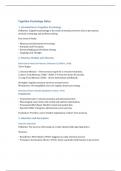
1. Introduction to Cognitive Psychology
Definition: Cognitive psychology is the study of mental processes such as perception,
memory, reasoning, and problem-solving.
Key Areas of Study:
• Memory and Information Processing
• Attention and Perception
• Decision Making and Problem Solving
• Language and Thought
2. Memory Models and Theories
Multi-Store Model of Memory (Atkinson & Shiffrin, 1968)
Three Stages:
1. Sensory Memory – Stores sensory input for a very short duration.
2. Short-Term Memory (STM) – Holds 5-9 items for about 30 seconds.
3. Long-Term Memory (LTM) – Stores information indefinitely.
Strengths: Explains memory structure and processes.
Weaknesses: Oversimplified, does not explain deeper processing.
Working Memory Model (Baddeley & Hitch, 1974)
Components:
• Central Executive: Controls attention and information flow.
• Phonological Loop: Deals with verbal and auditory information.
• Visuospatial Sketchpad: Handles visual and spatial data.
• Episodic Buffer: Integrates information across systems.
Evaluation: Provides a more detailed explanation of short-term memory.
3. Attention and Perception
Selective Attention
Definition: The process of focusing on certain stimuli while ignoring others.
Theories:
• Broadbent’s Filter Model (1958): Suggests an early selection process.
• Treisman’s Attenuation Theory (1964): Some unattended information is processed.
1. Introduction to Cognitive Psychology
Definition: Cognitive psychology is the study of mental processes such as perception,
memory, reasoning, and problem-solving.
Key Areas of Study:
• Memory and Information Processing
• Attention and Perception
• Decision Making and Problem Solving
• Language and Thought
2. Memory Models and Theories
Multi-Store Model of Memory (Atkinson & Shiffrin, 1968)
Three Stages:
1. Sensory Memory – Stores sensory input for a very short duration.
2. Short-Term Memory (STM) – Holds 5-9 items for about 30 seconds.
3. Long-Term Memory (LTM) – Stores information indefinitely.
Strengths: Explains memory structure and processes.
Weaknesses: Oversimplified, does not explain deeper processing.
Working Memory Model (Baddeley & Hitch, 1974)
Components:
• Central Executive: Controls attention and information flow.
• Phonological Loop: Deals with verbal and auditory information.
• Visuospatial Sketchpad: Handles visual and spatial data.
• Episodic Buffer: Integrates information across systems.
Evaluation: Provides a more detailed explanation of short-term memory.
3. Attention and Perception
Selective Attention
Definition: The process of focusing on certain stimuli while ignoring others.
Theories:
• Broadbent’s Filter Model (1958): Suggests an early selection process.
• Treisman’s Attenuation Theory (1964): Some unattended information is processed.