Human Anatomy & Physiology, 8e (Marieb/Hoehn)
Chapter 24 Nutrition, Metabolism, and Body Temperature Regulation
Matching Questions
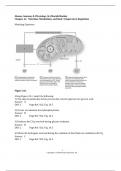
Figure 24.1
Using Figure 24.1, match the following:
1) Ten-step enzymatically driven process that converts glucose into pyruvic acid.
Answer: A
Diff: 2 Page Ref: 922; Fig. 24.5
2) Occurs via substrate-level phosphorylation.
Answer: D
Diff: 2 Page Ref: 922; Fig. 24.5
3) Produces the CO2 involved during glucose oxidation.
Answer: B
Diff: 2 Page Ref: 922; Fig. 24.5
4) Where the hydrogens removed during the oxidation of food fuels are combined with O2.
Answer: C
Diff: 3 Page Ref: 922; Fig. 24.5
1
Copyright © 2010 Pearson Education, Inc.
,5) Contains ATP synthases, small rotary motors.
Answer: C
Diff: 3 Page Ref: 922
6) ATP formed by oxidative phosphorylation.
Answer: E
Diff: 2 Page Ref: 922
7) Involves sugar activation, sugar cleavage, and oxidation and ATP formation.
Answer: A
Diff: 2 Page Ref: 922; Fig. 24.5
Match the following:
A) Glycolysis
B) Krebs cycle and electron transport chain
C) Krebs cycle and electron transport chain.
8) Glucose serves as the initial reactant.
Diff: 1 Page Ref: 923-924
9) Involves the removal of hydrogen electrons and CO2 from the substrate molecule.
Diff: 3 Page Ref: 924-928
10) Occurs in the cytosol of a cell.
Diff: 1 Page Ref: 923-924
11) Produces the most ATP
Diff: 1 Page Ref: 924-928
12) Involves the use of oxygen to pick up excess hydrogen and electrons.
Diff: 1 Page Ref: 924-928
Answers: 8) A 9) B 10) A 11) C 12) B
2
Copyright © 2010 Pearson Education, Inc.
, Match the following:
A) glycogenesis
B) glycogenolysis
C) glycolysis
D) gluconeogenesis
13) Breakdown of glycogen to release glucose.
Diff: 1 Page Ref: 930; Tbl. 24.4
14) Formation of glucose from proteins or fats.
Diff: 1 Page Ref: 930; Tbl. 24.4
15) Storage of glucose in the form of glycogen.
Diff: 1 Page Ref: 929; Tbl. 24.4
16) Breakdown of glucose to pyruvic acid.
Diff: 1 Page Ref: 923; Tbl. 24.4
Answers: 13) B 14) D 15) A 16) C
Match the following:
A) lipolysis
B) beta oxidation
C) lipogenesis
D) ketogenesis
17) Synthesis of lipids from glucose or amino acids.
Diff: 1 Page Ref: 931; Tbl. 24.4
18) Splitting of triglycerides into glycerol and fatty acids.
Diff: 1 Page Ref: 931; Tbl. 24.4
19) Conversion of fatty acids into acetyl groups.
Diff: 1 Page Ref: 931; Tbl. 24.4
20) Formation of ketone bodies.
Diff: 1 Page Ref: 932; Tbl. 24.4
Answers: 17) C 18) A 19) B 20) D
3
Copyright © 2010 Pearson Education, Inc.
Chapter 24 Nutrition, Metabolism, and Body Temperature Regulation
Matching Questions
Figure 24.1
Using Figure 24.1, match the following:
1) Ten-step enzymatically driven process that converts glucose into pyruvic acid.
Answer: A
Diff: 2 Page Ref: 922; Fig. 24.5
2) Occurs via substrate-level phosphorylation.
Answer: D
Diff: 2 Page Ref: 922; Fig. 24.5
3) Produces the CO2 involved during glucose oxidation.
Answer: B
Diff: 2 Page Ref: 922; Fig. 24.5
4) Where the hydrogens removed during the oxidation of food fuels are combined with O2.
Answer: C
Diff: 3 Page Ref: 922; Fig. 24.5
1
Copyright © 2010 Pearson Education, Inc.
,5) Contains ATP synthases, small rotary motors.
Answer: C
Diff: 3 Page Ref: 922
6) ATP formed by oxidative phosphorylation.
Answer: E
Diff: 2 Page Ref: 922
7) Involves sugar activation, sugar cleavage, and oxidation and ATP formation.
Answer: A
Diff: 2 Page Ref: 922; Fig. 24.5
Match the following:
A) Glycolysis
B) Krebs cycle and electron transport chain
C) Krebs cycle and electron transport chain.
8) Glucose serves as the initial reactant.
Diff: 1 Page Ref: 923-924
9) Involves the removal of hydrogen electrons and CO2 from the substrate molecule.
Diff: 3 Page Ref: 924-928
10) Occurs in the cytosol of a cell.
Diff: 1 Page Ref: 923-924
11) Produces the most ATP
Diff: 1 Page Ref: 924-928
12) Involves the use of oxygen to pick up excess hydrogen and electrons.
Diff: 1 Page Ref: 924-928
Answers: 8) A 9) B 10) A 11) C 12) B
2
Copyright © 2010 Pearson Education, Inc.
, Match the following:
A) glycogenesis
B) glycogenolysis
C) glycolysis
D) gluconeogenesis
13) Breakdown of glycogen to release glucose.
Diff: 1 Page Ref: 930; Tbl. 24.4
14) Formation of glucose from proteins or fats.
Diff: 1 Page Ref: 930; Tbl. 24.4
15) Storage of glucose in the form of glycogen.
Diff: 1 Page Ref: 929; Tbl. 24.4
16) Breakdown of glucose to pyruvic acid.
Diff: 1 Page Ref: 923; Tbl. 24.4
Answers: 13) B 14) D 15) A 16) C
Match the following:
A) lipolysis
B) beta oxidation
C) lipogenesis
D) ketogenesis
17) Synthesis of lipids from glucose or amino acids.
Diff: 1 Page Ref: 931; Tbl. 24.4
18) Splitting of triglycerides into glycerol and fatty acids.
Diff: 1 Page Ref: 931; Tbl. 24.4
19) Conversion of fatty acids into acetyl groups.
Diff: 1 Page Ref: 931; Tbl. 24.4
20) Formation of ketone bodies.
Diff: 1 Page Ref: 932; Tbl. 24.4
Answers: 17) C 18) A 19) B 20) D
3
Copyright © 2010 Pearson Education, Inc.