Human Anatomy & Physiology, 8e (Marieb/Hoehn)
Chapter 2 Chemistry Comes Alive
Matching Questions
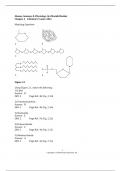
Figure 2.1
Using Figure 2.1, match the following:
1) Lipid.
Answer: D
Diff: 2 Page Ref: 46; Fig. 2.15b
2) Functional protein.
Answer: B
Diff: 2 Page Ref: 49; Fig. 2.19a
3) Nucleotide.
Answer: E
Diff: 2 Page Ref: 54; Fig. 2.22a
4) Polysaccharide.
Answer: C
Diff: 2 Page Ref: 44; Fig. 2.15c
5) Monosaccharide.
Answer: A
Diff: 2 Page Ref: 44; Fig. 2.15a
1
Copyright © 2010 Pearson Education, Inc.
,6) Polymer.
Answer: C
Diff: 2 Page Ref: 44; Fig. 2.15c
7) Tertiary (protein) structure.
Answer: B
Diff: 2 Page Ref: 49; Fig. 2.19c
Figure 2.2
Using Figure 2.2, match the following:
8) Deoxyribose sugar.
Answer: B
Diff: 2 Page Ref: 54 Fig. 2.22
9) Thymine.
Answer: D
Diff: 2 Page Ref: 54 Fig. 2.22
2
Copyright © 2010 Pearson Education, Inc.
, 10) Guanine.
Answer: E
Diff: 2 Page Ref: 54 Fig. 2.22
11) Phosphate.
Answer: C
Diff: 2 Page Ref: 54 Fig. 2.22
12) Hydrogen bonds.
Answer: A
Diff: 3 Page Ref: 54 Fig. 2.22
Match the following chemical bonds to the correct description:
A) Ionic bond
B) Polar covalent bond
C) Hydrogen bond
D) Nonpolar covalent bond
13) A bond in which electrons are shared unequally.
Diff: 1 Page Ref: 34; Fig. 2.9
14) A bond in which electrons are completely lost or gained by the atoms involved.
Diff: 1 Page Ref: 32, 34; Fig. 2.9
15) A bond in which electrons are shared equally.
Diff: 1 Page Ref: 34; Fig. 2.9
16) A type of bond important in tying different parts of the same molecule together into a three-
dimensional structure.
Diff: 2 Page Ref: 35
Answers: 13) B 14) A 15) D 16) C
3
Copyright © 2010 Pearson Education, Inc.
Chapter 2 Chemistry Comes Alive
Matching Questions
Figure 2.1
Using Figure 2.1, match the following:
1) Lipid.
Answer: D
Diff: 2 Page Ref: 46; Fig. 2.15b
2) Functional protein.
Answer: B
Diff: 2 Page Ref: 49; Fig. 2.19a
3) Nucleotide.
Answer: E
Diff: 2 Page Ref: 54; Fig. 2.22a
4) Polysaccharide.
Answer: C
Diff: 2 Page Ref: 44; Fig. 2.15c
5) Monosaccharide.
Answer: A
Diff: 2 Page Ref: 44; Fig. 2.15a
1
Copyright © 2010 Pearson Education, Inc.
,6) Polymer.
Answer: C
Diff: 2 Page Ref: 44; Fig. 2.15c
7) Tertiary (protein) structure.
Answer: B
Diff: 2 Page Ref: 49; Fig. 2.19c
Figure 2.2
Using Figure 2.2, match the following:
8) Deoxyribose sugar.
Answer: B
Diff: 2 Page Ref: 54 Fig. 2.22
9) Thymine.
Answer: D
Diff: 2 Page Ref: 54 Fig. 2.22
2
Copyright © 2010 Pearson Education, Inc.
, 10) Guanine.
Answer: E
Diff: 2 Page Ref: 54 Fig. 2.22
11) Phosphate.
Answer: C
Diff: 2 Page Ref: 54 Fig. 2.22
12) Hydrogen bonds.
Answer: A
Diff: 3 Page Ref: 54 Fig. 2.22
Match the following chemical bonds to the correct description:
A) Ionic bond
B) Polar covalent bond
C) Hydrogen bond
D) Nonpolar covalent bond
13) A bond in which electrons are shared unequally.
Diff: 1 Page Ref: 34; Fig. 2.9
14) A bond in which electrons are completely lost or gained by the atoms involved.
Diff: 1 Page Ref: 32, 34; Fig. 2.9
15) A bond in which electrons are shared equally.
Diff: 1 Page Ref: 34; Fig. 2.9
16) A type of bond important in tying different parts of the same molecule together into a three-
dimensional structure.
Diff: 2 Page Ref: 35
Answers: 13) B 14) A 15) D 16) C
3
Copyright © 2010 Pearson Education, Inc.