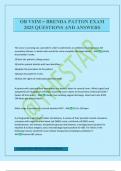
OB final exam & HESI
assessment exams with
correct questions and
answers.
The nurse should be concerned after the assessment finding on what during a
magnesium sulfate infusion for preeclampsia?
A. a sleepy, sedated effect
B. a respiratory rate of 10 bpm
C. DTR of 2+
D. absence of ankle clonus - CORRECT ANSWERS✔️✔️B should alert the nurse
for respiratory depression. The other findings are considered normal.
the most common medical complication of pregnancy - CORRECT
ANSWERS✔️✔️hypertension
preeclampsia results in what - CORRECT ANSWERS✔️✔d ️ ecreased function of
organs (placenta, liver, kidneys, brain) due to vasospasms diminishing the
diameter of blood vessels .
a woman being treated with magnesium sulfate should be considered to be
treated successfully if... - CORRECT ANSWERS✔️✔️no seizures occur
Mag is a CNS depressant, NOT an antihypertensive medication
,antidote for magnesium sulfate - CORRECT ANSWERS✔️✔️calcium gluconate
HELLP syndrome - CORRECT ANSWERS✔️✔️Hemolysis
Elevated Liver enzymes
Low Platelets
A pregnant woman who is at 21 weeks of gestation has an elevated blood
pressure of 140/98. Past medical history reveals that the woman has been treated
for hypertension. On the basis of this information, the nurse would classify this
patient as having: - CORRECT ANSWERS✔️✔️superimposed preeclampsia
positive ankle clonus indicates... - CORRECT ANSWERS✔️✔h
️ yperactivity and is a
cause for concern
which antihypertensive medication would cause a pregnant woman to have a
false positive Coombs test? - CORRECT ANSWERS✔️✔️methyldopa (aldomet)
lab values for preeclampsia - CORRECT ANSWERS✔️✔e️ levated hemoglobin
elevated LDH
decreased platelets (below 100,000)
increased BUN
the most important cause of perinatal loss in diabetic pregnancy is... - CORRECT
ANSWERS✔️✔️congenital malformations
hypothyroidism in mother could cause - CORRECT ANSWERS✔️✔️miscarriage
,preeclampsia and hypertension
placental abruption
stillbirth
low birth weight, premature
A patient who is pregnant already has Type 2 diabetes with a hemoglobin A1c
value of 7. The nurse would categorize this patient as having: - CORRECT
ANSWERS✔️✔️pregestational DM
priority assessment for pregnant woman experiencing nausea and vomiting -
CORRECT ANSWERS✔️✔️ketonuria
A pregnant woman has maternal phenylketonuria (PKU) and is interested in
whether or not she will be able to breastfeed her baby. Which reaction by the
nurse indicates accurate information? - CORRECT ANSWERS✔️✔️the patient
should be advised to not breastfeed the infant because her breast milk will
contain large amounts of phenylalanine
what interventions would the nurse anticipate to be ordered by the physician for
a patient in a thyroid storm during delivery? - CORRECT
ANSWERS✔️✔️administer oxygen
antipyretics
PTU
preeclampsia protein levels - CORRECT ANSWERS✔️✔️mild: 1+ on dipstick (0.3-2
g/24 hours)
, severe: 3+ dipstick (more than 5 g/24 hr)
mag toxicity - CORRECT ANSWERS✔️✔️flushing
sweating
hypotension
depressed DTR
respiratory depression
creatinine levels of severe preeclampsia - CORRECT ANSWERS✔️✔️elevated
(above 1.2)
platelet levels of severe preeclampsia - CORRECT ANSWERS✔️✔d
️ ecreased
(below 100,000)
incompetent cervix - CORRECT ANSWERS✔️✔p
️ remature dilation
tx: surgical placement of cervical cerclage 10-14 weeks gestation to constrict the
internal os
provide bed rest, hydration, tocolysis (to inhibit ctx), no sex or standing for a long
time
removed at 37 weeks gestation or prior to c/s
leading cause of life-threatening perinatal infections - CORRECT
ANSWERS✔️✔️GBS
assessment exams with
correct questions and
answers.
The nurse should be concerned after the assessment finding on what during a
magnesium sulfate infusion for preeclampsia?
A. a sleepy, sedated effect
B. a respiratory rate of 10 bpm
C. DTR of 2+
D. absence of ankle clonus - CORRECT ANSWERS✔️✔️B should alert the nurse
for respiratory depression. The other findings are considered normal.
the most common medical complication of pregnancy - CORRECT
ANSWERS✔️✔️hypertension
preeclampsia results in what - CORRECT ANSWERS✔️✔d ️ ecreased function of
organs (placenta, liver, kidneys, brain) due to vasospasms diminishing the
diameter of blood vessels .
a woman being treated with magnesium sulfate should be considered to be
treated successfully if... - CORRECT ANSWERS✔️✔️no seizures occur
Mag is a CNS depressant, NOT an antihypertensive medication
,antidote for magnesium sulfate - CORRECT ANSWERS✔️✔️calcium gluconate
HELLP syndrome - CORRECT ANSWERS✔️✔️Hemolysis
Elevated Liver enzymes
Low Platelets
A pregnant woman who is at 21 weeks of gestation has an elevated blood
pressure of 140/98. Past medical history reveals that the woman has been treated
for hypertension. On the basis of this information, the nurse would classify this
patient as having: - CORRECT ANSWERS✔️✔️superimposed preeclampsia
positive ankle clonus indicates... - CORRECT ANSWERS✔️✔h
️ yperactivity and is a
cause for concern
which antihypertensive medication would cause a pregnant woman to have a
false positive Coombs test? - CORRECT ANSWERS✔️✔️methyldopa (aldomet)
lab values for preeclampsia - CORRECT ANSWERS✔️✔e️ levated hemoglobin
elevated LDH
decreased platelets (below 100,000)
increased BUN
the most important cause of perinatal loss in diabetic pregnancy is... - CORRECT
ANSWERS✔️✔️congenital malformations
hypothyroidism in mother could cause - CORRECT ANSWERS✔️✔️miscarriage
,preeclampsia and hypertension
placental abruption
stillbirth
low birth weight, premature
A patient who is pregnant already has Type 2 diabetes with a hemoglobin A1c
value of 7. The nurse would categorize this patient as having: - CORRECT
ANSWERS✔️✔️pregestational DM
priority assessment for pregnant woman experiencing nausea and vomiting -
CORRECT ANSWERS✔️✔️ketonuria
A pregnant woman has maternal phenylketonuria (PKU) and is interested in
whether or not she will be able to breastfeed her baby. Which reaction by the
nurse indicates accurate information? - CORRECT ANSWERS✔️✔️the patient
should be advised to not breastfeed the infant because her breast milk will
contain large amounts of phenylalanine
what interventions would the nurse anticipate to be ordered by the physician for
a patient in a thyroid storm during delivery? - CORRECT
ANSWERS✔️✔️administer oxygen
antipyretics
PTU
preeclampsia protein levels - CORRECT ANSWERS✔️✔️mild: 1+ on dipstick (0.3-2
g/24 hours)
, severe: 3+ dipstick (more than 5 g/24 hr)
mag toxicity - CORRECT ANSWERS✔️✔️flushing
sweating
hypotension
depressed DTR
respiratory depression
creatinine levels of severe preeclampsia - CORRECT ANSWERS✔️✔️elevated
(above 1.2)
platelet levels of severe preeclampsia - CORRECT ANSWERS✔️✔d
️ ecreased
(below 100,000)
incompetent cervix - CORRECT ANSWERS✔️✔p
️ remature dilation
tx: surgical placement of cervical cerclage 10-14 weeks gestation to constrict the
internal os
provide bed rest, hydration, tocolysis (to inhibit ctx), no sex or standing for a long
time
removed at 37 weeks gestation or prior to c/s
leading cause of life-threatening perinatal infections - CORRECT
ANSWERS✔️✔️GBS