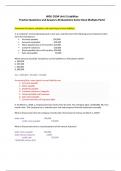
WGU D104 Unit 5 Liabilities
Practice Questions and Answers-46 Questions-Some Have Multiple Parts!
Determine the nature, valuation, and reporting of current liabilities.
2. A company’s normal operating cycle is one year, and they have the following account balances taken
from the trial balance:
• Accounts payable: $50,000
• Accounts receivable: $25,000
• Notes payable (due in 30 months): $15,000
• Customer advances: $10,000
• Bonds payable (due in 60 months): $30,000
• Sales tax payable: $5,000
Which amount should be included as current liabilities on the balance sheet?
a. $40,000
b. $55,000
c. $65,000
d. $80,000
Ans c ($50,000 + $10,000 + $5,000)
Accounting Rule: some typical current liabilities are
1. Accounts payable.
2. Notes payable.
3. Dividends payable.
4. Customer advances / deposits.
5. Unearned (deferred) revenues.
6. Sales taxes payable.
7. Current maturities of long-term debt
6. On March 1, 2020, a company borrows money from its bank. The company signs a $100,000, 6%, four-
month note. The company has a calendar year end and prepares financial statements annually.
What is the journal entry the company records when it borrows the money on March 1, 2020?
debit cash 100,000
credit notes payable 100,000
What is the journal entry to record payment of the note at maturity?
debit notes payable 100,000
debit interest expense 2,0001
credit cash 102,000
1(
$100,000 x 6%) x 4/12
,Accounting Rule: interest is calculated on an annual basis.
9. A fast food restaurant sells frosty milk shakes for $2.00. The restaurant also sells gift certificate
booklets containing 10 frosty milk shake certificates for $20 a booklet. On May 1st, a customer buys a
booklet. On June 1st, a customer redeems four certificates for four frosty milk shakes.
What is the entry to record the sale of the gift certificate booklet and redemption of 4 gift certificates?
5/1 debit cash 20
credit unearned gift card revenue 20
6/1 debit unearned gift card revenue 8
credit sales revenue 8
Accounting Rule: a company may collect cash from a customer in advance of selling a product or doing
work for a customer. Doing so creates a current liability (unearned revenue), which is an obligation
arising from receiving cash in advance of providing a product or a service. Unearned revenue is recorded
as a debit to cash, an asset account, and credit to unearned revenue, a current liability.
15. On January 1, a company received $24,000 in advance for monthly janitorial services for the year.
Which journal entry should the company use to record the month of May's revenue?
a. debit unearned sales revenue for $2,000; credit sales revenue for $2,000.
b. debit unearned sales revenue for $10,000; credit sales revenue for $10,000
c. debit to sales revenue for $2,000; credit unearned sales revenue for $2,000
d. debit to sales revenue for $10,000; credit unearned sales revenue for $10,000
Ans a $24,
Accounting Rule: revenue is earned when the service is provided.
16. A company collected sales tax of $2,800 on sales of $35,000. The sales tax rate is 8.5%.
What is the journal entry to record the sale if the company segregates the sales tax and sale?
debit cash 37,800
debit loss on sales tax collection 175
credit sales revenue 35,000
credit sales tax payable 2,975
Accounting Rule: sometimes the sales tax collections credited to the liability account are not equal to
the liability as computed by the governmental formula. In such a case, the company makes an
adjustment of the liability account by recognizing a gain or a loss on sales tax collections. The sales tax
that should have been collected was: $35,000 X 8.5% = $2,975; the company only collected $2,800.
Therefore, the $175 must be recorded as a loss or an expense.
, What is the journal entry to record payment to the sales tax agency?
debit sales tax payable 2,975
credit cash 2,975
What is the journal entry to record the sale if the company does not segregate the sales tax and sale?
debit cash 37,800
credit sales revenue 37,800
Accounting Rule: a company is not required to segregate the sales tax and the amount of the sale at the
time of sale. Instead, the company credits both amounts in total in the Sales Revenue account.
What is the journal entry to record payment to the sales tax agency?
debit sales revenue 2,800
debit loss on sales tax collection 175
credit cash 2,975
Accounting Rule: the company could credit sales tax payable instead of cash, and then reverse this
liability later by debiting sales tax payable and crediting cash.
18. A company does not segregate sales tax and the amount of sale at the time of sale. At quarter end,
the company must record the sales tax. The sales revenue account shows a balance of $200,000, which
includes 6% sales tax.
Which journal entry should be used to record the amount due to the taxing unit?
a. debit sales tax expense for $11,321; credit sales taxes payable for $11,321.
b. debit sales revenue for $11,321; credit sales taxes payable for $11,321.
c. debit sales revenue for $12,000; credit sales taxes payable for $12,000.
d. debit sales tax expense for $12,000; credit sales taxes payable for $12,000.
Ans b the sales revenue account balance without the sales tax is $188,679 = $200,.06. Subtract
this amount from the $200,000 for the sales tax amount.
24. On February 1, a company borrowed $24,600 from its bank. The terms of the loan require five equal
annual principal payments beginning January 31 of the following year. The company has a calendar
year-end.
Which journal entry should the company use to record the loan?
a. debit cash $24,600, credit current maturities of long-term debt $4,920, credit note payable $19,680.
b. debit cash $24,600, credit current maturities of long-term debt $4,510, credit note payable $20,090.
c. debit note payable $20,090, debit current maturities of long-term debt $4,510, credit cash $24,600.
d. debit note payable $19,680, debit current maturities of long-term debt $4,920, credit cash $24,600.
Ans a ($24,) = $4,920 current; $24,600 - $4,920 = $19,680 long-term
Practice Questions and Answers-46 Questions-Some Have Multiple Parts!
Determine the nature, valuation, and reporting of current liabilities.
2. A company’s normal operating cycle is one year, and they have the following account balances taken
from the trial balance:
• Accounts payable: $50,000
• Accounts receivable: $25,000
• Notes payable (due in 30 months): $15,000
• Customer advances: $10,000
• Bonds payable (due in 60 months): $30,000
• Sales tax payable: $5,000
Which amount should be included as current liabilities on the balance sheet?
a. $40,000
b. $55,000
c. $65,000
d. $80,000
Ans c ($50,000 + $10,000 + $5,000)
Accounting Rule: some typical current liabilities are
1. Accounts payable.
2. Notes payable.
3. Dividends payable.
4. Customer advances / deposits.
5. Unearned (deferred) revenues.
6. Sales taxes payable.
7. Current maturities of long-term debt
6. On March 1, 2020, a company borrows money from its bank. The company signs a $100,000, 6%, four-
month note. The company has a calendar year end and prepares financial statements annually.
What is the journal entry the company records when it borrows the money on March 1, 2020?
debit cash 100,000
credit notes payable 100,000
What is the journal entry to record payment of the note at maturity?
debit notes payable 100,000
debit interest expense 2,0001
credit cash 102,000
1(
$100,000 x 6%) x 4/12
,Accounting Rule: interest is calculated on an annual basis.
9. A fast food restaurant sells frosty milk shakes for $2.00. The restaurant also sells gift certificate
booklets containing 10 frosty milk shake certificates for $20 a booklet. On May 1st, a customer buys a
booklet. On June 1st, a customer redeems four certificates for four frosty milk shakes.
What is the entry to record the sale of the gift certificate booklet and redemption of 4 gift certificates?
5/1 debit cash 20
credit unearned gift card revenue 20
6/1 debit unearned gift card revenue 8
credit sales revenue 8
Accounting Rule: a company may collect cash from a customer in advance of selling a product or doing
work for a customer. Doing so creates a current liability (unearned revenue), which is an obligation
arising from receiving cash in advance of providing a product or a service. Unearned revenue is recorded
as a debit to cash, an asset account, and credit to unearned revenue, a current liability.
15. On January 1, a company received $24,000 in advance for monthly janitorial services for the year.
Which journal entry should the company use to record the month of May's revenue?
a. debit unearned sales revenue for $2,000; credit sales revenue for $2,000.
b. debit unearned sales revenue for $10,000; credit sales revenue for $10,000
c. debit to sales revenue for $2,000; credit unearned sales revenue for $2,000
d. debit to sales revenue for $10,000; credit unearned sales revenue for $10,000
Ans a $24,
Accounting Rule: revenue is earned when the service is provided.
16. A company collected sales tax of $2,800 on sales of $35,000. The sales tax rate is 8.5%.
What is the journal entry to record the sale if the company segregates the sales tax and sale?
debit cash 37,800
debit loss on sales tax collection 175
credit sales revenue 35,000
credit sales tax payable 2,975
Accounting Rule: sometimes the sales tax collections credited to the liability account are not equal to
the liability as computed by the governmental formula. In such a case, the company makes an
adjustment of the liability account by recognizing a gain or a loss on sales tax collections. The sales tax
that should have been collected was: $35,000 X 8.5% = $2,975; the company only collected $2,800.
Therefore, the $175 must be recorded as a loss or an expense.
, What is the journal entry to record payment to the sales tax agency?
debit sales tax payable 2,975
credit cash 2,975
What is the journal entry to record the sale if the company does not segregate the sales tax and sale?
debit cash 37,800
credit sales revenue 37,800
Accounting Rule: a company is not required to segregate the sales tax and the amount of the sale at the
time of sale. Instead, the company credits both amounts in total in the Sales Revenue account.
What is the journal entry to record payment to the sales tax agency?
debit sales revenue 2,800
debit loss on sales tax collection 175
credit cash 2,975
Accounting Rule: the company could credit sales tax payable instead of cash, and then reverse this
liability later by debiting sales tax payable and crediting cash.
18. A company does not segregate sales tax and the amount of sale at the time of sale. At quarter end,
the company must record the sales tax. The sales revenue account shows a balance of $200,000, which
includes 6% sales tax.
Which journal entry should be used to record the amount due to the taxing unit?
a. debit sales tax expense for $11,321; credit sales taxes payable for $11,321.
b. debit sales revenue for $11,321; credit sales taxes payable for $11,321.
c. debit sales revenue for $12,000; credit sales taxes payable for $12,000.
d. debit sales tax expense for $12,000; credit sales taxes payable for $12,000.
Ans b the sales revenue account balance without the sales tax is $188,679 = $200,.06. Subtract
this amount from the $200,000 for the sales tax amount.
24. On February 1, a company borrowed $24,600 from its bank. The terms of the loan require five equal
annual principal payments beginning January 31 of the following year. The company has a calendar
year-end.
Which journal entry should the company use to record the loan?
a. debit cash $24,600, credit current maturities of long-term debt $4,920, credit note payable $19,680.
b. debit cash $24,600, credit current maturities of long-term debt $4,510, credit note payable $20,090.
c. debit note payable $20,090, debit current maturities of long-term debt $4,510, credit cash $24,600.
d. debit note payable $19,680, debit current maturities of long-term debt $4,920, credit cash $24,600.
Ans a ($24,) = $4,920 current; $24,600 - $4,920 = $19,680 long-term