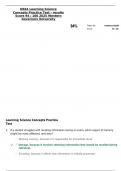
D664 Learning Science
Concepts Practice Test - results
Score 2025 Western
Governors University
94% Taken by:
Score
heatherzuniga65
Learning Science Concepts Practice
Test
1. If a student struggles with recalling information during an exam, which aspect of memory
might be most affected, and why?
Working memory, because it is responsible for immediate recall.
Storage, because it involves retaining information that should be recalled during
retrieval.
Encoding, because it affects how information is initially processed.
, Sensory memory, because it only holds information for a brief moment.
2. What is the primary role of feedback in the learning process?
Encouraging competition among learners
Guiding future actions to refine learning strategies
Increasing the amount of information retained
Providing emotional support to learners
3. A memory mechanism that can hold a limited amount of information for a brief period
of time, usually around 30 seconds, unless there is rehearsal (such as repeating a telephone
number) to maintain the information in short-term memory. Short-term memory is one of the
stages in the modal model of memory.
Semantic Memory
Short term memory
Episodic Memory
Procedural Memory
4. In the context of learning strategies, what does interleaving involve?
Using concrete examples to illustrate abstract concepts.
Focusing on one type of problem-solving for an extended
period. Arranging information in a systematic order for easy
recall.
Mixing different types of problems or topics within a study session.
, 5. What is executive function?
The ability to regulate emotions and behavior
The ability to process sensory information
The ability to control voluntary movement
The ability to plan, organize, and make decisions
6. If a student is trying to memorize a list of items for a test but only reviews them once, what
aspect of memory are they primarily relying on?
Long-term memory
Sensory memory
Working memory
Short-term memory
7. What is the definition of encoding in memory?
Encoding is the initial processing of information, converting sensory input into
a storable form.
Encoding is the retrieval of stored information from memory.
Encoding is the process of forgetting irrelevant
information.
Encoding is the organization of information into meaningful units.
8. In a classroom setting, how might a teacher apply principles from information processing
theory to enhance student learning?
By minimizing the use of technology in learning activities.
By implementing strategies that promote encoding and retrieval of
information, such as using graphic organizers and practice tests.
By encouraging students to rely on group work without individual accountability.
By focusing solely on rote memorization techniques.
9. The spacing effect refers to the finding that____practice is a more effective learning strategy
than____practice.
Immediate; delayed
Concepts Practice Test - results
Score 2025 Western
Governors University
94% Taken by:
Score
heatherzuniga65
Learning Science Concepts Practice
Test
1. If a student struggles with recalling information during an exam, which aspect of memory
might be most affected, and why?
Working memory, because it is responsible for immediate recall.
Storage, because it involves retaining information that should be recalled during
retrieval.
Encoding, because it affects how information is initially processed.
, Sensory memory, because it only holds information for a brief moment.
2. What is the primary role of feedback in the learning process?
Encouraging competition among learners
Guiding future actions to refine learning strategies
Increasing the amount of information retained
Providing emotional support to learners
3. A memory mechanism that can hold a limited amount of information for a brief period
of time, usually around 30 seconds, unless there is rehearsal (such as repeating a telephone
number) to maintain the information in short-term memory. Short-term memory is one of the
stages in the modal model of memory.
Semantic Memory
Short term memory
Episodic Memory
Procedural Memory
4. In the context of learning strategies, what does interleaving involve?
Using concrete examples to illustrate abstract concepts.
Focusing on one type of problem-solving for an extended
period. Arranging information in a systematic order for easy
recall.
Mixing different types of problems or topics within a study session.
, 5. What is executive function?
The ability to regulate emotions and behavior
The ability to process sensory information
The ability to control voluntary movement
The ability to plan, organize, and make decisions
6. If a student is trying to memorize a list of items for a test but only reviews them once, what
aspect of memory are they primarily relying on?
Long-term memory
Sensory memory
Working memory
Short-term memory
7. What is the definition of encoding in memory?
Encoding is the initial processing of information, converting sensory input into
a storable form.
Encoding is the retrieval of stored information from memory.
Encoding is the process of forgetting irrelevant
information.
Encoding is the organization of information into meaningful units.
8. In a classroom setting, how might a teacher apply principles from information processing
theory to enhance student learning?
By minimizing the use of technology in learning activities.
By implementing strategies that promote encoding and retrieval of
information, such as using graphic organizers and practice tests.
By encouraging students to rely on group work without individual accountability.
By focusing solely on rote memorization techniques.
9. The spacing effect refers to the finding that____practice is a more effective learning strategy
than____practice.
Immediate; delayed