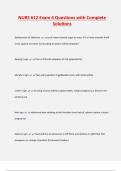
NURS 612 Exam 4 Questions with Complete
Solutions
Ballottement of abdomen push inward toward organ or mass. if it is freely movable it will
move upward and other surrounding structures will be displaced
Rovsing's sign Pain in RLQ with palpation of LLQ (appendicitis)
Murphy's sign Pain with palpation of gallbladder (seen with cholecystitis)
Cullen's sign bruising around umbilicus (pancreatitis, ectopic pregnancy or blood in the
peritoneum)
kehr sign abdominal pain radiating to left shoulder (renal calculi, splenic rupture, ectopic
pregnancy)
ballance sign Fixed dullness to percussion in left flank, and dullness in right flank that
disappears on change of position (Peritoneal irritation)
,blumberg sign rebound tenderness (peritoneal irritation)
dance sign absence of bowel sounds in RLQ (intussusception)
gray turner sign ecchymotic areas on the flank (retroperitoneal bleed, hemorrhagic
pancreatitis, blood in peritoneum)
markle sign pain in abdomen when the standing patient drops from standing on toes to
the heels with a jarring landing (appendicitis, peritoneal irritation)
Romberg-Howship sign pain down medial aspect of thigh to knees
(strangulated obturator hernia)
HPI questions musculoskeletal Joint pain- swelling, redness, stiffness, limited ROM, worse
with weather changes
Muscle pain- limited ROM, tremors, alleviated with ice/heat, spasms, aching
Skeletal symptoms- difficulty walking, numbness/tingling, crepitus, recent injury, medications
, Injury- clicks, mechanism of injury, ability to bear weight, swelling, numbness/tingling
Back pain- character of pain, associated events, better/worse with activity, medications,
alleviating/worsening factors
musculoskeletal inspection Size and contour of joint; inspect skin and tissues over joints
for color, swelling, and any masses or deformity
Presence of swelling signals joint irritation
Posture, gait, coordination, balance, symmetry
Atrophy
Musculoskeletal palpation palpate for heat, tenderness, swelling, crepitus, pain and
resistance to movement. muscles should be firm. assess for synovial thickening
ROM and muscle tone (joints and upper extremities) assess for pain, limitation of
movement, spasticity, joint instability, deformity or contracture. measure angle of greatest
flexion and extension and compare with expected values with goniometer
Solutions
Ballottement of abdomen push inward toward organ or mass. if it is freely movable it will
move upward and other surrounding structures will be displaced
Rovsing's sign Pain in RLQ with palpation of LLQ (appendicitis)
Murphy's sign Pain with palpation of gallbladder (seen with cholecystitis)
Cullen's sign bruising around umbilicus (pancreatitis, ectopic pregnancy or blood in the
peritoneum)
kehr sign abdominal pain radiating to left shoulder (renal calculi, splenic rupture, ectopic
pregnancy)
ballance sign Fixed dullness to percussion in left flank, and dullness in right flank that
disappears on change of position (Peritoneal irritation)
,blumberg sign rebound tenderness (peritoneal irritation)
dance sign absence of bowel sounds in RLQ (intussusception)
gray turner sign ecchymotic areas on the flank (retroperitoneal bleed, hemorrhagic
pancreatitis, blood in peritoneum)
markle sign pain in abdomen when the standing patient drops from standing on toes to
the heels with a jarring landing (appendicitis, peritoneal irritation)
Romberg-Howship sign pain down medial aspect of thigh to knees
(strangulated obturator hernia)
HPI questions musculoskeletal Joint pain- swelling, redness, stiffness, limited ROM, worse
with weather changes
Muscle pain- limited ROM, tremors, alleviated with ice/heat, spasms, aching
Skeletal symptoms- difficulty walking, numbness/tingling, crepitus, recent injury, medications
, Injury- clicks, mechanism of injury, ability to bear weight, swelling, numbness/tingling
Back pain- character of pain, associated events, better/worse with activity, medications,
alleviating/worsening factors
musculoskeletal inspection Size and contour of joint; inspect skin and tissues over joints
for color, swelling, and any masses or deformity
Presence of swelling signals joint irritation
Posture, gait, coordination, balance, symmetry
Atrophy
Musculoskeletal palpation palpate for heat, tenderness, swelling, crepitus, pain and
resistance to movement. muscles should be firm. assess for synovial thickening
ROM and muscle tone (joints and upper extremities) assess for pain, limitation of
movement, spasticity, joint instability, deformity or contracture. measure angle of greatest
flexion and extension and compare with expected values with goniometer