Funds Exam 2
Chapters 14-18: Nursing Process (ADPIE)
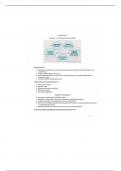
Nursing Process
● Developed to guide nurses clinical reasoning & decision making when field became more
autonomous
● 5-step scientifically based process
● Nurse works WITH client in each step of nursing process encourages collaboration &
continuity of care
● Promotes holistic, individualized care
Characteristics of the Nursing Process
● Systematic: ordered
● Dynamic: fluid
● Interpersonal: person centered
● Outcome oriented
● Universally applicable
Chapter 14: Assessment
● Continuous & systematic collection of data
● Database is all pertinent information obtained by interdisciplinary team
● All following steps of nursing process rely on accurate data
● Differs from medical assessment (med assessment focuses on obtaining data that pertains
to a pathological process)
● Nursing assessment focuses on client’s response to health problems
To promote clinical reasoning, the nursing assessment should be:
1
, ● Purposeful: situation based
● Prioritized: get the most important data first!
● Complete: identify all pertinent data
● Systematic: organized
● Factual: avoid biases, stereotyping; use effective delegation
● Accurate & Relevant
● Recorded standardly (no slang, per hospital standards)
Types of Nursing Assessments
1. Initial Assessment – also called an admission/comprehensive assessment (within 24hrs)
- Review of systems
- Medical/ surgical history
- Physical & psychosocial assessment
- Risk factor assessment
2. Focused Assessment – exploration of specific identified problem
- pain assessment, suicide assessment, cardiovascular assessment
3. Emergency Assessment – identifying life threatening problems quickly
4. Time-lapsed Assessment – long term trends in data
5. Patient-Centered Assessment Method – assess social determinants of health
- Health & well-being
- Social environment
- Health literacy & communication
Assessment Considerations
1. Prioritization
- Review medical record first to ensure eliciting only newly required info
- Ensure necessary assessments are completed for patient population
2. Health Orientation: potential for wellness
3. Developmental Stage: special procedures & assessment data required
4. Culture: nonverbal cues, religious preferences, communication
5. Need for nursing: acuity
Structuring an Assessment
- Minimum data: info that must be obtained from every patient every time
- Maslow’s structure: physiologic, safety, self-esteem, relationships, higher level
functioning (wellness); if Maslow’s doesn’t help, use ABC, then nursing process
- Medical structure: based on body systems
- HELP structure: Help, Environmental, Look, People
Subjective data (collected during nursing history)
● Information perceived only by the affected person (EX: pain, feeling dizzy or anxious)
● what the client tells the nurse
2
,Objective data (collected during physical exam)
● Observable & measurable data that can be seen, heard, or felt by someone other than the
person experiencing
● EX: elevated temperature, skin moisture, vomiting
Nursing History
● Obtaining all information nurse & care team needs to meet client’s individual needs
- Patient demographics
- Chief complaint
- Health literacy, communication, usual health patterns, cultural considerations
- Current review of systems
- Medical/ surgical history
- Advance directives, expectation of care
- ALWAYS assess allergies!
Physical Assessment
● Head-to-toe comprehensive
● Inspection, palpation, percussion (advanced), auscultation
● Potential Barriers to Assessment: pain, anxiety, language, previous negative experiences,
unrealistic expectations, inaccurate data in HER – always validate data, old data (vital
data should be reported immediately)
Documentation of Data
● Immediately give verbal report of data whenever a critical change in patient’s health
status is assessed
● Enter initial database into computer same day patient is admitted
● Summarize objective & subjective data in concise, comprehensive, & easily retrievable
manner
● Use good grammar & standard medical abbreviations
● Use patient’s own words whenever possible (use quotations)
● Avoid nonspecific terms subject to individual interpretation or definition
Privacy, Confidentiality, & Professionalism
● One of the nurse’s primary ethical responsibilities is safeguarding the privacy of patients
● Must be familiar with institution’s policies on privacy & requirements of HIPAA
3
, Chapter 15: Diagnosing
Types of diagnoses
1. Nursing Diagnosis
- Describes patient problems that nurses can treat independently
- Deals with the human response
- Selecting nursing diagnosis will influence chosen interventions in the next step
- EX: Nursing diagnosis: impaired airway clearance; Medical diagnosis: asthma
● MUST be NANDA (North American Nursing Diagnosis Association) approved
- Cluster the assessment data into broader ideas that will lead us to a nursing diagnosis
- Organized into domains: Health promotion, nutrition, activity/rest, role/relationship,
sexuality, coping/stress, safety/protection, growth & development, etc
● PPMP (Predict, Prevent, Manage, Promote)
- Predict the most common & most dangerous complications & take most immediate action
to prevent them & manage them
- Prevent problems by identifying the risk factors & aiming to reduce or control them
- Manage problems and their potential complications
- Promote optimum function and independence and ensure that all safety & learning needs
are met
● Data Interpretation & Analysis
- Cluster data into problem groups; data may contain “red flags”
- Identify client’s strengths, problems, potential problems
- What data is significant? A.) Changes in condition, B.) Deviation from accepted
norms, C.) Behavior that’s nonproductive to the person, D.) Behaviors that indicate
developmental delay or dysfunctional pattern
**NCLEX rarely tests on specific nursing diagnoses, but test heavily on concept of
nursing diagnoses
● Types of Nursing Diagnoses
4
Chapters 14-18: Nursing Process (ADPIE)
Nursing Process
● Developed to guide nurses clinical reasoning & decision making when field became more
autonomous
● 5-step scientifically based process
● Nurse works WITH client in each step of nursing process encourages collaboration &
continuity of care
● Promotes holistic, individualized care
Characteristics of the Nursing Process
● Systematic: ordered
● Dynamic: fluid
● Interpersonal: person centered
● Outcome oriented
● Universally applicable
Chapter 14: Assessment
● Continuous & systematic collection of data
● Database is all pertinent information obtained by interdisciplinary team
● All following steps of nursing process rely on accurate data
● Differs from medical assessment (med assessment focuses on obtaining data that pertains
to a pathological process)
● Nursing assessment focuses on client’s response to health problems
To promote clinical reasoning, the nursing assessment should be:
1
, ● Purposeful: situation based
● Prioritized: get the most important data first!
● Complete: identify all pertinent data
● Systematic: organized
● Factual: avoid biases, stereotyping; use effective delegation
● Accurate & Relevant
● Recorded standardly (no slang, per hospital standards)
Types of Nursing Assessments
1. Initial Assessment – also called an admission/comprehensive assessment (within 24hrs)
- Review of systems
- Medical/ surgical history
- Physical & psychosocial assessment
- Risk factor assessment
2. Focused Assessment – exploration of specific identified problem
- pain assessment, suicide assessment, cardiovascular assessment
3. Emergency Assessment – identifying life threatening problems quickly
4. Time-lapsed Assessment – long term trends in data
5. Patient-Centered Assessment Method – assess social determinants of health
- Health & well-being
- Social environment
- Health literacy & communication
Assessment Considerations
1. Prioritization
- Review medical record first to ensure eliciting only newly required info
- Ensure necessary assessments are completed for patient population
2. Health Orientation: potential for wellness
3. Developmental Stage: special procedures & assessment data required
4. Culture: nonverbal cues, religious preferences, communication
5. Need for nursing: acuity
Structuring an Assessment
- Minimum data: info that must be obtained from every patient every time
- Maslow’s structure: physiologic, safety, self-esteem, relationships, higher level
functioning (wellness); if Maslow’s doesn’t help, use ABC, then nursing process
- Medical structure: based on body systems
- HELP structure: Help, Environmental, Look, People
Subjective data (collected during nursing history)
● Information perceived only by the affected person (EX: pain, feeling dizzy or anxious)
● what the client tells the nurse
2
,Objective data (collected during physical exam)
● Observable & measurable data that can be seen, heard, or felt by someone other than the
person experiencing
● EX: elevated temperature, skin moisture, vomiting
Nursing History
● Obtaining all information nurse & care team needs to meet client’s individual needs
- Patient demographics
- Chief complaint
- Health literacy, communication, usual health patterns, cultural considerations
- Current review of systems
- Medical/ surgical history
- Advance directives, expectation of care
- ALWAYS assess allergies!
Physical Assessment
● Head-to-toe comprehensive
● Inspection, palpation, percussion (advanced), auscultation
● Potential Barriers to Assessment: pain, anxiety, language, previous negative experiences,
unrealistic expectations, inaccurate data in HER – always validate data, old data (vital
data should be reported immediately)
Documentation of Data
● Immediately give verbal report of data whenever a critical change in patient’s health
status is assessed
● Enter initial database into computer same day patient is admitted
● Summarize objective & subjective data in concise, comprehensive, & easily retrievable
manner
● Use good grammar & standard medical abbreviations
● Use patient’s own words whenever possible (use quotations)
● Avoid nonspecific terms subject to individual interpretation or definition
Privacy, Confidentiality, & Professionalism
● One of the nurse’s primary ethical responsibilities is safeguarding the privacy of patients
● Must be familiar with institution’s policies on privacy & requirements of HIPAA
3
, Chapter 15: Diagnosing
Types of diagnoses
1. Nursing Diagnosis
- Describes patient problems that nurses can treat independently
- Deals with the human response
- Selecting nursing diagnosis will influence chosen interventions in the next step
- EX: Nursing diagnosis: impaired airway clearance; Medical diagnosis: asthma
● MUST be NANDA (North American Nursing Diagnosis Association) approved
- Cluster the assessment data into broader ideas that will lead us to a nursing diagnosis
- Organized into domains: Health promotion, nutrition, activity/rest, role/relationship,
sexuality, coping/stress, safety/protection, growth & development, etc
● PPMP (Predict, Prevent, Manage, Promote)
- Predict the most common & most dangerous complications & take most immediate action
to prevent them & manage them
- Prevent problems by identifying the risk factors & aiming to reduce or control them
- Manage problems and their potential complications
- Promote optimum function and independence and ensure that all safety & learning needs
are met
● Data Interpretation & Analysis
- Cluster data into problem groups; data may contain “red flags”
- Identify client’s strengths, problems, potential problems
- What data is significant? A.) Changes in condition, B.) Deviation from accepted
norms, C.) Behavior that’s nonproductive to the person, D.) Behaviors that indicate
developmental delay or dysfunctional pattern
**NCLEX rarely tests on specific nursing diagnoses, but test heavily on concept of
nursing diagnoses
● Types of Nursing Diagnoses
4