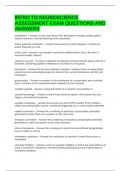
ESSENTIALS OF NEUROSCIENCE
EXAM QUESTIONS WITH VERIFIED
ANSWERS
Axoplasmic transport - Answer-an active process by which substances are propelled
along microtubules that run the length of the axon
Anterograde - Answer-in a direction along an axon from the cell body toward the
terminal buttons
Retrograde - Answer-in a direction along an axon from the terminal buttons toward
the cell body
Glia - Answer-the supporting cells of the CNS
Astrocyte - Answer-a glial cell that provides support for neurons of the CNS, provides
nutrients and other substances and regulates the chemical composition of the
extracellular fluid
Phagocytosis - Answer-the process by which cells engulf and digest other cells or
debris caused by cellular degeneration
Oligodendrocyte - Answer-a type of glial cell in the CNS the forms myelin sheaths
Myelin sheath - Answer-a sheath that surrounds axons and insulates them,
preventing messages from spreading between adjacent axons
Node of Ranvier - Answer-a naked portion of a myelinated axon between adjacent
oligodendroglia or Schwann cells
Microglia - Answer-the smallest of glial cells; act as phagocytes and protect the brain
from invading micro organisms
Schwann cell - Answer-a cell in the peripheral nervous system that is wrapped
around a myelinated axon, providing one segment of its myelin sheath
Blood-brain barrier - Answer-a semipermeable barrier between the blood and the
brain produced by the cells in the walls of the brain's capillaries
Area postrema - Answer-a region of the medulla where the blood-brain barrier is
weak; poisons can be detected there and can initiate vomiting
Electrode - Answer-a conductive medium that can be used to apply electrical
stimulation or to record electrical potentials
Microelectrode - Answer-a very fine electrode, generally used to record activity of
individual neurons
, Membrane potential - Answer-the electrical charge across a cell membrane; the
difference in electrical potential inside and outside the cell
Oscilloscope - Answer-a lab instrument that is capable of displaying a graph of
voltage as a function of time on the face of a cathode ray tube
Resting potential - Answer-the membrane potential of a neuron when it is not being
altered by excitatory or inhibitory postsynaptic potentials; approximately -70 mV in
the giant squad axon
Depolarization - Answer-reduction of the membrane potential of a cell from its normal
resting potential
Hyperpolarization - Answer-an increase in the membrane potential of a cell, relative
to the normal resting potential
Action potential - Answer-the brief electrical impulse that provides the basis for
conduction of information along an axon
Synapse - Answer-a junction between the terminal button of an axon and the
membrane of another neuron
Axon - Answer-the long, thin, cylindrical structure that conveys information from the
soma of a neuron to its terminal buttons
Multipolar neuron - Answer-a neuron with one axon and many dendrites attached to
its soma
Bipolar neuron - Answer-a neuron with one axon and one dendrite attached to its
soma
Unipolar neuron - Answer-a neuron with one axon attached to its soma; the axon
divides, with one branch receiving sensory information and the other sending the
information into the CNS
Terminal button - Answer-the bud at the end of an axon; forms synapses with
another neuron; sends information to that neuron
Neurotransmitter - Answer-a chemical that is released by a terminal button; has an
excitatory or inhibitory effect on another neuron
Membrane - Answer-a structure consisting principally of lipid molecules that defines
the outer boundaries of a cell and also constitutes many of the cell organelles
Nucleus - Answer-a structure in the central region of a cell, containing the nucleolus
and chromosomes
Nucleolus - Answer-a structure within the nucleus of a cell that produces the
ribosomes
EXAM QUESTIONS WITH VERIFIED
ANSWERS
Axoplasmic transport - Answer-an active process by which substances are propelled
along microtubules that run the length of the axon
Anterograde - Answer-in a direction along an axon from the cell body toward the
terminal buttons
Retrograde - Answer-in a direction along an axon from the terminal buttons toward
the cell body
Glia - Answer-the supporting cells of the CNS
Astrocyte - Answer-a glial cell that provides support for neurons of the CNS, provides
nutrients and other substances and regulates the chemical composition of the
extracellular fluid
Phagocytosis - Answer-the process by which cells engulf and digest other cells or
debris caused by cellular degeneration
Oligodendrocyte - Answer-a type of glial cell in the CNS the forms myelin sheaths
Myelin sheath - Answer-a sheath that surrounds axons and insulates them,
preventing messages from spreading between adjacent axons
Node of Ranvier - Answer-a naked portion of a myelinated axon between adjacent
oligodendroglia or Schwann cells
Microglia - Answer-the smallest of glial cells; act as phagocytes and protect the brain
from invading micro organisms
Schwann cell - Answer-a cell in the peripheral nervous system that is wrapped
around a myelinated axon, providing one segment of its myelin sheath
Blood-brain barrier - Answer-a semipermeable barrier between the blood and the
brain produced by the cells in the walls of the brain's capillaries
Area postrema - Answer-a region of the medulla where the blood-brain barrier is
weak; poisons can be detected there and can initiate vomiting
Electrode - Answer-a conductive medium that can be used to apply electrical
stimulation or to record electrical potentials
Microelectrode - Answer-a very fine electrode, generally used to record activity of
individual neurons
, Membrane potential - Answer-the electrical charge across a cell membrane; the
difference in electrical potential inside and outside the cell
Oscilloscope - Answer-a lab instrument that is capable of displaying a graph of
voltage as a function of time on the face of a cathode ray tube
Resting potential - Answer-the membrane potential of a neuron when it is not being
altered by excitatory or inhibitory postsynaptic potentials; approximately -70 mV in
the giant squad axon
Depolarization - Answer-reduction of the membrane potential of a cell from its normal
resting potential
Hyperpolarization - Answer-an increase in the membrane potential of a cell, relative
to the normal resting potential
Action potential - Answer-the brief electrical impulse that provides the basis for
conduction of information along an axon
Synapse - Answer-a junction between the terminal button of an axon and the
membrane of another neuron
Axon - Answer-the long, thin, cylindrical structure that conveys information from the
soma of a neuron to its terminal buttons
Multipolar neuron - Answer-a neuron with one axon and many dendrites attached to
its soma
Bipolar neuron - Answer-a neuron with one axon and one dendrite attached to its
soma
Unipolar neuron - Answer-a neuron with one axon attached to its soma; the axon
divides, with one branch receiving sensory information and the other sending the
information into the CNS
Terminal button - Answer-the bud at the end of an axon; forms synapses with
another neuron; sends information to that neuron
Neurotransmitter - Answer-a chemical that is released by a terminal button; has an
excitatory or inhibitory effect on another neuron
Membrane - Answer-a structure consisting principally of lipid molecules that defines
the outer boundaries of a cell and also constitutes many of the cell organelles
Nucleus - Answer-a structure in the central region of a cell, containing the nucleolus
and chromosomes
Nucleolus - Answer-a structure within the nucleus of a cell that produces the
ribosomes