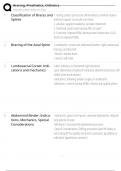
Bracing, Prosthetics, Orthotics
Study online at https://quizlet.com/_6vjiug
1. Classification of Braces and 1. resting: protect joint (acute inflammation), minimize motion
Splints (external support so muscles can relax)
2. assistive: augment weakness, facilitate movement
3. functional: protect joint during ADL's or sport
4. Corrective: improve ROM, decrease tone/contracture (LLLD
stretch to improve ROM)
2. Bracing of the Axial Spine -Lumbopelvic: corsets and abdominal binders, rigid lumbosacral
bracing, sacroiliac belt
-Thoracic: boston brace
-Cervical: soft collar
3. Lumbosacral Corset: Indi- -fabric orthoses, no horizontal rigid structures
cations and mechanics -goal: abdominal compression (improve abdominal pressure, will
inhibit some trunk motion)
-Indications: following lumbar surgery or vertebral fx
-Mechanics: restricts lumbar ROM in frontal and sagittal planes
4. Abdominal Binder: Indica- -indications: spinal cord injuries, impaired abdominals, reduced
tions, Mechanics, Special lung volume or voice
Considerations -Mechanics: increased intraabdoominal pressure
-Special Considerations: Doffing procedure (take off slowly so
not to drop BP too quickly and lead to autonomic dysreflexia or
orthostatic hypotension moment)
, Bracing, Prosthetics, Orthotics
Study online at https://quizlet.com/_6vjiug
5. Lumbosacral Flex-Ext Lat- -aka Knight Spinal Orthosis
eral Orthosis: Indications, -differs from lumbosacral corset in that its a rigid orthoses
Mechanics and Special Con- -pelvic band used to provide firm anchorage over the midsection
siderations of the buttocks; thoracic band (lies horizontally over lower thorax):
two bands going by a pair of posterior uprights on either side of
the spine and a pair of lateral uprights placed at the R and L lateral
midline of the torso
-Indications: restrict sagittal plane movement
-Mechanics: 3-pt system anterior and posterior
-Special Considerations: limited ability prevent rotation
6. Knight Spinal Orthosis: how -flexion: controlled by a posterior directed force from top and bot-
does it resist flexion, exten- tom of abdominal front; anteriorly direct force at the midportion
sion and lateral movements of the posterior uprights
-extension: posteriorly directed force of the midsection of the ab-
dominal front, anterior directed force at thoracic and pelvic bands
-lateral flexion: lateral stays resist this movement
7. -indications: pregnancy (2nd or 3rd trimester), instability about
SIJ
, Bracing, Prosthetics, Orthotics
Study online at https://quizlet.com/_6vjiug
Sacroiliac Belt: Indications, -mechanics: provides compression and stabilization
Mechanics, Special Consid- -special considerations: assess pelvic floor function, trial assess-
erations ment
*fairly inexpensive
8. TLSO Boston Brace: Indi- -indications: idiopathic scoliosis, kyperkyphosis
cations, Mechanics, Special -mechanics: applies distraction, derotation, and bending forces
Considerations (to realign vertebral column and thoracic cage)
-special considerations: worn 18-23 hrs/day (worn until pt. reach-
es skeletal maturity)
-pads may be added to apply adequate counter forces needed by
the unique patient (orthoses is mass produced)
-effectiveness: depends on skeletal maturity, trunk flexibility, curve
should be <35 deg (more than that, should consider surgery),
requires snug contact over orthoses w/ torso and compliance with
wearing protocol; won't fix curvature but reduces rate of spine
deformity
9. -indications: acute cervical injury (i.e. whiplash)
-mechanics: resting splint, limits frontal and sagittal ROM (allows
, Bracing, Prosthetics, Orthotics
Study online at https://quizlet.com/_6vjiug
Cervical Soft Collar: Indi- muscles to relax and heal)
cations, Mechanics, Special -special considerations: should be used short term, weaning
Considerations process
10. Cervical Philadelphia Col- -indications: cervical fx, post-operatively
lar: Indications, Mechanics, -mechanics: limits 3 planes of movement
Special Considerations -special considerations: temporomandibular pain; pt may feel
claustrophobic
-mandibular and occipital extension (more robust than soft collar)
11. Halo and Minerva Or- -indications: requires maximum protection, upper cervical fx (no
thoses: Indications, Me- cervical movement whatsoever)
chanics, Special Considera- -mechanics: halo (external fixation), minerva (rigid posterior sec-
tions tion from head to mid-trunk, non-invasive, forehead band holds
orthoses in place)
-special considerations: halo (wound management, fixed to skull
by 4 screws, uprights connect halo to thoracic vest, most restrictive
neck brace)
Study online at https://quizlet.com/_6vjiug
1. Classification of Braces and 1. resting: protect joint (acute inflammation), minimize motion
Splints (external support so muscles can relax)
2. assistive: augment weakness, facilitate movement
3. functional: protect joint during ADL's or sport
4. Corrective: improve ROM, decrease tone/contracture (LLLD
stretch to improve ROM)
2. Bracing of the Axial Spine -Lumbopelvic: corsets and abdominal binders, rigid lumbosacral
bracing, sacroiliac belt
-Thoracic: boston brace
-Cervical: soft collar
3. Lumbosacral Corset: Indi- -fabric orthoses, no horizontal rigid structures
cations and mechanics -goal: abdominal compression (improve abdominal pressure, will
inhibit some trunk motion)
-Indications: following lumbar surgery or vertebral fx
-Mechanics: restricts lumbar ROM in frontal and sagittal planes
4. Abdominal Binder: Indica- -indications: spinal cord injuries, impaired abdominals, reduced
tions, Mechanics, Special lung volume or voice
Considerations -Mechanics: increased intraabdoominal pressure
-Special Considerations: Doffing procedure (take off slowly so
not to drop BP too quickly and lead to autonomic dysreflexia or
orthostatic hypotension moment)
, Bracing, Prosthetics, Orthotics
Study online at https://quizlet.com/_6vjiug
5. Lumbosacral Flex-Ext Lat- -aka Knight Spinal Orthosis
eral Orthosis: Indications, -differs from lumbosacral corset in that its a rigid orthoses
Mechanics and Special Con- -pelvic band used to provide firm anchorage over the midsection
siderations of the buttocks; thoracic band (lies horizontally over lower thorax):
two bands going by a pair of posterior uprights on either side of
the spine and a pair of lateral uprights placed at the R and L lateral
midline of the torso
-Indications: restrict sagittal plane movement
-Mechanics: 3-pt system anterior and posterior
-Special Considerations: limited ability prevent rotation
6. Knight Spinal Orthosis: how -flexion: controlled by a posterior directed force from top and bot-
does it resist flexion, exten- tom of abdominal front; anteriorly direct force at the midportion
sion and lateral movements of the posterior uprights
-extension: posteriorly directed force of the midsection of the ab-
dominal front, anterior directed force at thoracic and pelvic bands
-lateral flexion: lateral stays resist this movement
7. -indications: pregnancy (2nd or 3rd trimester), instability about
SIJ
, Bracing, Prosthetics, Orthotics
Study online at https://quizlet.com/_6vjiug
Sacroiliac Belt: Indications, -mechanics: provides compression and stabilization
Mechanics, Special Consid- -special considerations: assess pelvic floor function, trial assess-
erations ment
*fairly inexpensive
8. TLSO Boston Brace: Indi- -indications: idiopathic scoliosis, kyperkyphosis
cations, Mechanics, Special -mechanics: applies distraction, derotation, and bending forces
Considerations (to realign vertebral column and thoracic cage)
-special considerations: worn 18-23 hrs/day (worn until pt. reach-
es skeletal maturity)
-pads may be added to apply adequate counter forces needed by
the unique patient (orthoses is mass produced)
-effectiveness: depends on skeletal maturity, trunk flexibility, curve
should be <35 deg (more than that, should consider surgery),
requires snug contact over orthoses w/ torso and compliance with
wearing protocol; won't fix curvature but reduces rate of spine
deformity
9. -indications: acute cervical injury (i.e. whiplash)
-mechanics: resting splint, limits frontal and sagittal ROM (allows
, Bracing, Prosthetics, Orthotics
Study online at https://quizlet.com/_6vjiug
Cervical Soft Collar: Indi- muscles to relax and heal)
cations, Mechanics, Special -special considerations: should be used short term, weaning
Considerations process
10. Cervical Philadelphia Col- -indications: cervical fx, post-operatively
lar: Indications, Mechanics, -mechanics: limits 3 planes of movement
Special Considerations -special considerations: temporomandibular pain; pt may feel
claustrophobic
-mandibular and occipital extension (more robust than soft collar)
11. Halo and Minerva Or- -indications: requires maximum protection, upper cervical fx (no
thoses: Indications, Me- cervical movement whatsoever)
chanics, Special Considera- -mechanics: halo (external fixation), minerva (rigid posterior sec-
tions tion from head to mid-trunk, non-invasive, forehead band holds
orthoses in place)
-special considerations: halo (wound management, fixed to skull
by 4 screws, uprights connect halo to thoracic vest, most restrictive
neck brace)