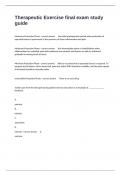
Therapeutic Exercise final exam study
guide
Maximum Protection Phase - correct answer the initial postoperative period when protection of
operated tissues is paramount in the presence of tissue inflammation and pain.
Moderate Protection Phase - correct answer the intermediate phase of rehabilitation when
inflammation has subsided, pain and tenderness are minimal, and tissues are able to withstand
gradually increasing levels of stress.
Minimum Protection Phase - correct answer little to no protection of operated tissues is required. To
progress to this phase, full or almost full, pain-free active ROM should be available, and the joint capsule
(if involved) should be clinically stable.
Irreversible Protection Phase - correct answer There is no such thing
Tactile cues from the therapist during patient exercise execution is an example of ______________
feedback.
A.
extrinsic
B.
intrinsic
C.
associative
D.
internal - correct answer A.
extrinsic
,pathology - correct answer C. L4-5 disc herniation
impairment - correct answer A. pain radiating down the leg
functional limitation - correct answer B. unable to squat or sit for long periods
disability - correct answer D.
unable to complete computer data entry at Wells Fargo
Which of the following is an open-ended question?
A.
Why do you think you have pain?
B.
Does the pain still feel like it is stabbing?
C.
Is your ROM improving?
D.
Did your pain increase from last visit? - correct answer A.
Why do you think you have pain?
When performing PROM with a patient, the therapist should_________________whenever possible.
A. start distally and work proximally
B. talk to the patient to keep them calm and relaxed
C. stretch the patient as far as possible
D. support proximal segments while moving distal segments - correct answer D. support proximal
segments while moving distal segments
,When discussing the model of disablement, an 'impairment' relates primarily to the impact upon
_____________________.
A.
an environment
B.
a task
C.
a body system
D.
a prognosis - correct answer C.
a body system
All of the following are goals for PROM except:
A.
decreasing pain
B.
maintaining connective tissue extensibility
C.
enhancing joint nutrition
D.
preventing muscle atrophy - correct answer D.
preventing muscle atrophy
Describe an element in the application of every PROM technique performed by the PTA.
A.
Grasp firmly but avoid pain.
, B.
Have the patient comfortably seated during treatment.
C.
Stabilize distal segments while moving proximal segments.
D.
Position the patient for their body mechanics. - correct answer A.
Grasp firmly but avoid pain.
A PTA is assessing a knee patient to determine how many repetitions of a straight leg raise the patient
can perform before fatiguing. The component of physical fitness or function being assessed is
______________________.
A.
mobility/flexibility
B.
muscle performance
C.
neuromuscular coordination
D.
cardiopulmonary endurance - correct answer B.
muscle performance
A PTA performs lower extremity AAROM exercises with a patient. Which of the following most
accurately describes the technique?
A.
the PTA assists the patient through the fullest, unrestricted range of movement with patient
participation
B.
guide
Maximum Protection Phase - correct answer the initial postoperative period when protection of
operated tissues is paramount in the presence of tissue inflammation and pain.
Moderate Protection Phase - correct answer the intermediate phase of rehabilitation when
inflammation has subsided, pain and tenderness are minimal, and tissues are able to withstand
gradually increasing levels of stress.
Minimum Protection Phase - correct answer little to no protection of operated tissues is required. To
progress to this phase, full or almost full, pain-free active ROM should be available, and the joint capsule
(if involved) should be clinically stable.
Irreversible Protection Phase - correct answer There is no such thing
Tactile cues from the therapist during patient exercise execution is an example of ______________
feedback.
A.
extrinsic
B.
intrinsic
C.
associative
D.
internal - correct answer A.
extrinsic
,pathology - correct answer C. L4-5 disc herniation
impairment - correct answer A. pain radiating down the leg
functional limitation - correct answer B. unable to squat or sit for long periods
disability - correct answer D.
unable to complete computer data entry at Wells Fargo
Which of the following is an open-ended question?
A.
Why do you think you have pain?
B.
Does the pain still feel like it is stabbing?
C.
Is your ROM improving?
D.
Did your pain increase from last visit? - correct answer A.
Why do you think you have pain?
When performing PROM with a patient, the therapist should_________________whenever possible.
A. start distally and work proximally
B. talk to the patient to keep them calm and relaxed
C. stretch the patient as far as possible
D. support proximal segments while moving distal segments - correct answer D. support proximal
segments while moving distal segments
,When discussing the model of disablement, an 'impairment' relates primarily to the impact upon
_____________________.
A.
an environment
B.
a task
C.
a body system
D.
a prognosis - correct answer C.
a body system
All of the following are goals for PROM except:
A.
decreasing pain
B.
maintaining connective tissue extensibility
C.
enhancing joint nutrition
D.
preventing muscle atrophy - correct answer D.
preventing muscle atrophy
Describe an element in the application of every PROM technique performed by the PTA.
A.
Grasp firmly but avoid pain.
, B.
Have the patient comfortably seated during treatment.
C.
Stabilize distal segments while moving proximal segments.
D.
Position the patient for their body mechanics. - correct answer A.
Grasp firmly but avoid pain.
A PTA is assessing a knee patient to determine how many repetitions of a straight leg raise the patient
can perform before fatiguing. The component of physical fitness or function being assessed is
______________________.
A.
mobility/flexibility
B.
muscle performance
C.
neuromuscular coordination
D.
cardiopulmonary endurance - correct answer B.
muscle performance
A PTA performs lower extremity AAROM exercises with a patient. Which of the following most
accurately describes the technique?
A.
the PTA assists the patient through the fullest, unrestricted range of movement with patient
participation
B.