100% satisfaction guarantee Immediately available after payment Both online and in PDF No strings attached 4.2 TrustPilot
logo-home
Exam (elaborations)

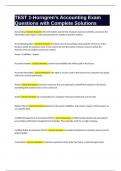
TEST 1-Horngren-s Accounting Exam Questions with Complete Solutions.

Rating
-
Sold
-
Pages
10
Grade
A+
Uploaded on
27-03-2025
Written in
2024/2025

TEST 1-Horngren's Accounting Exam Questions with Complete Solutions Accounting - Correct Answers: The information system that measures business activities, processes the information into reports, and communicates the results to decision makers. Accounting Equation - Correct Answers: The basic tool of accounting, measuring the resources of the business (what the business owns or has control of) and the claims to those resources (what the business owes to creditors and to the owner). Assets = Liabilities + Equity Accounts Payable - Correct Answers: A short-term liability that will be paid in the future. Accounts Receivable - Correct Answers: The right to receive cash in the future from customers for goods sold or for services performed. Assets - Correct Answers: Economic resources that are expected to benefit the business in the future. Something the business owns or has control of. Audit - Correct Answers: An examination of a company's financial statements and records. Balance Sheet - Correct Answers: Reports on the assets, liabilities, and owners' equity of the business as of a specific date. Certified Management Accountants (CMAs) - Correct Answers: Certified professionals who specialize in accounting and financial management knowledge. They typically work for a single company. Certified Public Accountants (CPAs) - Correct Answers: Licensed professional accountants who serve the general public. Corporation - Correct Answers: A business organized under state law that is a separate legal entity. Cost Principle - Correct Answers: A principle that states that acquired assets and services should be recorded at their actual cost. Creditor - Correct Answers: Any person or business to whom a business owes money. Economic Entity Assumption - Correct Answers: An organization that stands apart as a separate economic unit. Equity - Correct Answers: The owners claim to the assets of the business. Expenses - Correct Answers: The costs of selling goods or services. Faithful Representation - Correct Answers: Providing information that is complete, neutral, and free from error. Financial Accounting - Correct Answers: The field of accounting that focuses on providing information for external decision makers. Financial Accounting Standards Board (FASB) - Correct Answers: The private organization that oversees the creation and governance of accounting standards in the United States. Financial Statements - Correct Answers: Business documents that are used to communicate information needed to make business decisions. Generally Accepted Accounting Principles (GAAP) - Correct Answers: Accounting guidelines, currently formulated by the Financial Accounting Standards Board (FASB); the main U.S. accounting rule book. Going Concern Assumption - Correct Answers: Assumes that the entity will remain in operation for the foreseeable future. Income Statement - Correct Answers: Reports the net income or net floss of the business for a specific period. International Accounting Standards Board (IASB) - Correct Answers: The private organization that oversees the creation and governance of International Financial Reporting Standards (IFRS) International Financial Reporting Standards (IFRS) - Correct Answers: A set of global accounting guidelines, formulated by the International Accounting Standards Board (IASB) Liabilities - Correct Answers: Debts that are owed to creditors. Limited-Liability Company (LLC) - Correct Answers: A company in which each member is only liable for his or her own actions. Managerial Accounting - Correct Answers: The field of accounting that focuses on providing information for internal decision makers. Monetary Unit Assumption - Correct Answers: The assumption that requires the items on the financial statements to be measured in terms of a monetary unit. Net Income - Correct Answers: The results of operations that occurs when total revenues are greater than total expenses. Net Loss - Correct Answers: The result of operations that occurs when total expenses are greater than total revenue. Owner's Capital - Correct Answers: Owners contributions to a business. Owner's Withdrawals - Correct Answers: Payments of equity to the owner. Partnership - Correct Answers: A business with two or more owners and not organized as a corporation. Return on Assets (ROA) - Correct Answers: Measures how profitably a company uses its assets. Net income/Average total assets Revenues - Correct Answers: Amounts earned from delivering goods or services to customers. Sarbanes-Oxley Act (SOX) - Correct Answers: Requires management to review internal control and take responsibility for the accuracy and completeness of their financial reports. Securities and Exchange Commission (SEC) - Correct Answers: U.S. governmental agency that oversees the U.S. financial markets. Sole Proprietorship - Correct Answers: A business with a single owner. Statement of Cash Flows - Correct Answers: Reports on a businesses cash receipts and cash payments for a specific period. Statement of Owner's Equity - Correct Answers: Shows the changes in the owner's capital account for a specific period. Transaction - Correct Answers: An event that affects the financial position of the business and can be measured with faithful representation. Account - Correct Answers: A detailed record of all increases and decrease that have occurred in an individual asset, liability, or equity during a specific period. Accrued Liability - Correct Answers: A liability for which the business knows the amount owed but the bill has not been paid. Chart of Accounts - Correct Answers: A list of all of a company's accounts with their account numbers. Compound Journal Entry - Correct Answers: A journal entry that is characterized by having multiple debits and/or multiple credits. Credit - Correct Answers: The right side of a T-Account. Debit - Correct Answers: The left side of a T-Account. Debt Ratio - Correct Answers: Shows the proportion of assets financed with debt Total liabilities / total assets Double-Entry System - Correct Answers: A system of accounting in which every transaction affects at least two accounts. Journal - Correct Answers: A record of transactions in date order. Ledger - Correct Answers: The record holding all the accounts of a business, the changes in those accounts, and their balances. Normal Balance - Correct Answers: The balance that appears on the increase side of an account. Notes Payable - Correct Answers: A written promise made by the business to pay a debt, usually involving interest, in the future. Notes Receivable - Correct Answers: A written promise that a customer will pay a fixed amount of principle plus interest by a certain date in the future. Posting - Correct Answers: Transferring data from the journal into the ledger. Prepaid Expense - Correct Answers: A payment of an expense in advance. Source Document - Correct Answers: Provides the evidence and data for accounting transactions. T-Account - Correct Answers: A summary device that is shaped like a capital T with debits posted on the left side of the vertical line and credits on the right side of the vertical line. Trial Balance - Correct Answers: A list of all ledger accounts with their balances at a point in time. Unearned Revenue - Correct Answers: A liability created when a business collects cash from customers in advance of providing services or delivering goods. Accrual Basis Accounting - Correct Answers: Accounting method that records revenues when earned and expenses when incurred. Accrued Expense - Correct Answers: An expense that the business has incurred but has not yet paid. Accrued Revenue - Correct Answers: A revenue that has been earned but for which the cash has not yet been collected. Accumulated Depreciation - Correct Answers: The sum of all the depreciation expense recorded to date for a depreciable asset. Adjusted Trial Balance - Correct Answers: A list of all the accounts with their adjusted balances. Adjusting Entry - Correct Answers: An entry made at the end of the accounting period that is used to record revenues to the period in which they are earned and expenses to the period in which they occur. Book Value - Correct Answers: A depreciable asset's cost minus accumulated depreciation. Cash Basis Accounting - Correct Answers: Accounting method that records revenues only when cash is received and expenses only when cash is paid. Contra Account - Correct Answers: An account that is paired with, and is listed immediately after, its related account in the chart of accounts and associated financial statement and whose normal balance is the opposite of the normal balance of the related account. Deferred Expense - Correct Answers: An asset created when a business makes advance payments of future expenses. Deferred Revenue - Correct Answers: A liability created when a business collects cash from customers in advance of completing a service or delivering a product. Depreciation - Correct Answers: The process by which businesses spread the allocation of a plant asset's cost over its useful life. Fiscal Year - Correct Answers: An accounting year of any 12 consecutive months that may or may not coincide with the calendar year. Matching Principle - Correct Answers: Guides accounting for expenses ensure that all expenses are recorded when they are incurred during the period, and matches those expenses against the revenues of the period. Property, Plant, and Equipment - Correct Answers: Long-lived, tangible assets, such as land, buildings, and equipment, used in the operation of a business. Residual Value - Correct Answers: The expected value of a depreciable asset at the end of its useful life Revenue Recognition Principle - Correct Answers: Requires companies to record revenue when (or as) the entity satisfies each performance obligation. Straight-Line Method - Correct Answers: A depreciation method that allocates an equal amount of depreciation each year. (Cost-residual value) / useful life Time Period Concept - Correct Answers: Assumes that a business's activities can be sliced into small time segments and that financial statements can be prepared for specific periods, such as a month, quarter, or year. Worksheet - Correct Answers: An internal document that helps summarize data for the preparation of financial statements. Accounting Cycle - Correct Answers: The process by which companies produce their financial statements for a specific period. Classified Balance Sheet - Correct Answers: A balance sheet that places each asset and each liability into a specific category. Closing Entries - Correct Answers: Entries that transfer the revenues, expenses, and Owner, Withdrawals balances to the Owner, Capital account to prepare the company's books for the next period. Closing process - Correct Answers: A step in the accounting cycle that occurs at the end of the period. It consists of journalizing and posting entries to set the balances of the revenues, expenses, Income Summary, and Owner, Withdrawals accounts to zero for the next period. Current Asset - Correct Answers: An asset that is expected to be converted to cash, sold, or used up during the next 12 months.. Current Liability - Correct Answers: A liability that must be paid with cash or with goods and services within one year. Current Ratio - Correct Answers: Measures the company's ability to pay current liabilities from current assets. Total current assets / Total current liabilities. Income Summary - Correct Answers: A temporary account into which revenues and expenses are transferred prior to their final transfer into the Owner, Capital accounts. Summarizes net income (or net loss) for the period. Intangible asset - Correct Answers: An asset with no physical form that is valuable because of the special rights it carries. Long Term Investment - Correct Answers: Investments in bonds (debt securities) or stocks (equity securities) that the company intends to hold the investment for longer than one year. Long Term Liability - Correct Answers: A liability that does not need to be paid with one year. Operating Cycle - Correct Answers: The time span during which cash is paid for goods and services, which are then sold to customers from whom the business collects cash. Permanent Account - Correct Answers: An account that is not closed at the end of the period. Post-Closing Trial Balance - Correct Answers: List of permanent accounts and their balances from the ledger after all closing entries are journalized and posted. Temporary Accounts - Correct Answers: An account that relates to a particular accounting period and is closed (zeroed out) at the end of that period. Plant Asset - Correct Answers: Long-lived, tangible asset, such as land, buildings, and equipment used in the operation of a business. Liquidity - Correct Answers: A measure of how quickly an item can be converted to cash. Long-Term Asset - Correct Answers: An asset that will not be converted to cash or used up within one year. 1. Start with beginning account balances 2. Analyze transactions 3. Post entries 4. Prepare unadjusted trial balance 5. Prepare worksheet (optional) 6. Journalize and post adjusting entries 7. Prepare adjusted trial balance 8. Prepare financial Statements (Income statement, Statement of O.E., Balance sheet in that order). 9. Journalize and post closing entries 10. Prepare post-closing trial balance - Correct Answers: List the Accounting Cycle steps Reversing Entry - Correct Answers: A special entry that eases the bourdon of accounting for transactions in the next period. Such entries are the exact opposite of a adjusting entry.

Show more Read less
Institution
Horngren\\\'s Cost Accounting
Course
Horngren\\\'s Cost Accounting


Whoops! We can’t load your doc right now. Try again or contact support.

Written for

Institution
Horngren\\\'s Cost Accounting
Course
Horngren\\\'s Cost Accounting

Document information

Uploaded on
March 27, 2025
Number of pages
10
Written in
2024/2025
Type
Exam (elaborations)
Contains
Questions & answers

Subjects

Content preview

TEST 1-Horngren's Accounting Exam
Questions with Complete Solutions
Accounting - Correct Answers: The information system that measures business activities, processes the
information into reports, and communicates the results to decision makers.


Accounting Equation - Correct Answers: The basic tool of accounting, measuring the resources of the
business (what the business owns or has control of) and the claims to those resources (what the
business owes to creditors and to the owner).

Assets = Liabilities + Equity


Accounts Payable - Correct Answers: A short-term liability that will be paid in the future.


Accounts Receivable - Correct Answers: The right to receive cash in the future from customers for goods
sold or for services performed.


Assets - Correct Answers: Economic resources that are expected to benefit the business in the future.
Something the business owns or has control of.


Audit - Correct Answers: An examination of a company's financial statements and records.


Balance Sheet - Correct Answers: Reports on the assets, liabilities, and owners' equity of the business as
of a specific date.


Certified Management Accountants (CMAs) - Correct Answers: Certified professionals who specialize in
accounting and financial management knowledge. They typically work for a single company.


Certified Public Accountants (CPAs) - Correct Answers: Licensed professional accountants who serve the
general public.


Corporation - Correct Answers: A business organized under state law that is a separate legal entity.

, Cost Principle - Correct Answers: A principle that states that acquired assets and services should be
recorded at their actual cost.


Creditor - Correct Answers: Any person or business to whom a business owes money.


Economic Entity Assumption - Correct Answers: An organization that stands apart as a separate
economic unit.


Equity - Correct Answers: The owners claim to the assets of the business.


Expenses - Correct Answers: The costs of selling goods or services.


Faithful Representation - Correct Answers: Providing information that is complete, neutral, and free
from error.


Financial Accounting - Correct Answers: The field of accounting that focuses on providing information for
external decision makers.


Financial Accounting Standards Board (FASB) - Correct Answers: The private organization that oversees
the creation and governance of accounting standards in the United States.


Financial Statements - Correct Answers: Business documents that are used to communicate information
needed to make business decisions.


Generally Accepted Accounting Principles (GAAP) - Correct Answers: Accounting guidelines, currently
formulated by the Financial Accounting Standards Board (FASB); the main U.S. accounting rule book.


Going Concern Assumption - Correct Answers: Assumes that the entity will remain in operation for the
foreseeable future.
$17.89
Get access to the full document:

100% satisfaction guarantee
Immediately available after payment
Both online and in PDF
No strings attached

Get to know the seller
Seller avatar
EXAMSTUVIA

Also available in package deal

Thumbnail
Package deal
Test Bank for Horngren's Cost Accounting 17th Edition
-
10 2025
$ 178.60 More info

Get to know the seller

Seller avatar
EXAMSTUVIA stuvia
View profile
Follow You need to be logged in order to follow users or courses
Sold
2
Member since
1 year
Number of followers
2
Documents
1114
Last sold
3 months ago
Stuvia Exam

Assignments, Case Studies, Research, Essay writing service, Questions and Answers, Discussions etc. for students who want to see results twice as fast. I have done papers of various topics and complexities. I am punctual and always submit work on-deadline. I write engaging and informative content on all subjects. Send me your research papers, case studies, psychology papers, etc, and I’ll do them to the best of my abilities. Writing is my passion when it comes to academic work. I’ve got a good sense of structure and enjoy finding interesting ways to deliver information in any given paper. I love impressing clients with my work, and I am very punctual about deadlines. Send me your assignment and I’ll take it to the next level. I strive for my content to be of the highest quality. Your wishes come first— send me your requirements and I’ll make a piece of work with fresh ideas, consistent structure, and following the academic formatting rules. For every student you refer to me with an order that is completed and paid transparently, I will do one assignment for you, free of charge!!!!!!!!!!!!

Read more Read less
0.0

0 reviews

5
0
4
0
3
0
2
0
1
0

Recently viewed by you

Why students choose Stuvia

Created by fellow students, verified by reviews

Quality you can trust: written by students who passed their tests and reviewed by others who've used these notes.

Didn't get what you expected? Choose another document

No worries! You can instantly pick a different document that better fits what you're looking for.

Pay as you like, start learning right away

No subscription, no commitments. Pay the way you're used to via credit card and download your PDF document instantly.

Student with book image

“Bought, downloaded, and aced it. It really can be that simple.”

Alisha Student

Frequently asked questions