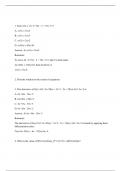
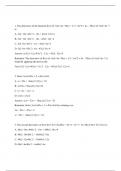
1. The solution to x2−3x+2=0x^2 - 3x + 2 = 0x2−3x+2=0 is:
A. 1,21, 21,2
B. 2,−12, -12,−1
C. −1,−2-1, -2−1,−2
D. 1,−21, -21,−2
Answer: b) 2,−12, -12,−1
Rationale:
Factoring the equation x2−3x+2=0x^2 - 3x + 2 = 0x2−3x+2=0 gives (x−2)(x−1)=0(x - 2)(x - 1)
= 0(x−2)(x−1)=0, so the roots are x=2x = 2x=2 and x=−1x = -1x=−1.
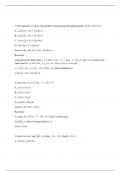
2. The second derivative of f(x)=x3+4x2−2xf(x) = x^3 + 4x^2 - 2xf(x)=x3+4x2−2x is:
A. 6x+86x + 86x+8
B. 6x2+8x−26x^2 + 8x - 26x2+8x−2
C. 6x2+8x6x^2 + 8x6x2+8x
D. 6x+86x + 86x+8
Answer: c) 6x2+8x6x^2 + 8x6x2+8x
Rationale:
The first derivative is f′(x)=3x2+8x−2f'(x) = 3x^2 + 8x - 2f′(x)=3x2+8x−2, and the second
derivative is f′′(x)=6x+8f''(x) = 6x + 8f′′(x)=6x+8.
3. The value of ∫0πcos(x) dx\int_0^\pi \cos(x) \, dx∫0πcos(x)dx is:
A. π\piπ
B. 0
C. -1
D. 2
Answer: b) 0
,Rationale:
The integral of cos(x)\cos(x)cos(x) from 0 to π\piπ is [sin(x)]0π=sin(π)−sin(0)=0\left[
\sin(x) \right]_0^\pi = \sin(\pi) - \sin(0) = 0[sin(x)]0π=sin(π)−sin(0)=0.
4. The second derivative of f(x)=4x4−3x3+2x2f(x) = 4x^4 - 3x^3 + 2x^2f(x)=4x4−3x3+2x2 is:
A. 48x2−18x+448x^2 - 18x + 448x2−18x+4
B. 48x2−18x48x^2 - 18x48x2−18x
C. 48x2−12x48x^2 - 12x48x2−12x
D. 48x2−6x48x^2 - 6x48x2−6x
Answer: a) 48x2−18x+448x^2 - 18x + 448x2−18x+4
Rationale:
First derivative: f′(x)=16x3−9x2+4xf'(x) = 16x^3 - 9x^2 + 4xf′(x)=16x3−9x2+4x
Second derivative: f′′(x)=48x2−18x+4f''(x) = 48x^2 - 18x + 4f′′(x)=48x2−18x+4.
5. The equation of a circle with center (2,3)(2, 3)(2,3) and radius 4 is:
A. (x−2)2+(y−3)2=4(x - 2)^2 + (y - 3)^2 = 4(x−2)2+(y−3)2=4
B. (x−2)2+(y−3)2=16(x - 2)^2 + (y - 3)^2 = 16(x−2)2+(y−3)2=16
C. (x+2)2+(y−3)2=4(x + 2)^2 + (y - 3)^2 = 4(x+2)2+(y−3)2=4
D. (x−3)2+(y−2)2=4(x - 3)^2 + (y - 2)^2 = 4(x−3)2+(y−2)2=4
Answer: b) (x−2)2+(y−3)2=16(x - 2)^2 + (y - 3)^2 = 16(x−2)2+(y−3)2=16
Rationale:
The standard equation of a circle with center (h,k)(h, k)(h,k) and radius rrr is
(x−h)2+(y−k)2=r2(x - h)^2 + (y - k)^2 = r^2(x−h)2+(y−k)2=r2. Substituting h=2h = 2h=2, k=3k
= 3k=3, and r=4r = 4r=4, we get (x−2)2+(y−3)2=16(x - 2)^2 + (y - 3)^2 = 16(x−2)2+(y−3)2=16.
6. The value of ∫0∞e−x dx\int_0^\infty e^{-x} \, dx∫0∞e−xdx is:
A. 0
B. 1
, C. ∞\infty∞
D. -1
Answer: b) 1
Rationale:
∫0∞e−x dx=[−e−x]0∞=0−(−1)=1\int_0^\infty e^{-x} \, dx = \left[ -e^{-x} \right]_0^\infty = 0 - (-
1) = 1∫0∞e−xdx=[−e−x]0∞=0−(−1)=1.
7. The integral of 2x2x2x with respect to xxx is:
A. x2+Cx^2 + Cx2+C
B. x2x^2x2
C. 2x22x^22x2
D. 2x+C2x + C2x+C
Answer: a) x2+Cx^2 + Cx2+C
Rationale:
The integral of 2x2x2x is x2+Cx^2 + Cx2+C.
8. Find the solution to 2x−5=92x - 5 = 92x−5=9:
A. x=7x = 7x=7
B. x=14x = 14x=14
C. x=−7x = -7x=−7
D. x=−14x = -14x=−14
Answer: a) x=7x = 7x=7
Rationale:
Solve 2x−5=92x - 5 = 92x−5=9 by adding 5 to both sides:
2x=142x = 142x=14
x=7x = 7x=7.
A. 1,21, 21,2
B. 2,−12, -12,−1
C. −1,−2-1, -2−1,−2
D. 1,−21, -21,−2
Answer: b) 2,−12, -12,−1
Rationale:
Factoring the equation x2−3x+2=0x^2 - 3x + 2 = 0x2−3x+2=0 gives (x−2)(x−1)=0(x - 2)(x - 1)
= 0(x−2)(x−1)=0, so the roots are x=2x = 2x=2 and x=−1x = -1x=−1.
2. The second derivative of f(x)=x3+4x2−2xf(x) = x^3 + 4x^2 - 2xf(x)=x3+4x2−2x is:
A. 6x+86x + 86x+8
B. 6x2+8x−26x^2 + 8x - 26x2+8x−2
C. 6x2+8x6x^2 + 8x6x2+8x
D. 6x+86x + 86x+8
Answer: c) 6x2+8x6x^2 + 8x6x2+8x
Rationale:
The first derivative is f′(x)=3x2+8x−2f'(x) = 3x^2 + 8x - 2f′(x)=3x2+8x−2, and the second
derivative is f′′(x)=6x+8f''(x) = 6x + 8f′′(x)=6x+8.
3. The value of ∫0πcos(x) dx\int_0^\pi \cos(x) \, dx∫0πcos(x)dx is:
A. π\piπ
B. 0
C. -1
D. 2
Answer: b) 0
,Rationale:
The integral of cos(x)\cos(x)cos(x) from 0 to π\piπ is [sin(x)]0π=sin(π)−sin(0)=0\left[
\sin(x) \right]_0^\pi = \sin(\pi) - \sin(0) = 0[sin(x)]0π=sin(π)−sin(0)=0.
4. The second derivative of f(x)=4x4−3x3+2x2f(x) = 4x^4 - 3x^3 + 2x^2f(x)=4x4−3x3+2x2 is:
A. 48x2−18x+448x^2 - 18x + 448x2−18x+4
B. 48x2−18x48x^2 - 18x48x2−18x
C. 48x2−12x48x^2 - 12x48x2−12x
D. 48x2−6x48x^2 - 6x48x2−6x
Answer: a) 48x2−18x+448x^2 - 18x + 448x2−18x+4
Rationale:
First derivative: f′(x)=16x3−9x2+4xf'(x) = 16x^3 - 9x^2 + 4xf′(x)=16x3−9x2+4x
Second derivative: f′′(x)=48x2−18x+4f''(x) = 48x^2 - 18x + 4f′′(x)=48x2−18x+4.
5. The equation of a circle with center (2,3)(2, 3)(2,3) and radius 4 is:
A. (x−2)2+(y−3)2=4(x - 2)^2 + (y - 3)^2 = 4(x−2)2+(y−3)2=4
B. (x−2)2+(y−3)2=16(x - 2)^2 + (y - 3)^2 = 16(x−2)2+(y−3)2=16
C. (x+2)2+(y−3)2=4(x + 2)^2 + (y - 3)^2 = 4(x+2)2+(y−3)2=4
D. (x−3)2+(y−2)2=4(x - 3)^2 + (y - 2)^2 = 4(x−3)2+(y−2)2=4
Answer: b) (x−2)2+(y−3)2=16(x - 2)^2 + (y - 3)^2 = 16(x−2)2+(y−3)2=16
Rationale:
The standard equation of a circle with center (h,k)(h, k)(h,k) and radius rrr is
(x−h)2+(y−k)2=r2(x - h)^2 + (y - k)^2 = r^2(x−h)2+(y−k)2=r2. Substituting h=2h = 2h=2, k=3k
= 3k=3, and r=4r = 4r=4, we get (x−2)2+(y−3)2=16(x - 2)^2 + (y - 3)^2 = 16(x−2)2+(y−3)2=16.
6. The value of ∫0∞e−x dx\int_0^\infty e^{-x} \, dx∫0∞e−xdx is:
A. 0
B. 1
, C. ∞\infty∞
D. -1
Answer: b) 1
Rationale:
∫0∞e−x dx=[−e−x]0∞=0−(−1)=1\int_0^\infty e^{-x} \, dx = \left[ -e^{-x} \right]_0^\infty = 0 - (-
1) = 1∫0∞e−xdx=[−e−x]0∞=0−(−1)=1.
7. The integral of 2x2x2x with respect to xxx is:
A. x2+Cx^2 + Cx2+C
B. x2x^2x2
C. 2x22x^22x2
D. 2x+C2x + C2x+C
Answer: a) x2+Cx^2 + Cx2+C
Rationale:
The integral of 2x2x2x is x2+Cx^2 + Cx2+C.
8. Find the solution to 2x−5=92x - 5 = 92x−5=9:
A. x=7x = 7x=7
B. x=14x = 14x=14
C. x=−7x = -7x=−7
D. x=−14x = -14x=−14
Answer: a) x=7x = 7x=7
Rationale:
Solve 2x−5=92x - 5 = 92x−5=9 by adding 5 to both sides:
2x=142x = 142x=14
x=7x = 7x=7.