________________________________________
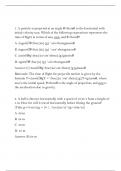
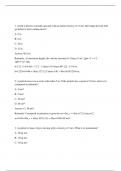
1. If f(x)=2x+1f(x) = 2x + 1f(x)=2x+1 and g(x)=x2−1g(x) = x^2 -
1g(x)=x2−1, what is (f∘g)(x)(f \circ g)(x)(f∘g)(x)?
A. 2x2−12x^2 - 12x2−1
B. 2x2+12x^2 + 12x2+1
C. 2x2+32x^2 + 32x2+3
D. 2x2+22x^2 + 22x2+2
Answer: C) 2x2+32x^2 + 32x2+3
Rationale: The composition
(f∘g)(x)=f(g(x))=2(x2−1)+1=2x2−2+1=2x2+3(f \circ g)(x) = f(g(x)) =
2(x^2 - 1) + 1 = 2x^2 - 2 + 1 = 2x^2 +
3(f∘g)(x)=f(g(x))=2(x2−1)+1=2x2−2+1=2x2+3.
2. If cos(2θ)=0\cos(2\theta) = 0cos(2θ)=0, the general solution is
A. θ=π2+nπ\theta = \frac{\pi}{2} + n\piθ=2π+nπ
B. θ=π4+nπ\theta = \frac{\pi}{4} + n\piθ=4π+nπ
C. θ=π2+nπ\theta = \frac{\pi}{2} + n\piθ=2π+nπ or
θ=3π2+nπ\theta = \frac{3\pi}{2} + n\piθ=23π+nπ
D. θ=π4+nπ\theta = \frac{\pi}{4} + n\piθ=4π+nπ or
θ=5π4+nπ\theta = \frac{5\pi}{4} + n\piθ=45π+nπ
Answer: C) θ=π2+nπ\theta = \frac{\pi}{2} + n\piθ=2π+nπ or
θ=3π2+nπ\theta = \frac{3\pi}{2} + n\piθ=23π+nπ
,Rationale: The cosine function equals zero at π2+nπ\frac{\pi}{2} +
n\pi2π+nπ and 3π2+nπ\frac{3\pi}{2} + n\pi23π+nπ.
3. The solution to the quadratic equation x2−5x+6=0x^2 - 5x + 6 =
0x2−5x+6=0 is
A. x=1,6x = 1, 6x=1,6
B. x=−1,−6x = -1, -6x=−1,−6
C. x=2,3x = 2, 3x=2,3
D. x=−2,−3x = -2, -3x=−2,−3
Answer: C) x=2,3x = 2, 3x=2,3
Rationale: Factoring the quadratic equation x2−5x+6=0x^2 - 5x + 6 =
0x2−5x+6=0, we get (x−2)(x−3)=0(x - 2)(x - 3) = 0(x−2)(x−3)=0, so
x=2x = 2x=2 and x=3x = 3x=3.
4. The integral ∫x2dx\int x^2 dx∫x2dx is
A. x33+C\frac{x^3}{3} + C3x3+C
B. x32+C\frac{x^3}{2} + C2x3+C
C. x35+C\frac{x^3}{5} + C5x3+C
D. x3+Cx^3 + Cx3+C
Answer: A) x33+C\frac{x^3}{3} + C3x3+C
Rationale: The integral of x2x^2x2 with respect to xxx is
x33+C\frac{x^3}{3} + C3x3+C.
, 5. If cos(θ)=12\cos(\theta) = \frac{1}{2}cos(θ)=21, the general
solution for θ\thetaθ is
A. θ=π3+2nπ\theta = \frac{\pi}{3} + 2n\piθ=3π+2nπ
B. θ=π3+nπ\theta = \frac{\pi}{3} + n\piθ=3π+nπ
C. θ=π6+nπ\theta = \frac{\pi}{6} + n\piθ=6π+nπ
D. θ=π3+π2n\theta = \frac{\pi}{3} + \frac{\pi}{2}nθ=3π+2πn
Answer: B) θ=π3+nπ\theta = \frac{\pi}{3} + n\piθ=3π+nπ
Rationale: The cosine function equals 12\frac{1}{2}21 at
θ=π3+2nπ\theta = \frac{\pi}{3} + 2n\piθ=3π+2nπ and
θ=−π3+2nπ\theta = -\frac{\pi}{3} + 2n\piθ=−3π+2nπ, hence
θ=π3+nπ\theta = \frac{\pi}{3} + n\piθ=3π+nπ is the general
solution.
6. The sum of the infinite geometric series 1+12+14+⋯1 +
\frac{1}{2} + \frac{1}{4} + \cdots1+21+41+⋯ is
A. 2
B. 3
C. 1
D. 12\frac{1}{2}21
Answer: A) 2
Rationale: The sum of an infinite geometric series is given by S=a1−rS
= \frac{a}{1 - r}S=1−ra, where a=1a = 1a=1 and r=12r =
\frac{1}{2}r=21. Thus, S=11−12=2S = \frac{1}{1 - \frac{1}{2}} =
2S=1−211=2.
1. If f(x)=2x+1f(x) = 2x + 1f(x)=2x+1 and g(x)=x2−1g(x) = x^2 -
1g(x)=x2−1, what is (f∘g)(x)(f \circ g)(x)(f∘g)(x)?
A. 2x2−12x^2 - 12x2−1
B. 2x2+12x^2 + 12x2+1
C. 2x2+32x^2 + 32x2+3
D. 2x2+22x^2 + 22x2+2
Answer: C) 2x2+32x^2 + 32x2+3
Rationale: The composition
(f∘g)(x)=f(g(x))=2(x2−1)+1=2x2−2+1=2x2+3(f \circ g)(x) = f(g(x)) =
2(x^2 - 1) + 1 = 2x^2 - 2 + 1 = 2x^2 +
3(f∘g)(x)=f(g(x))=2(x2−1)+1=2x2−2+1=2x2+3.
2. If cos(2θ)=0\cos(2\theta) = 0cos(2θ)=0, the general solution is
A. θ=π2+nπ\theta = \frac{\pi}{2} + n\piθ=2π+nπ
B. θ=π4+nπ\theta = \frac{\pi}{4} + n\piθ=4π+nπ
C. θ=π2+nπ\theta = \frac{\pi}{2} + n\piθ=2π+nπ or
θ=3π2+nπ\theta = \frac{3\pi}{2} + n\piθ=23π+nπ
D. θ=π4+nπ\theta = \frac{\pi}{4} + n\piθ=4π+nπ or
θ=5π4+nπ\theta = \frac{5\pi}{4} + n\piθ=45π+nπ
Answer: C) θ=π2+nπ\theta = \frac{\pi}{2} + n\piθ=2π+nπ or
θ=3π2+nπ\theta = \frac{3\pi}{2} + n\piθ=23π+nπ
,Rationale: The cosine function equals zero at π2+nπ\frac{\pi}{2} +
n\pi2π+nπ and 3π2+nπ\frac{3\pi}{2} + n\pi23π+nπ.
3. The solution to the quadratic equation x2−5x+6=0x^2 - 5x + 6 =
0x2−5x+6=0 is
A. x=1,6x = 1, 6x=1,6
B. x=−1,−6x = -1, -6x=−1,−6
C. x=2,3x = 2, 3x=2,3
D. x=−2,−3x = -2, -3x=−2,−3
Answer: C) x=2,3x = 2, 3x=2,3
Rationale: Factoring the quadratic equation x2−5x+6=0x^2 - 5x + 6 =
0x2−5x+6=0, we get (x−2)(x−3)=0(x - 2)(x - 3) = 0(x−2)(x−3)=0, so
x=2x = 2x=2 and x=3x = 3x=3.
4. The integral ∫x2dx\int x^2 dx∫x2dx is
A. x33+C\frac{x^3}{3} + C3x3+C
B. x32+C\frac{x^3}{2} + C2x3+C
C. x35+C\frac{x^3}{5} + C5x3+C
D. x3+Cx^3 + Cx3+C
Answer: A) x33+C\frac{x^3}{3} + C3x3+C
Rationale: The integral of x2x^2x2 with respect to xxx is
x33+C\frac{x^3}{3} + C3x3+C.
, 5. If cos(θ)=12\cos(\theta) = \frac{1}{2}cos(θ)=21, the general
solution for θ\thetaθ is
A. θ=π3+2nπ\theta = \frac{\pi}{3} + 2n\piθ=3π+2nπ
B. θ=π3+nπ\theta = \frac{\pi}{3} + n\piθ=3π+nπ
C. θ=π6+nπ\theta = \frac{\pi}{6} + n\piθ=6π+nπ
D. θ=π3+π2n\theta = \frac{\pi}{3} + \frac{\pi}{2}nθ=3π+2πn
Answer: B) θ=π3+nπ\theta = \frac{\pi}{3} + n\piθ=3π+nπ
Rationale: The cosine function equals 12\frac{1}{2}21 at
θ=π3+2nπ\theta = \frac{\pi}{3} + 2n\piθ=3π+2nπ and
θ=−π3+2nπ\theta = -\frac{\pi}{3} + 2n\piθ=−3π+2nπ, hence
θ=π3+nπ\theta = \frac{\pi}{3} + n\piθ=3π+nπ is the general
solution.
6. The sum of the infinite geometric series 1+12+14+⋯1 +
\frac{1}{2} + \frac{1}{4} + \cdots1+21+41+⋯ is
A. 2
B. 3
C. 1
D. 12\frac{1}{2}21
Answer: A) 2
Rationale: The sum of an infinite geometric series is given by S=a1−rS
= \frac{a}{1 - r}S=1−ra, where a=1a = 1a=1 and r=12r =
\frac{1}{2}r=21. Thus, S=11−12=2S = \frac{1}{1 - \frac{1}{2}} =
2S=1−211=2.