________________________________________
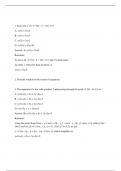
1. The equation of the tangent to the curve y=x2+xy = x^2 +
xy=x2+x at x=−1x = -1x=−1 is
A. y=2xy = 2xy=2x
B. y=x−2y = x - 2y=x−2
C. y=−x+1y = -x + 1y=−x+1
D. y=x+1y = x + 1y=x+1
Answer: C) y=−x+1y = -x + 1y=−x+1
Rationale: The derivative of y=x2+xy = x^2 + xy=x2+x is y′=2x+1y'
= 2x + 1y′=2x+1. At x=−1x = -1x=−1, the slope is −1-1−1, and the
equation of the tangent is y−(−1)=−1(x−(−1))y - (-1) = -1(x - (-
1))y−(−1)=−1(x−(−1)), which simplifies to y=−x+1y = -x +
1y=−x+1.
2. If y=sin(x)+cos(x)y = \sin(x) + \cos(x)y=sin(x)+cos(x), what is
dydx\frac{dy}{dx}dxdy?
A. cos(x)−sin(x)\cos(x) - \sin(x)cos(x)−sin(x)
B. cos(x)+sin(x)\cos(x) + \sin(x)cos(x)+sin(x)
C. cos(x)−sin(x)\cos(x) - \sin(x)cos(x)−sin(x)
D. sin(x)+cos(x)\sin(x) + \cos(x)sin(x)+cos(x)
Answer: A) cos(x)−sin(x)\cos(x) - \sin(x)cos(x)−sin(x)
,Rationale: Differentiating y=sin(x)+cos(x)y = \sin(x) +
\cos(x)y=sin(x)+cos(x), we get dydx=cos(x)−sin(x)\frac{dy}{dx}
= \cos(x) - \sin(x)dxdy=cos(x)−sin(x).
3. The roots of the equation x2+6x+9=0x^2 + 6x + 9 = 0x2+6x+9=0
are
A. x=−3,−3x = -3, -3x=−3,−3
B. x=3,3x = 3, 3x=3,3
C. x=−3,3x = -3, 3x=−3,3
D. x=3,0x = 3, 0x=3,0
Answer: A) x=−3,−3x = -3, -3x=−3,−3
Rationale: The equation x2+6x+9=0x^2 + 6x + 9 = 0x2+6x+9=0
factors as (x+3)2=0(x + 3)^2 = 0(x+3)2=0, so x=−3x = -3x=−3 is the
repeated root.
4. The value of ∫0∞e−x2dx\int_0^\infty e^{-x^2} dx∫0∞e−x2dx is
A. π\sqrt{\pi}π
B. π2\frac{\pi}{2}2π
C. 1
D. ∞\infty∞
Answer: A) π\sqrt{\pi}π
Rationale: The integral ∫0∞e−x2dx\int_0^\infty e^{-x^2}
dx∫0∞e−x2dx is a standard result and equals
, π2\frac{\sqrt{\pi}}{2}2π (for the full range, from −∞-\infty−∞ to
∞\infty∞, it equals π\sqrt{\pi}π).
5. If f(x)=x3−6x2+12x−8f(x) = x^3 - 6x^2 + 12x -
8f(x)=x3−6x2+12x−8, what is f′(x)f'(x)f′(x)?
A. 3x2−12x+123x^2 - 12x + 123x2−12x+12
B. 3x2−6x+123x^2 - 6x + 123x2−6x+12
C. 3x2−12x−83x^2 - 12x - 83x2−12x−8
D. 3x2−6x+83x^2 - 6x + 83x2−6x+8
Answer: A) 3x2−12x+123x^2 - 12x + 123x2−12x+12
Rationale: The derivative of f(x)=x3−6x2+12x−8f(x) = x^3 - 6x^2 +
12x - 8f(x)=x3−6x2+12x−8 is f′(x)=3x2−12x+12f'(x) = 3x^2 - 12x +
12f′(x)=3x2−12x+12.
6. If y=cos2(x)y = \cos^2(x)y=cos2(x), what is
dydx\frac{dy}{dx}dxdy?
A. 2cos(x)sin(x)2\cos(x) \sin(x)2cos(x)sin(x)
B. −2cos(x)sin(x)-2\cos(x) \sin(x)−2cos(x)sin(x)
C. −2sin(x)cos(x)-2\sin(x) \cos(x)−2sin(x)cos(x)
D. sin2(x)\sin^2(x)sin2(x)
Answer: A) 2cos(x)sin(x)2\cos(x) \sin(x)2cos(x)sin(x)
Rationale: Using the chain rule, dydx=2cos(x)sin(x)\frac{dy}{dx}
= 2\cos(x) \sin(x)dxdy=2cos(x)sin(x).
1. The equation of the tangent to the curve y=x2+xy = x^2 +
xy=x2+x at x=−1x = -1x=−1 is
A. y=2xy = 2xy=2x
B. y=x−2y = x - 2y=x−2
C. y=−x+1y = -x + 1y=−x+1
D. y=x+1y = x + 1y=x+1
Answer: C) y=−x+1y = -x + 1y=−x+1
Rationale: The derivative of y=x2+xy = x^2 + xy=x2+x is y′=2x+1y'
= 2x + 1y′=2x+1. At x=−1x = -1x=−1, the slope is −1-1−1, and the
equation of the tangent is y−(−1)=−1(x−(−1))y - (-1) = -1(x - (-
1))y−(−1)=−1(x−(−1)), which simplifies to y=−x+1y = -x +
1y=−x+1.
2. If y=sin(x)+cos(x)y = \sin(x) + \cos(x)y=sin(x)+cos(x), what is
dydx\frac{dy}{dx}dxdy?
A. cos(x)−sin(x)\cos(x) - \sin(x)cos(x)−sin(x)
B. cos(x)+sin(x)\cos(x) + \sin(x)cos(x)+sin(x)
C. cos(x)−sin(x)\cos(x) - \sin(x)cos(x)−sin(x)
D. sin(x)+cos(x)\sin(x) + \cos(x)sin(x)+cos(x)
Answer: A) cos(x)−sin(x)\cos(x) - \sin(x)cos(x)−sin(x)
,Rationale: Differentiating y=sin(x)+cos(x)y = \sin(x) +
\cos(x)y=sin(x)+cos(x), we get dydx=cos(x)−sin(x)\frac{dy}{dx}
= \cos(x) - \sin(x)dxdy=cos(x)−sin(x).
3. The roots of the equation x2+6x+9=0x^2 + 6x + 9 = 0x2+6x+9=0
are
A. x=−3,−3x = -3, -3x=−3,−3
B. x=3,3x = 3, 3x=3,3
C. x=−3,3x = -3, 3x=−3,3
D. x=3,0x = 3, 0x=3,0
Answer: A) x=−3,−3x = -3, -3x=−3,−3
Rationale: The equation x2+6x+9=0x^2 + 6x + 9 = 0x2+6x+9=0
factors as (x+3)2=0(x + 3)^2 = 0(x+3)2=0, so x=−3x = -3x=−3 is the
repeated root.
4. The value of ∫0∞e−x2dx\int_0^\infty e^{-x^2} dx∫0∞e−x2dx is
A. π\sqrt{\pi}π
B. π2\frac{\pi}{2}2π
C. 1
D. ∞\infty∞
Answer: A) π\sqrt{\pi}π
Rationale: The integral ∫0∞e−x2dx\int_0^\infty e^{-x^2}
dx∫0∞e−x2dx is a standard result and equals
, π2\frac{\sqrt{\pi}}{2}2π (for the full range, from −∞-\infty−∞ to
∞\infty∞, it equals π\sqrt{\pi}π).
5. If f(x)=x3−6x2+12x−8f(x) = x^3 - 6x^2 + 12x -
8f(x)=x3−6x2+12x−8, what is f′(x)f'(x)f′(x)?
A. 3x2−12x+123x^2 - 12x + 123x2−12x+12
B. 3x2−6x+123x^2 - 6x + 123x2−6x+12
C. 3x2−12x−83x^2 - 12x - 83x2−12x−8
D. 3x2−6x+83x^2 - 6x + 83x2−6x+8
Answer: A) 3x2−12x+123x^2 - 12x + 123x2−12x+12
Rationale: The derivative of f(x)=x3−6x2+12x−8f(x) = x^3 - 6x^2 +
12x - 8f(x)=x3−6x2+12x−8 is f′(x)=3x2−12x+12f'(x) = 3x^2 - 12x +
12f′(x)=3x2−12x+12.
6. If y=cos2(x)y = \cos^2(x)y=cos2(x), what is
dydx\frac{dy}{dx}dxdy?
A. 2cos(x)sin(x)2\cos(x) \sin(x)2cos(x)sin(x)
B. −2cos(x)sin(x)-2\cos(x) \sin(x)−2cos(x)sin(x)
C. −2sin(x)cos(x)-2\sin(x) \cos(x)−2sin(x)cos(x)
D. sin2(x)\sin^2(x)sin2(x)
Answer: A) 2cos(x)sin(x)2\cos(x) \sin(x)2cos(x)sin(x)
Rationale: Using the chain rule, dydx=2cos(x)sin(x)\frac{dy}{dx}
= 2\cos(x) \sin(x)dxdy=2cos(x)sin(x).