1
AS PHYSICS – MODULE 4: ELECTRONS, WAVES AND
PHOTONS
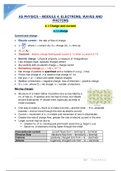
4.1 Charge and current
4.1.1 Charge
Current and charge
• Electric current – the rate of flow of charge
• where I = current (A), Q = charge (C), t = time (s)
• 1C =1 As ∴
• Coulomb – electric charge flowing past a point in 1s when a current of 1A
• Electric charge – physical property, a measure of ‘chargedness’
• Like charges repel, opposite charges attract
• Any particle with an electric charge = charge carrier
• Elementary charge (e) = 1.60 x 10⁻¹⁹ C
• Net charge of particle is quantised and a multiple of e (e.g. +12e)
• Proton has charge of +1e, electron has charge of -1e,
• Not just +1 or -1 which are called relative charges
• Addition of electrons = negative charge, loss of electrons = positive charge
• Q = ± ne where Q = net charge, n = number of electrons
Moving charges
• Structure of a metal: lattice of positive ions surrounded by a
no. of free e-s → positive ions not free to move, but vibrate
around fixed points → vibrate more vigorously as temp of
metal increases
• One way to make e-s move is to make one end + and the other – → e-s attracted
towards + end so move through the wire as electric current
• Current = movement of e-s in metals and movement of ions in electrolytes
• Greater the rate of charge flow, greater the rate of electric current in the wire
• Larger current may be due to:
▪ Greater no. of e-s moving past point each second (e.g. larger c.s.a)
▪ Same no. of electrons moving faster through the metal
Conventional current current flows from + terminal to – terminal
Electron flow electrons flow from – terminal to + terminal
Cations positively charged ions from + to – electrode
Anions negatively charged ions from – to + electrode
1|T. Chaudhary
,2
Kirchhoff’s first law
• Conservation of charge – electric charge can neither be created nor destroyed
• Total charge before = total charge after
• Kirchhoff’s first law: sum of currents into point on circuit = sum of currents out
of that point → consequence of the conservation of charge
4.1.2 Mean drift velocity
• Number density (n) – no. of free electrons per m3 of material (unit: m-3)
• The higher the number density, the greater the no. of free electrons and so the
better the electrical conductor
• Conductors have a very high number density (1028), followed by semiconductors
(1017), and then insulators which have a much lower value
• Semiconductors can be ‘doped’ where impurity atoms are added to the material
to improve their conducting properties
• Semiconductors have a much lower number density than metals, so in order to
carry same current, the e-s need to move much faster → increases temp of the
semiconductor → important for processors made of silicon
• I = A n e v where I = current in conductor, A = c.s.a of conductor, n = number
density, e = elementary charge, v = mean drift velocity of charge carriers (ms-1)
• Mean drift velocity – average displacement travelled by the electrons along the
wire per unit time
▪ Most e-s move slowly in one direction through the metal as they repeatedly
collide with the + metal ions as they drift through the wire towards the
positive terminal
• Smaller cross-sectional area = greater drift velocity in order for the current to be
the same (inversely proportional)
4.2 Energy, power and resistance
4.2.1 Circuit Symbols
Capacitor
+ -
+ -
2|T. Chaudhary
, 3
4.2.2 E.m.f and p.d
Potential difference and electromotive force
• Potential difference (p.d.) – energy transferred from electrical energy to other
forms (heat, light etc.) per unit charge
• where V = p.d. (V), W = energy transferred (J), Q = charge (C)
• 1V = 1JC-1 ∴
• Volt – p.d. across a component when 1J of energy is transferred per C of charge
• Electromotive force (e.m.f.) – energy transferred from some form of energy
(e.g. chemical) to electrical energy per unit charge
• E.m.f is from a source such as a cell, battery or a power supply
• Other sources: solar cells (light), dynamos (movement), thermocouples (heat)
• p.d. → work done by charge carriers (they lose energy)
• e.m.f. → work done on charge carriers (they gain energy)
• where ε = e.m.f. (V), W = energy transferred (J), Q = charge (C)
The electron gun
• Electron gun – used to produce a narrow beam of electrons
▪ Small metal filament heated by an electric current
▪ Electrons in this piece of wire gain KE
▪ Some gain enough KE to escape from the surface of the metal
▪ Process called thermionic emission (emission of e-s through heat)
▪ If heated filament is placed in vacuum + high p.d. applied between filament
and an anode, then the filament acts as cathode
▪ Freed electrons accelerate towards anode, gaining KE
▪ If anode has small hole, electrons in line pass through, creating a beam of
electrons with a specific KE
• Work done on electron = gain in KE
• eV = ½ mv2 where e = elementary charge (C), V = accelerating p.d → this
assumes that the electrons have negligible KE at the cathode
• Greater the p.d., the more energy is transferred to e-s so faster they move
4.2.3 Resistance
• Resistance – p.d. per unit current → restricts the flow of charge carriers through
a component
• Higher the resistance, more energy it takes to push e-s through it
• where R = resistance (Ω), V = p.d. (V), I = current (A)
• 1Ω = 1VA-1 ∴
• Ohm – resistance of a component when p.d. across it of 1V per A of current in it
3|T. Chaudhary
AS PHYSICS – MODULE 4: ELECTRONS, WAVES AND
PHOTONS
4.1 Charge and current
4.1.1 Charge
Current and charge
• Electric current – the rate of flow of charge
• where I = current (A), Q = charge (C), t = time (s)
• 1C =1 As ∴
• Coulomb – electric charge flowing past a point in 1s when a current of 1A
• Electric charge – physical property, a measure of ‘chargedness’
• Like charges repel, opposite charges attract
• Any particle with an electric charge = charge carrier
• Elementary charge (e) = 1.60 x 10⁻¹⁹ C
• Net charge of particle is quantised and a multiple of e (e.g. +12e)
• Proton has charge of +1e, electron has charge of -1e,
• Not just +1 or -1 which are called relative charges
• Addition of electrons = negative charge, loss of electrons = positive charge
• Q = ± ne where Q = net charge, n = number of electrons
Moving charges
• Structure of a metal: lattice of positive ions surrounded by a
no. of free e-s → positive ions not free to move, but vibrate
around fixed points → vibrate more vigorously as temp of
metal increases
• One way to make e-s move is to make one end + and the other – → e-s attracted
towards + end so move through the wire as electric current
• Current = movement of e-s in metals and movement of ions in electrolytes
• Greater the rate of charge flow, greater the rate of electric current in the wire
• Larger current may be due to:
▪ Greater no. of e-s moving past point each second (e.g. larger c.s.a)
▪ Same no. of electrons moving faster through the metal
Conventional current current flows from + terminal to – terminal
Electron flow electrons flow from – terminal to + terminal
Cations positively charged ions from + to – electrode
Anions negatively charged ions from – to + electrode
1|T. Chaudhary
,2
Kirchhoff’s first law
• Conservation of charge – electric charge can neither be created nor destroyed
• Total charge before = total charge after
• Kirchhoff’s first law: sum of currents into point on circuit = sum of currents out
of that point → consequence of the conservation of charge
4.1.2 Mean drift velocity
• Number density (n) – no. of free electrons per m3 of material (unit: m-3)
• The higher the number density, the greater the no. of free electrons and so the
better the electrical conductor
• Conductors have a very high number density (1028), followed by semiconductors
(1017), and then insulators which have a much lower value
• Semiconductors can be ‘doped’ where impurity atoms are added to the material
to improve their conducting properties
• Semiconductors have a much lower number density than metals, so in order to
carry same current, the e-s need to move much faster → increases temp of the
semiconductor → important for processors made of silicon
• I = A n e v where I = current in conductor, A = c.s.a of conductor, n = number
density, e = elementary charge, v = mean drift velocity of charge carriers (ms-1)
• Mean drift velocity – average displacement travelled by the electrons along the
wire per unit time
▪ Most e-s move slowly in one direction through the metal as they repeatedly
collide with the + metal ions as they drift through the wire towards the
positive terminal
• Smaller cross-sectional area = greater drift velocity in order for the current to be
the same (inversely proportional)
4.2 Energy, power and resistance
4.2.1 Circuit Symbols
Capacitor
+ -
+ -
2|T. Chaudhary
, 3
4.2.2 E.m.f and p.d
Potential difference and electromotive force
• Potential difference (p.d.) – energy transferred from electrical energy to other
forms (heat, light etc.) per unit charge
• where V = p.d. (V), W = energy transferred (J), Q = charge (C)
• 1V = 1JC-1 ∴
• Volt – p.d. across a component when 1J of energy is transferred per C of charge
• Electromotive force (e.m.f.) – energy transferred from some form of energy
(e.g. chemical) to electrical energy per unit charge
• E.m.f is from a source such as a cell, battery or a power supply
• Other sources: solar cells (light), dynamos (movement), thermocouples (heat)
• p.d. → work done by charge carriers (they lose energy)
• e.m.f. → work done on charge carriers (they gain energy)
• where ε = e.m.f. (V), W = energy transferred (J), Q = charge (C)
The electron gun
• Electron gun – used to produce a narrow beam of electrons
▪ Small metal filament heated by an electric current
▪ Electrons in this piece of wire gain KE
▪ Some gain enough KE to escape from the surface of the metal
▪ Process called thermionic emission (emission of e-s through heat)
▪ If heated filament is placed in vacuum + high p.d. applied between filament
and an anode, then the filament acts as cathode
▪ Freed electrons accelerate towards anode, gaining KE
▪ If anode has small hole, electrons in line pass through, creating a beam of
electrons with a specific KE
• Work done on electron = gain in KE
• eV = ½ mv2 where e = elementary charge (C), V = accelerating p.d → this
assumes that the electrons have negligible KE at the cathode
• Greater the p.d., the more energy is transferred to e-s so faster they move
4.2.3 Resistance
• Resistance – p.d. per unit current → restricts the flow of charge carriers through
a component
• Higher the resistance, more energy it takes to push e-s through it
• where R = resistance (Ω), V = p.d. (V), I = current (A)
• 1Ω = 1VA-1 ∴
• Ohm – resistance of a component when p.d. across it of 1V per A of current in it
3|T. Chaudhary