100% satisfaction guarantee Immediately available after payment Both online and in PDF No strings attached 4.2 TrustPilot
logo-home
Exam (elaborations)

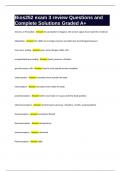
Bios252 exam 3 review Questions and Complete Solutions Graded A+.

Rating
-
Sold
-
Pages
16
Grade
A+
Uploaded on
27-03-2025
Written in
2024/2025

Bios252 exam 3 review Questions and Complete Solutions Graded A+ Sensory vs Perception - Answer: for perception to happen, the sensory signal must reach the cerebrum Adaptation - Answer: the ability to no longer perceive sensation due to prolonged exposure Free nerve ending - Answer: pain, temp changes, tickle, itch encapsulated neve ending - Answer: touch, pressure, vibration special sensory cells - Answer: used to creat special sensory reception exteroceptors - Answer: sensations from outside the body interoceptors - Answer: sensation from inside the body proprioreceptors - Answer: where your body is in space and time body position Mechanoreceptors - Answer: stretch (touch, pressure, vibrations, stretch, proprioception) Osmoreceptors - Answer: osmolarity (blood) thermoreceptors - Answer: temperature chemoreceptors - Answer: chemicals Photoreceptors - Answer: light Nociceptors - Answer: pain; fast(acute-sharp stabbing) slow(chronic-dull achy) Different referred pain sites - Answer: free nerve endings Tactile - Answer: itch tickle free nerve ending non tactile - Answer: temperature change, pain free nerve ending root hair plexuses - Answer: sense movement on skin by movement of hair corpuscles for touch - Answer: meissners corpuscle- light touch, low-frequency vibration type 1 cutaneous mechanoreceptors - Answer: merkel cells- pressure type 2 cutaneous mechanoreceptors - Answer: ruffinis corpuscle- light and deep pressure (baroreceptors)(stretching)(how great of pressure) lamellated corpuscles - Answer: pacinain corpuscle- high frequency vibration complex tactile sensations - Answer: combination of the previous nerve endings- gives surface texture layers of the eye - Answer: Fibrous tunic Vascular tunic retina anterior chamber vitreous chamber Fibrous Tunic - Answer: sclera cornea sclera - Answer: whites of the eyes made of dense irregular connective tissue where extrinsic eye muscles attach cornea - Answer: less strong but more transparent than the sclera allowing light to pass through vascular tunic - Answer: choroid ciliary body iris choroid - Answer: begins with the center of the optic nerve and extends tp the choroid; mostly made of connective tissue and blood vessels Ciliary body - Answer: ciliary muscles- responsible for changing shape of the lens ciliary process- secretes aqueous humor zonular fibers- connect the lens to the ciliary body iris - Answer: color of eye retina - Answer: photoreceptors(cones and rods) bipolar cell ganglion cell horizontal cell amacrine cell anterior chamber - Answer: aqueous humor vitreous chamber - Answer: vitreous body visual pathway physiology - Answer: o Refraction - the bending of light when it passes through a clear substance o Light will pass through the cornea, it is then refracted by the aqueous humor, next it passes through the pupil that focuses the light onto the lens. The lens will then accommodate (contract and thicken or relax and flatten) which will bend the light further as it then enters the vitreous chamber and focuses on the retina (on the fovea centralis - the area of sharpest visual acuity). o Photoreceptor cells will then send the signal to the retina; through the optic disc (place where the optic nerve exits the eye); to the optic nerve; the optic chiasm; optic tracts; thalamus; optic radiations; and lastly to the occipital lobe eye - Answer: olfaction - Answer: chemoreceptor cells send the signal to olfactory nerve, olfactory bulb, olfactory tract, limbic system, temporal and frontal lobe olfactory - Answer: Gustation nerves - Answer: fascial nerve 7 glossopharyngeal nerve 9 vagus nerve 10 gustation pathway - Answer: -gustatory receptor send signals to CN7 CN9 CN 10 -signal goes to medulla oblongata, thalamus, parietal lobe Papilla - Answer: bumps on tongue vallate papillae - Answer: 12 of them each containing 100-300 taste buds Fingiform papillae - Answer: scattered all over the tongue and contain about 5 taste buds each foliate papillae - Answer: located in the lateral trenches of the tongue and degenerate in early childhood filiform papillae - Answer: cover the entire tongue, NO TASTE BUDS function to move food and contain tactile receptors taste sensations - Answer: sweet, sour, salty, bitter, umami Gustation (taste) - Answer: layers of ear - Answer: outer, middle, inner Pathway of auditory information - Answer: auricle, external auditory canal, tympanic membrane, eustachian tube, ossicles, oval window, round window, bony labyrinth, cochlea, organ of corti equilibrium - Answer: maculae of the utricle and saccule detect linear acceleration or deceleration of head cristea in semicircular canals detect rotation otoliths present in semicircular canals help detect head rotation vertigo - Answer: loss of sense of balance causes: stroke, encephalitis, and toxin or drugs like alcohol muscular degeneration - Answer: dark spots in vision caused by destruction of the macula lutea wet: caused by poorly constructed capillaries dry:destruction w/out leaky vessels ear - Answer: functions of the endocrine system - Answer: metabolism, growth, sleep, mood, tissue function, reproduction, stress, fluid dynamics primary endocrine structures - Answer: pineal glands, pituitary gland, thyroid gland, parathyroid gland, and adrenal gland secondary endocrine structures - Answer: pancreas, thymus, skin, heart, stomach, liver, kidney, hypothalamus, gonads, small intestine endocrine - Answer: secreting internally blood exocrine - Answer: secreting externally sweat Neirotransmitters - Answer: release in central nervous system lipid soluble - Answer: bound to transport proteins; receptors inside cell steroid based, thyroid hormones, nitric oxide water soluble - Answer: circulate freely in blood amines, peptides, proteins, glycoproteins, and eicosanoids hormonal stimuli - Answer: other hormones either trigger the release or inhibits the release neural stimuli - Answer: neurons control the trigger or inhibition of the release humoral stimuli - Answer: chemicals control the trigger or inhibition of the release endocrine control by hypothalamus & pituitary gland - Answer: -hypothalamus connects to the pituitary via the stalk of the infundibulum -hypothamamus is connected to anterior pituitary by blood vessels(adenohypophysis)-hypophyseal portal system -hypothalamus is connected to the posterior pituitary via nerves(neurohypophysis) Hypothalamus hormones - Answer: growth hormone-releasing hormone thyrotropin-releasing hormone gonadotropin-releasing hormone prolactin-releasing hormone corticotropin-releasing hormone(CRH) Growth hormone-releasing hormone (GHRH) (Stimulus, Target tissue, Effect) - Answer: -stimulus- cell injury, drop in protein, carbohydrate, or lipids in the blood -target tissue-somatotrophs anterior pituitary -effect- triggers the release of growth hormone Thyrotropin-releasing hormone (TRH) (Stimulus, Target tissue, Effect) - Answer: -Stimulus - elevation of iodine in the blood, damage to cells -Target Tissues - Thyrotrophs in the anterior pituitary -Effect - Triggers the release of Thyroid-stimulating hormone Gonadotropin-releasing hormone (GnRH) (Stimulus, Target tissue, Effect) - Answer: -Stimulus - levels of estrogen and testosterone in the body -Target Tissues - Gonadotrophs in the anterior pituitary -Effect - Release of FSH and/or LH Prolactin Releasing Hormone (PRH) (Stimulus, Target tissue, Effect) - Answer: Stimulus - pregnancy Target Tissues - Lactotrophs of the anterior pituitary Effect - Release prolactin corticotropin-releasing hormone(CRH) (Stimulus, Target tissue, Effect) - Answer: -Stimulus - decrease detected in blood levels of glucose, Na+, and/or testosterone -Target Tissues - Corticotrophs cells of the anterior pituitary -Effect - Release of ACTH or MSH Anterior Pituitary Gland Hormones - Answer: Growth hormone thyroid-stimulating hormone follicle-stimulating hormone Luteinizing hormone prolactin adrenocorticotropic hormone melanocytes-stimulating hormone Growth Hormone (GH) (Stimulus, Target tissue, Effect) - Answer: -Stimulus - Growth hormone releasing hormone; hypoglycemia; decrease blood fatty acids and/or amino acids; sympathetic activity; deep sleep; testosterone, estrogen, thyroid hormones and ghrelin. -Target tissue - Liver, bone, skeletal muscle and cartilage -Effects on Target Tissue - Synthesize and release IGFs which in turn promote growth of body tissues. Enhance lipolysis and decrease glucose uptake. Thyroid Stimulating Hormone (TSH) (Stimulus, Target tissue, Effect) - Answer: -Stimulus - Thyrotropin releasing-hormone -Target tissue - Thyroid gland -Effects - Stimulates synthesis and secretion of thyroid hormones by thyroid gland Follicle-stimulating hormone (FSH) (Stimulus, Target tissue, Effect) - Answer: -Stimulus - GnRH -Target Tissue - Ovary and Testis -Effects - In females, initiates development of oocytes and induces ovarian secretion of estrogens. In males, stimulates testes to produce sperm luteinizing hormone (LH) (Stimulus, Target tissue, Effect) - Answer: -Stimulus - GnRH -Target Tissue - Ovary and Testis -Effect - In females, stimulates secretion of estrogens and progesterone, ovulation and formation of corpus luteum. In males, stimulates testes to produce testosterone Prolactin (PRL) (Stimulus, Target tissue, Effect) - Answer: -Stimulus - Prolactin Releasing Hormone; Pregnancy -Target Tissue - Mammary glands -Effect - Together with other hormones, promotes milk production by mammary glands Adrenocorticotropic hormone (ACTH) (Stimulus, Target tissue, Effect) - Answer: -Stimulus - Corticotropin Releasing Hormone -Target Tissue - Adrenal cortex -Effect - Controls hormone secretion from the adrenal cortex, mainly cortisol. melanocyte-stimulating hormone (MSH) (Stimulus, Target tissue, Effect) - Answer: -Stimulus - Corticotropin Releasing Hormone -Target Tissue - Brain -Effect - Exact role in humans is unknown but may influence brain activity; when present in excess, can cause darkening of skin Posterior Pituitary Gland hormones - Answer: Oxytocin antidiuretic hormone (ADH, vasopressin) Oxytocin (Stimulus, Target tissue, Effect) - Answer: -Stimulus - stretching of the cervix during childbirth; suckling of the nipple -Target Tissue - Smooth muscle of the cervix; Mammary glands -Effect - enhances contractions; stimulates milk letdown and ejection Antidiuretic hormone (ADH, vasopressin) (Stimulus, Target tissue, Effect) - Answer: -Stimulus - drop in blood pressure; elevated osmotic pressure; dehydration -Target Tissue - Distal convoluted tubule and collecting ducts of the renal nephron -Effect - Conserves body water by decreasing urine volume, decreases water loss though perspiration, raises blood pressure by constricting arterioles pituitary gland - Answer: thyroid gland hormones - Answer: Thyroxine (T4) Triiodothyronine (T3) Calcitonin T3 (triiodothyronine) (Stimulus, Target tissue, Effect) - Answer: -Stimulus - Thyroid Stimulating hormone, low metabolic rate, cold, pregnancy, high altitudes -Target Tissue - Many cells in the body -Effect - Increases rate of metabolism t4(tetraiodothyronine) (Stimulus, Target tissue, Effect) - Answer: -Stimulus - Thyroid stimulating hormone, low metabolic rate, cold, pregnancy, high altitudes -Target Tissue - Many cells in the body -Effect - Increase rate of metabolism (usually converted into T3 first) Calcitonin (Stimulus, Target tissue, Effect) - Answer: -Stimulus - high blood Ca2+ levels stimulate secretion -Target Tissue - Bone tissue (osteoblasts) -Effect - Increase calcium storage in bone, lower blood calcium levels Parathyroid Gland hormone - Answer: parathyroid hormone (PTH) parathyroid hormone(PTH) (Stimulus, Target tissue, Effect) - Answer: -Stimulus - Low blood Ca2+ levels stimulate secretion -Target Tissue - Bone tissue (osteoclasts) and kidney -Effect - Increase calcium removal from storage in bone, produces the active form of vitamin D in the kidney, increase absorption of calcium by intestines, increases blood Ca2+ levels Adrenal Gland hormones - Answer: aldosterone cortisol adrenal androgens(mainly DHEA) epinephrine and Norepinephrine aldosterone (Stimulus, Target tissue, Effect) - Answer: - Stimulus - Low blood Na+ levels stimulate secretion; Angiotensin II - Target Tissue - Kidney -Effect - Stimulates kidney tubules to conserve sodium; triggers the release of ADH and the resulting conservation of water by the kidney Cortisol (Stimulus, Target tissue, Effect) - Answer: -Stimulus - ACTH; stress and low blood levels of glucocorticoids -Target Tissue - Many cells - Effect - Increase protein breakdown, stimulate gluconeogenesis and lipolysis, provide resistance to stress, dampen inflammation, depress immune responses adrenal androgens(mainly DHEA) (Stimulus, Target tissue, Effect) - Answer: -Stimulus - ACTH stimulates the secretion -Target Tissue - Sex organs and other effectors -Effect - Assist in early growth of axillary and pubic hair, contributes to libido and are source of estrogens after menopause epinephrine and norepinephrine (Stimulus, Target tissue, Effect) - Answer: -Stimulus - Ach secretion from preganglionic sympathetic nerves, fight or flight response -Target Tissues - Sympathetic nervous system effectors -Effect - Enhance effects of sympathetic division of autonomic nervous system during stress Pancreatic Islets hormones - Answer: glucagon insulin Glucagon (Stimulus, Target tissue, Effect) - Answer: -Stimulus - low blood glucose levels -Target Tissues - liver and other cells -Effect - Raises blood glucose levels by accelerating glycogenolysis, converting other nutrients into glucose in the liver and releasing glucose into blood Insulin (Stimulus, Target tissue, Effect) - Answer: -Stimulus - raise in blood glucose levels -Target Tissues - most cells in the body -Effect - Lowers blood glucose level by accelerating transport of glucose into cells, glycogenesis, and decreasing glycogenolysis and gluconeogenesis, increases lipogenesis and stimulates protein synthesis Ovaries and Testis hormones - Answer: estrogen progesterone testosterone relaxin inhibin Estrogen (Stimulus, Target tissue, Effect) - Answer: -Stimulus - Cyclical with menses -Target Tissue - Uterus, breast, and other tissues -Effect - Regulate female reproductive cycle, maintain pregnancy, promote maintenance of female secondary sex characteristics progesterone (Stimulus, Target tissue, Effect) - Answer: -Stimulus - Cyclical with menses -Target Tissue - Uterus, mammary glands and other tissues -Effect - Maintain endometrial thickness and proper conditions for pregnancy testosterone (Stimulus, Target tissue, Effect) - Answer: -Stimulus - Decrease in blood testosterone levels -Target Tissue - Sperm-producing cells of the testis, muscles, and other tissues -Effect - Increase production of sperm, develop and maintain secondary sex characteristics, libido relaxin (Stimulus, Target tissue, Effect) - Answer: -Stimulus - Pregnancy -Target Tissue - Pubic symphysis and uterine cervix -Effect - Increases flexibility in the pubic symphysis during pregnancy; and helps dilate the cervix during labor and delivery Inhibin (Stimulus, Target tissue, Effect) - Answer: -Stimulus - Levels of estrogen and testosterone -Target Tissue - Gonadotrophs of the anterior pituitary gland -Effect - Inhibits the secretion of FSH from anterior pituitary primary and secondary endocrine - Answer: local chemical messengers and hormonal interaction - Answer: effect down-regulation up-regulation autocrine paracrine effect - Answer: effect only target cells that have the specific receptors to the given hormone down-regulation - Answer: lessen the amount of receptors due to large amounts of hormone up-regulation - Answer: increase the amount of receptors due to small amount of hormone autocrine - Answer: effects the cell that produces the hormone (target cell) paracrine - Answer: effects the cells that surround the cell that produces the hormone (next to target cell) eicosanoids - Answer: derived from arachidonic acid leukotrienes - Answer: mediate allergic and inflammatory responses prostacyclin - Answer: produced by blood vessels to prevent blood clotting thromboxane - Answer: produced by blood platelets to inhibit prostacyclin prostaglandins - Answer: the most diverse eicosanoids that are produced throughout the body with a variety of functions depending on the body system affected NSAIDS - Answer: Nonsteroidal anti-inflammatory drugs. Ibuprofen, naproxen. SAIDS - Answer: Steroidal anti-inflammatory drugs Cortisol and corticosterone block release of arachidonic acid inhibit synthesis of all eicosanoides Hormone response to stress - Answer: eustress distress eustress - Answer: helpful, everyday stress that prepares us to meet everyday challenges distress - Answer: any type of harmful stress that may be damaging -fight-or-flight -resistance reaction -exhaustion -disease fight or flight - Answer: initiated by nerves of hypothalamus stimulating the sympathetic division of the ANS and the adrenal medulla resistance reaction - Answer: hypothalamus releases CRH, TRH, and GHRH -Longer lasting and accelerate breakdown reactions to provide ATP for counteracting stress exhaustion - Answer: results from depletion of body resources during resistance phase disease - Answer: can result from inhibiting the immune system by stress Pituitary gigantism - Answer: hypersecretion of growth hormone during childhood acromegaly - Answer: hypersecretion of growth hormone during adulthood pituitary dwarfism - Answer: hyposecretion of growth hormone during childhood graves disease - Answer: hyperthyroidism endemic goiters - Answer: hypothyroidism Cushing syndrome - Answer: hypersecretion of cortisol addisons disease - Answer: hyposecretion of cortisol diabetes mellitus - Answer: hyposecretion or inaction of insulin type 1: insufficient secretion of insulin type 2: inactivity of insulin caused by obesity

Show more Read less
Institution
BIOS252
Course
BIOS252


Whoops! We can’t load your doc right now. Try again or contact support.

Written for

Institution
BIOS252
Course
BIOS252

Document information

Uploaded on
March 27, 2025
Number of pages
16
Written in
2024/2025
Type
Exam (elaborations)
Contains
Questions & answers

Subjects

Content preview

Bios252 exam 3 review Questions and
Complete Solutions Graded A+
Sensory vs Perception - Answer: for perception to happen, the sensory signal must reach the cerebrum


Adaptation - Answer: the ability to no longer perceive sensation due to prolonged exposure


Free nerve ending - Answer: pain, temp changes, tickle, itch


encapsulated neve ending - Answer: touch, pressure, vibration


special sensory cells - Answer: used to creat special sensory reception


exteroceptors - Answer: sensations from outside the body


interoceptors - Answer: sensation from inside the body


proprioreceptors - Answer: where your body is in space and time body position


Mechanoreceptors - Answer: stretch (touch, pressure, vibrations, stretch, proprioception)


Osmoreceptors - Answer: osmolarity (blood)


thermoreceptors - Answer: temperature


chemoreceptors - Answer: chemicals


Photoreceptors - Answer: light

,Nociceptors - Answer: pain; fast(acute-sharp stabbing) slow(chronic-dull achy)


Different referred pain sites - Answer:


free nerve endings

Tactile - Answer: itch tickle


free nerve ending

non tactile - Answer: temperature change, pain


free nerve ending

root hair plexuses - Answer: sense movement on skin by movement of hair


corpuscles for touch - Answer: meissners corpuscle- light touch, low-frequency vibration


type 1 cutaneous mechanoreceptors - Answer: merkel cells- pressure


type 2 cutaneous mechanoreceptors - Answer: ruffinis corpuscle- light and deep pressure
(baroreceptors)(stretching)(how great of pressure)


lamellated corpuscles - Answer: pacinain corpuscle- high frequency vibration


complex tactile sensations - Answer: combination of the previous nerve endings- gives surface texture


layers of the eye - Answer: Fibrous tunic

Vascular tunic

retina

anterior chamber

, vitreous chamber


Fibrous Tunic - Answer: sclera

cornea


sclera - Answer: whites of the eyes made of dense irregular connective tissue where extrinsic eye
muscles attach


cornea - Answer: less strong but more transparent than the sclera allowing light to pass through


vascular tunic - Answer: choroid

ciliary body

iris


choroid - Answer: begins with the center of the optic nerve and extends tp the choroid; mostly made of
connective tissue and blood vessels


Ciliary body - Answer: ciliary muscles- responsible for changing shape of the lens

ciliary process- secretes aqueous humor

zonular fibers- connect the lens to the ciliary body


iris - Answer: color of eye


retina - Answer: photoreceptors(cones and rods)

bipolar cell

ganglion cell

horizontal cell

amacrine cell
Get to know the seller

Seller avatar
Reputation scores are based on the amount of documents a seller has sold for a fee and the reviews they have received for those documents. There are three levels: Bronze, Silver and Gold. The better the reputation, the more your can rely on the quality of the sellers work.
YourExamplug Grand Canyon University
View profile
Follow You need to be logged in order to follow users or courses
Sold
171
Member since
1 year
Number of followers
26
Documents
14332
Last sold
4 days ago
Your Exm Plug

Assignments, Case Studies, Research, Essay writing service, Questions and Answers, Discussions etc. for students who want to see results twice as fast. I have done papers of various topics and complexities. I am punctual and always submit work on-deadline. I write engaging and informative content on all subjects. Send me your research papers, case studies, psychology papers, etc, and I’ll do them to the best of my abilities. Writing is my passion when it comes to academic work. I’ve got a good sense of structure and enjoy finding interesting ways to deliver information in any given paper. I love impressing clients with my work, and I am very punctual about deadlines. Send me your assignment and I’ll take it to the next level. I strive for my content to be of the highest quality. Your wishes come first— send me your requirements and I’ll make a piece of work with fresh ideas, consistent structure, and following the academic formatting rules. For every student you refer to me with an order that is completed and paid transparently, I will do one assignment for you, free of charge!!!!!!!!!!!!

Read more Read less
4.3

67 reviews

5
38
4
16
3
7
2
4
1
2

Recently viewed by you

Why students choose Stuvia

Created by fellow students, verified by reviews

Quality you can trust: written by students who passed their tests and reviewed by others who've used these notes.

Didn't get what you expected? Choose another document

No worries! You can instantly pick a different document that better fits what you're looking for.

Pay as you like, start learning right away

No subscription, no commitments. Pay the way you're used to via credit card and download your PDF document instantly.

Student with book image

“Bought, downloaded, and aced it. It really can be that simple.”

Alisha Student

Frequently asked questions