

Cell Division
- repeated process in which cell <parent cell> divides to give new cells <daughter
cells> for
- growth
- replacing damaged cells
- reproduction passing on of genetic information
- why not cell enlargement instead of cell division
- when cell size ↑, volume increase at faster rate, SA to volume ratio ↓
- ↓ SA for exchanging gases, obtaining nutrients and removing wastes
- rate of exchange becomes inadequate to maintain cells’ rate of metabolism
- cytoplasm too far from cell membrane
- cell has to divide or stop growing
Chromosomes
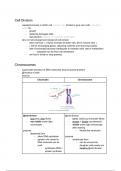
- supercoiled structure of DNA molecules around special proteins
- @nucleus of cells
- exist as
Chromatin Chromosome
@cell division @cell division
- long and v thin fibres - tightly coiled-up chromatin fibres
- not visible under light - shorter + thicker (condensed)
microscope - visible under light microscope
after staining
purpose - thread-like structures
- dispersed form
- allow DNA replication purpose
- genetic info carried in - condensed form
DNA molecule can be - can be moved into
read daughter cells easily w/o
- synthesise RNA > tangling @cell division
protein synthesis
, transcription structure
- beginning of cell division
- 2 sister chromatids
joined at centromere
- identical
- 1 DNA molecule
/chromatid
- during cell division
- sister chromatids
separate
- separated chromatids
called chromosomes
Homologous chromosomes
- pairs of chromosomes that control the same biological characteristic
- each pair:
- same shape + size1
- paternal chromosome + maternal chromosome
- diff no of chromosomes for diff species of organisms
- humans: 23 pairs of homologous chromosomes, 46 chromosomes in total
- size/complexity of organism unrelated to no of chromosomes 2
Diploid cells (2n) Haploid cells (n)
- contain both members of each - contain only 1 member of each
homologous pair of chromosomes homologous pair of chromosomes
- 2 sets of chromosomes - only 1 set of chromosomes
- examples - examples
- most somatic cells3 of - gametes sex cells
organisms body cells - ova / sperm
@humans
The Cell Cycle
- sequence of events during cell division
- duration of cell cycle varies with cell types
- neurones: X complete cell cycle, remain in resting stage divide
- injury to brain cells X recover
- liver cells: 300-500 days slow
- can faster when organ damaged
- skin cells: ~2 weeks
1
23rd pair of chromosomes in males: diff shape + size
2
shrimp: 127 pairs, total 254
3
X mature red blood cells (NO nucleus!)
- repeated process in which cell <parent cell> divides to give new cells <daughter
cells> for
- growth
- replacing damaged cells
- reproduction passing on of genetic information
- why not cell enlargement instead of cell division
- when cell size ↑, volume increase at faster rate, SA to volume ratio ↓
- ↓ SA for exchanging gases, obtaining nutrients and removing wastes
- rate of exchange becomes inadequate to maintain cells’ rate of metabolism
- cytoplasm too far from cell membrane
- cell has to divide or stop growing
Chromosomes
- supercoiled structure of DNA molecules around special proteins
- @nucleus of cells
- exist as
Chromatin Chromosome
@cell division @cell division
- long and v thin fibres - tightly coiled-up chromatin fibres
- not visible under light - shorter + thicker (condensed)
microscope - visible under light microscope
after staining
purpose - thread-like structures
- dispersed form
- allow DNA replication purpose
- genetic info carried in - condensed form
DNA molecule can be - can be moved into
read daughter cells easily w/o
- synthesise RNA > tangling @cell division
protein synthesis
, transcription structure
- beginning of cell division
- 2 sister chromatids
joined at centromere
- identical
- 1 DNA molecule
/chromatid
- during cell division
- sister chromatids
separate
- separated chromatids
called chromosomes
Homologous chromosomes
- pairs of chromosomes that control the same biological characteristic
- each pair:
- same shape + size1
- paternal chromosome + maternal chromosome
- diff no of chromosomes for diff species of organisms
- humans: 23 pairs of homologous chromosomes, 46 chromosomes in total
- size/complexity of organism unrelated to no of chromosomes 2
Diploid cells (2n) Haploid cells (n)
- contain both members of each - contain only 1 member of each
homologous pair of chromosomes homologous pair of chromosomes
- 2 sets of chromosomes - only 1 set of chromosomes
- examples - examples
- most somatic cells3 of - gametes sex cells
organisms body cells - ova / sperm
@humans
The Cell Cycle
- sequence of events during cell division
- duration of cell cycle varies with cell types
- neurones: X complete cell cycle, remain in resting stage divide
- injury to brain cells X recover
- liver cells: 300-500 days slow
- can faster when organ damaged
- skin cells: ~2 weeks
1
23rd pair of chromosomes in males: diff shape + size
2
shrimp: 127 pairs, total 254
3
X mature red blood cells (NO nucleus!)


