100% satisfaction guarantee Immediately available after payment Both online and in PDF No strings attached 4.2 TrustPilot
logo-home
Exam (elaborations)

3990 Exam 1 study guide Questions and Complete Solutions Graded A+

Rating
-
Sold
-
Pages
15
Grade
A+
Uploaded on
26-03-2025
Written in
2024/2025

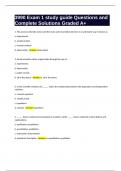
3990 Exam 1 study guide Questions and Complete Solutions Graded A+ 1. The process whereby social scientists note and record phenomenon in a systematic way is known as: a. experiments b. empirical tests c. content analysis d. observation - Answer: observation 2. Social scientists collect original data through the use of: a. experiments b. observation c. public records d. all of the above - Answer: d. all of the above 3. In the scientific method, the _____ states the relationship between the dependent and independent variables: a. research question b. empirical test c. hypothesis d. analysis - Answer: hypothesis 4. _____ data is collected and analyzed as numbers, while _____ data is collected as descriptions and explanations: a. qualitative; quantitative b. quantitative; qualitative c. systematic; observational d. analytical; descriptive - Answer: b. quantitative; qualitative 5. Which of the following is not an example of quantitative data? a. presidential speeches b. campaign finance reports c. public opinion poll d. voter turnout statistics - Answer: a. presidential speeches 6. Statistics that merely describe the distribution of a population are knows as: a. descriptive statistics b. inferential statistics c. univariate statistics d. bivariate statistics - Answer: a. descriptive statistics 7. The analysis of a sample or subset of the population is referred to as: a. descriptive statistics b. inferential statistics c. univariate statistics d. bivariate statistics - Answer: b. inferential statistics 8. _____ are used to statistically measure the average of a single variable. a. measures of dispersion b. bivariate statistics c. cross tabulations d. measures of central tendency - Answer: d. measures of central tendency 9. A _____ hypothesis states that there is no relationship between a dependent and independent variable. a. positive b. negative c. null d. statistically significant - Answer: c. null 10. Which of the following statistics analyze a single variable? a. descriptive b. inferential c. univariate d. bivariate - Answer: c. univariate 11. The term that refers to an apparent relationship which is false is known as: a. correlation b. causation c. probability d. spurious - Answer: d. spurious 12. Statisticians use _____ to address whether fluctuations in the measurement of a concept have a cause or are merely random effects of time and place. a. the scientific method b. probability c. content analysis d. spurious relationships - Answer: b. probability 13. The first step of statistical analysis is to: a. provide a conceptual definition b. collect data for each case measured c. identify who or what is being studied d. evaluate the measurement - Answer: c. identify who or what is being studied 14. The process whereby observations are translated into a measurement is known as: a. statistical analysis b. the scientific method c. operationalizing a variable d. conceptualization - Answer: c. operationalizing a variable 15. Which of the following level of measurement can be categorized but has no natural order? a. ratio b. interval c. ordinal d. nominal - Answer: d. nominal 16. Which level of measurement is identified by having an absolute zero? a. ratio b. interval c. ordinal d. nominal - Answer: a. ratio 17. Which of the following is not an example of nominal level data? a. gender b. astrological sign c. educational degrees d. race - Answer: c. educational degrees 18. Which of the following are examples of ratio level data? a. religion and age b. class and socioeconomic status c. political parties and race d. unemployment rate and income - Answer: d. unemployment rate and income 19. Ordinal levels of measure have _____ but no _____. a. order; scale b. absolute zeros; categorization c. categorization; order d. order; categorization - Answer: a. order; scale 20. _____ and _____ are used to demonstrate how well a measure accurately expresses a concept. a. indicators; variables b. validity; reliability c. reliability; indicators d. theories; statistics - Answer: b. validity; reliability 21. A measure that "makes sense" is said to have: a. consensual validity b. associational validity c. predictive validity d. face validity - Answer: d. face validity 22. _____ is used to argue that a measurement makes logical sense because it is generally accepted and has widespread use. a. consensual validity b. associational validity c. predictive validity d. face validity - Answer: a. consensual validity 23. The process of translating information into numbers is known as _____: a. operationalizing b. conceptualizing c. coding d. measuring - Answer: a. operationalizing 24. A _____ is used to show the total number of cases for each category of a variable. a. coding sheet b. panel study c. frequency table d. cross sectional survey - Answer: c. frequency table 25. The arithmetic average of a variable refers to which measure of central tendency? a. mean b. median c. mode d. none of the above - Answer: a. mean 26. Which measure of central tendency can be reported for nominal level data? a. mode b. median c. mean d. both a and b - Answer: a. mode 27. If interval level data are skewed by an outlier, which average would best describe the middle of the data? a. mean b. median c. mode d. both a and b - Answer: b. median 28. What is the only measure of central tendency that can be reported for all levels of measurement? a. mean b. median c. mode d. none of the above - Answer: c. mode 29. If a frequency distribution has two values tied for the highest frequency, it is called _____. a. bi-modal b. modal c. outliers d. bivariate - Answer: a. bi-modal 30. _____ is the symbol used to represent a population mean. a. X b. fx c. µ d. N - Answer: c. µ 31. The mean cannot be reported for _____ or _____ level data. a. interval; ratio b. ordinal; interval c. nominal; ratio d. nominal; ordinal - Answer: d. nominal; ordinal 32. The _____ is one approach that is used to describe how dispersed a variable is. a. range b. mean c. median d. frequency - Answer: a. range 33. The range within which the middle two-fourths of a population lie is known as: a. the frequency b. the standard deviation c. the interquartile range d. the five point summary - Answer: c. the interquartile range 34. A _____ is used to illustrate a five point summary. a. memo b. frequency table c. contingency table d. box and whiskers plotd. box and whiskers plot - Answer: d. box and whiskers plot 35. Which of the following measures are used look at how far each of the cases is from the mean? a. variance b. range c. standard deviation d. both a and c - Answer: d. both a and c 36. The average square distance from the mean is referred to as: a. variance b. range c. standard deviation d. both a and c - Answer: a. variance 37. Which of the following is the symbol for the standard deviation of a population: a. µ b. σ c. λ d. η - Answer: b. σ 38. The _____ is used to compare the value of each case with the mean. a. frequency b. standard deviation c. interquartile range d. five point summary - Answer: b. standard deviation 39. Calculating the standard deviation requires what level of measurement? a. nominal b. ordinal c. interval d. ratio - Answer: c. interval 40. A nominal variable that only has two categories is known as: a. dichotomous b. bivariate c. univariate d. bi-modal - Answer: a. dichotomous 41. Which of the following is an example of a dichotomous variable? a. gender b. religion c. astrological signs d. unemployment rate - Answer: a. gender 42. Approximately how many cases fall within one standard deviation above and below the mean? a. one-quarter b. one-third c. two-thirds d. none - Answer: b. one-third 43. The normal curve is _____. a. unimodal b. bi-modal c. symmetrical d. both a and c - Answer: d. both a and c 44. The distance, measured in standard deviations, that a case is located from a mean is called a: a. z-score b. standardized value c. distributed variable d. interval level variable - Answer: a. z-score 45. A case which is less than the mean has a z-score which is: a. negative b. non-existent c. valueless d. none of the above - Answer: a. negative 46. The probability of being above the mean with a normal distribution is: a. 0.25 b. 0.50 c. 0.75 d. 1.00 - Answer: b. 0.50 47. To calculate a z-score, you need both the _____ and the _____. a. median; frequency b. mean; frequency c. mean; standard deviation d. frequency; standard deviation - Answer: c. mean; standard deviation 48. If your case does not fall between the mean and a given standard deviation, then it is in the _____. a. tail b. mean c. probability d. standard deviation - Answer: a. tail 49. The normal curve is shaped like a _____: a. bow b. cone c. bell d. inverted bell - Answer: c. bell 50. _____ is a statistical technique that is used to compare a population mean and a sample distribution. a. Means testing b. Content analysis c. Analysis of variance d. Predictive validity - Answer: a. Means testing 51. A false positive finding is referred to as a: a. Type I error b. Type II error c. ecological fallacy d. spurious relationship - Answer: a. Type I error 52. _____ refers to observable results that have a five percent chance or less of being due to random error. a. Associational validity b. Consensual validity c. Statistical significance d. Specification - Answer: c. Statistical significance 53. When comparing the distribution of an attribute for a population with the distribution for a subsample, we want there to be a _____ chance or less of a Type I error. a. 15 percent b. 10 percent c. 5 percent d. none of the above - Answer: c. 5 percent 54. The _____ is used to compare a sample mean to a population mean to determine how many standard errors away from the mean the sample is. a. z-score b. t-score c. variance d. Sum of Squares - Answer: b. t-score 55. A degree of freedom (d.f.) for a t-score is calculated by subtracting one from the _____. a. standard deviation b. variance c. Sum of Squares d. sample size - Answer: d. sample size 56. The T Table shows the probability that a case will be in the _____. a. interquartile range b. range between the mean and value of X c. tail of the normal curve d. fiftieth percentile below the mean - Answer: b. range between the mean and value of X 57. A dichotomous variable whose cases have been coded "1" (exhibits attribute) and "0" (no attribute) is referred to as a(n): a. dependent variable b. independent variable c. dummy variable d. antecedent variable - Answer: c. dummy variable 58. A sample mean is represented by which symbol? a. µ b. X c. d. n - Answer: b. X 59. A story that is told to explain variation in an attribute across a population is known as a: a. theory b. conceptual definition c. hypothesis d. null hypothesis - Answer: a. theory 60. _____ are used to predict expectations of theories that have yet to be observed. a. Theories b. Conceptual definitions c. Hypotheses d. Null hypotheses - Answer: c. Hypotheses 61. A useful hypothesis needs to: a. be based on a theory b. state a relationship between variables c. be testable d. all of the above - Answer: d. all of the above 62. A _____ is a word picture that depicts the relationship between independent variables and a dependent variable. a. figure b. table c. model d. none of the above - Answer: c. model 63. A direct relationship between an independent variable (IV) and a dependent variable (DV) means that: a. as the IV increases, the DV increases b. as the IV increases, the DV decreases c. as the IV decreases, the DV increases d. none of the above - Answer: a. as the IV increases, the DV increases 64. A negative relationship can also be referred to as: a. direct b. inverse c. heteroscedastic d. homoscedastic - Answer: b. inverse 65. The _____ states that there is no relationship between the dependent and independent variables. a. hypothesis b. theory c. model d. null hypothesis - Answer: d. null hypothesis 66. Within ANOVA, the _____ is used to determine whether or not a relationship exists (if it is statistically significant). a. t-score b. z-score c. F-statistic d. frequency - Answer: c. F-statistic 67. The appropriate measure of association for analysis of variance is: a. the F-statistic b. the t-score c. eta-squared d. ANOVA - Answer: c. eta-squared

Show more Read less
Institution
CON 3990
Course
CON 3990


Whoops! We can’t load your doc right now. Try again or contact support.

Written for

Institution
CON 3990
Course
CON 3990

Document information

Uploaded on
March 26, 2025
Number of pages
15
Written in
2024/2025
Type
Exam (elaborations)
Contains
Questions & answers

Subjects

Content preview

3990 Exam 1 study guide Questions and
Complete Solutions Graded A+
1. The process whereby social scientists note and record phenomenon in a systematic way is known as:

a. experiments

b. empirical tests

c. content analysis

d. observation - Answer: observation


2. Social scientists collect original data through the use of:

a. experiments

b. observation

c. public records

d. all of the above - Answer: d. all of the above


3. In the scientific method, the _____ states the relationship between the dependent and independent
variables:

a. research question

b. empirical test

c. hypothesis

d. analysis - Answer: hypothesis


4. _____ data is collected and analyzed as numbers, while _____ data is collected as descriptions and
explanations:

a. qualitative; quantitative

b. quantitative; qualitative

c. systematic; observational

d. analytical; descriptive - Answer: b. quantitative; qualitative

, 5. Which of the following is not an example of quantitative data?

a. presidential speeches

b. campaign finance reports

c. public opinion poll

d. voter turnout statistics - Answer: a. presidential speeches


6. Statistics that merely describe the distribution of a population are knows as:

a. descriptive statistics

b. inferential statistics

c. univariate statistics

d. bivariate statistics - Answer: a. descriptive statistics


7. The analysis of a sample or subset of the population is referred to as:

a. descriptive statistics

b. inferential statistics

c. univariate statistics

d. bivariate statistics - Answer: b. inferential statistics


8. _____ are used to statistically measure the average of a single variable.

a. measures of dispersion

b. bivariate statistics

c. cross tabulations

d. measures of central tendency - Answer: d. measures of central tendency


9. A _____ hypothesis states that there is no relationship between a dependent and independent
variable.

a. positive

b. negative

c. null
Get to know the seller

Seller avatar
Reputation scores are based on the amount of documents a seller has sold for a fee and the reviews they have received for those documents. There are three levels: Bronze, Silver and Gold. The better the reputation, the more your can rely on the quality of the sellers work.
YourExamplug Grand Canyon University
View profile
Follow You need to be logged in order to follow users or courses
Sold
171
Member since
1 year
Number of followers
26
Documents
14332
Last sold
3 days ago
Your Exm Plug

Assignments, Case Studies, Research, Essay writing service, Questions and Answers, Discussions etc. for students who want to see results twice as fast. I have done papers of various topics and complexities. I am punctual and always submit work on-deadline. I write engaging and informative content on all subjects. Send me your research papers, case studies, psychology papers, etc, and I’ll do them to the best of my abilities. Writing is my passion when it comes to academic work. I’ve got a good sense of structure and enjoy finding interesting ways to deliver information in any given paper. I love impressing clients with my work, and I am very punctual about deadlines. Send me your assignment and I’ll take it to the next level. I strive for my content to be of the highest quality. Your wishes come first— send me your requirements and I’ll make a piece of work with fresh ideas, consistent structure, and following the academic formatting rules. For every student you refer to me with an order that is completed and paid transparently, I will do one assignment for you, free of charge!!!!!!!!!!!!

Read more Read less
4.3

67 reviews

5
38
4
16
3
7
2
4
1
2

Recently viewed by you

Why students choose Stuvia

Created by fellow students, verified by reviews

Quality you can trust: written by students who passed their tests and reviewed by others who've used these notes.

Didn't get what you expected? Choose another document

No worries! You can instantly pick a different document that better fits what you're looking for.

Pay as you like, start learning right away

No subscription, no commitments. Pay the way you're used to via credit card and download your PDF document instantly.

Student with book image

“Bought, downloaded, and aced it. It really can be that simple.”

Alisha Student

Frequently asked questions