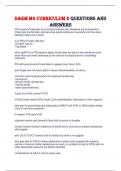
MAC3701 ASSIGNMENT 1 QUESTIONS AND
ANSWERS GRADED A+
Read the following:
You have been appointed by the Department of
Environment, Forestry and Fisheries to inspect and
evaluate the severity of air pollution, specifically
within the Mpumalanga Province of South Africa.
The inspection and evaluation has been requested
due to an increase in human health related
complaints.
Evaluate the following conclusions made and
determine the correct conclusion made in the
report.
1. The measured air quality show tolerable and
unacceptable levels, specifically at areas
dominated by industrial activities. The health of
people living near these areas are more vulnerable
to air pollution due to falling within the low-income
population group.
2. Temporal air quality trends within the Vaal
Triangle and the Highveld show a decrease in air
pollutant concentrations, supporting the decision to
remove the region as a priority area.
3. Measured sulphate and nitrogen dioxide levels
are within - ANSWERS>>>>>1. The measured air
, quality show tolerable and unacceptable levels,
specifically at areas dominated by industrial
activities. The health of people living near these
areas are more vulnerable to air pollution due to
falling within the low-income population group ✔
A news article has been published related to the
African continent's water crisis. The following
statements or conclusions are made in the article.
By using the knowledge which you have gained
throughout the module, review the main
conclusions made related to water scarcity.
Determine which of the following options is a
correct conclusion made by the article.
1. Regions with high annual rainfall never
experience water scarcity.
2. The Southern African region experiences only
experiences physical water scarcity.
3. Physical water scarcity is experienced in arid
areas such as Yemen and Malawi.
4. A shortage of safe drinking water caused by a
lack of infrastructure is usually experienced by
poor and vulnerable communities and countries
such as Mozambique. - ANSWERS>>>>>4. A
shortage of safe drinking water caused by a lack of
infrastructure is usually experienced by poor and
ANSWERS GRADED A+
Read the following:
You have been appointed by the Department of
Environment, Forestry and Fisheries to inspect and
evaluate the severity of air pollution, specifically
within the Mpumalanga Province of South Africa.
The inspection and evaluation has been requested
due to an increase in human health related
complaints.
Evaluate the following conclusions made and
determine the correct conclusion made in the
report.
1. The measured air quality show tolerable and
unacceptable levels, specifically at areas
dominated by industrial activities. The health of
people living near these areas are more vulnerable
to air pollution due to falling within the low-income
population group.
2. Temporal air quality trends within the Vaal
Triangle and the Highveld show a decrease in air
pollutant concentrations, supporting the decision to
remove the region as a priority area.
3. Measured sulphate and nitrogen dioxide levels
are within - ANSWERS>>>>>1. The measured air
, quality show tolerable and unacceptable levels,
specifically at areas dominated by industrial
activities. The health of people living near these
areas are more vulnerable to air pollution due to
falling within the low-income population group ✔
A news article has been published related to the
African continent's water crisis. The following
statements or conclusions are made in the article.
By using the knowledge which you have gained
throughout the module, review the main
conclusions made related to water scarcity.
Determine which of the following options is a
correct conclusion made by the article.
1. Regions with high annual rainfall never
experience water scarcity.
2. The Southern African region experiences only
experiences physical water scarcity.
3. Physical water scarcity is experienced in arid
areas such as Yemen and Malawi.
4. A shortage of safe drinking water caused by a
lack of infrastructure is usually experienced by
poor and vulnerable communities and countries
such as Mozambique. - ANSWERS>>>>>4. A
shortage of safe drinking water caused by a lack of
infrastructure is usually experienced by poor and