100% satisfaction guarantee Immediately available after payment Both online and in PDF No strings attached 4.6 TrustPilot
logo-home
Exam (elaborations)

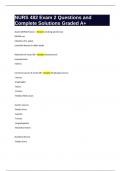
ENGR 482 Exam 2 Questions with Complete Solutions Graded A+

Rating
-
Sold
-
Pages
16
Grade
A+
Uploaded on
23-03-2025
Written in
2024/2025

ENGR 482 Exam 2 Questions and Complete Solutions Graded A+ Engineering Definition of Risk AKA _______________________ - Answer: Probability Model of Risk Engineering Definition of Risk Formula - Answer: Risk=sum{(probability of event)(consequences)}^i Engineering Definition of Risk - Answer: Product of the likelihood of an event & the magnitude of the resulting harm When using Engineering definition of risk, one must be cautious not to _______________________________________________ - Answer: Quantitatively compare or add risk quantities that have different units 4 limitations to probabilistic definition of risk - Answer: Utilitarian Not risk averse Not probabilistic Cannot explain how risk is perceived by the public (car crash vs. nuclear meltdown) Utilitarian - Answer: Calculates magnitude of risk in terms of EXPECTED consequences. Limits of Utilitarianism - Answer: Cost/benefits distributed unjustly, expected outcome doesn't equal actual outcomes, permits us to do counterintuitive things. Limits of not risk averse - Answer: Does not tell you to avoid risk of a certain magnitude Limits of not being probabilistic - Answer: Can't assume the event in question has a known probability (never happened before) Conditions of _________ risk usually vary based on ______________ - Answer: Acceptable Perspective Engineers focus on the __________ issues of the probability & magnitude of harm and contains no _____________ evaluation of whether a risk is morally acceptable - Answer: factual implicit In order to determine whether a risk is acceptable, engineers and risk experts considering engineering solutions often use a ________________ that is fundamentally a _____________ approach. - Answer: cost-benefit analysis Utilitarian According to _____________, an acceptable risk is one in which the product of probability and magnitude of the harm is ____________ or ___________ by the product of probability and magnitude of the benefit. - Answer: Engineers Equaled Exceeded The engineering conditions of acceptable risk is very ____________ - Answer: Utilitarian Limitations to the acceptable risk model are ___________ to the limitations of the probabilistic model of risk - Answer: Closely related (both utilitarian) Limitations of acceptable risk model - Answer: Can't always anticipate all effects/consequences (cost-benefit analysis will be unreliable). Certain kinds of value don't seem measurable in monetary terms (human life). Makes no allowance for the distribution of costs/benefits (only considers net benefits). Gives no place for informed consent. Informed consent - Answer: Permission granted in the knowledge of the possible consequences, typically that which is given by a patient to a doctor for treatment with full knowledge of the possible risks and benefits. Layperson - Answer: A person without professional or specialized knowledge in a particular subject. Voluntary assumed risk - Answer: Risks which an individual knowingly takes on and accepts, as opposed to an uncertain risk involuntarily imposed on them. Free and Informed Consent and Equity and Justice - Answer: People tend to see risk as more acceptable when they freely consent to the risk, and are informed about it. Additionally, people tend to be willing to assume more risk when they are justly and equitably recompensed for it. Definition of acceptable risk from the "respect for persons" approach to ethics, which is more Kantian in nature: - Answer: "An Acceptable Risk is a risk that is freely assumed with informed consent or properly compensated..." (Harris et al) When imposing a risk on others, we are not permitted to treat them in a way they would not consent to, or rational people could not consent to. Perceived Risk AKA __________ - Answer: Subjective Risk Actual Risk AKA __________ - Answer: Objective Risk Perceived Risk - Answer: People perceive risk differently depending on how they perceive the risk to themselves (the likelihood that an event will happen to them) Actual Risk - Answer: The risk of an event actually happening at all Precautionary Principle - Answer: Where there are threats of serious or irreversible damage, lack of full scientific certainty shall not be used as a reason for postponing cost-effective measures to prevent environmental degradation. 4 dimensions of precautionary principle - Answer: If there is a THREAT, which is UNCERTAIN, then some kind of ACTION is MANDATORY. There is a ________ (pertaining to our knowledge) and __________ (pertaining to what we are required to do) element to the precautionary principle - Answer: Epistemic Normative Epistemic interpretation - Answer: In a precautionary appraisal of risk, it is more desirable to avoid false negative errors than false positive ones. In a precautionary appraisal of risk, it is more desirable to avoid false ___________ errors than false ___________ ones. - Answer: Negative Positive (Think cancer example, rather safe than sorry) False Positive Error - Answer: Type II False Alarm! You incorrectly think there is a correlation between some variables where none really exists. False Negative Error - Answer: Type I You fail to discover a correlation between some variables. In some sense, the ___________ interpretation of the precautionary principle is that you have to do something when there is an uncertain threat, and the ____________ interpretation says, "better safe than sorry." - Answer: Normative Epistemic Common limitations of fault & event tree analysis, especially inaccuracies that arise from __________ & _________ interactions - Answer: Tight coupling Complex (Often coincide) Tight Coupling Interactions - Answer: Temporal, meaning events happen too quickly for a response Complex Interactions - Answer: One event affects other systems or exacerbates other events in an unexpected way Technocratic Model - Answer: Holds that experts should be in charge of determining how we handle & manage risk (engineers call the shots) Democratic Model - Answer: Holds that all parties, even laypeople, should have a say in how we manage risk. Technocrat - Answer: Expert Downside to Democratic Model - Answer: Uninformed public perceives risk differently from engineers & in any case, we can be wrong about what is actually a risk Normalization of Deviance - Answer: The tendency to come to consider behavior that varies from good design/engineering practice as acceptable. Normalization of Deviance Example - Answer: Knowledge and Acceptance of "blow by" of hot gases during the launches of the space shuttle in the Challenger case. A "fix", not a redesign was always the remedy. Groupthink - Answer: The practice of thinking or making decisions as a group in a way that discourages creativity or individual responsibility 8 symptoms of groupthink - Answer: Invulnerability of group to failure A strong "we-feeling" Shift responsibility to others Assumes inherent morality of group Self-censorship to not "rock the boat" Illusion of unanimity, silence = consent Direct pressure on those who disagree Mindguarding, preventing outside views Proper Engineering Decision (PED) - Answer: A decision that should be made by engineers because it either involves technical matters that require engineering expertise OR falls within the ethical standards embodied in engineering codes (public health/safety) Proper Management Decision (PMD) - Answer: A decision that should be made by managers because it involves factors relating to the well-being of the organization, such as cost, scheduling, marketing, & employee morale/welfare AND the decision does not force engineers to make unacceptable compromises with their own technical and ethical standards. It is the __________ who should be involved when there is an ethical issue or morally relevant feature in a decision, and it is the _________ job not to interfere with that - Answer: Engineer Managers 3 kinds of ______________________ that engineers can employ when faced with an immoral decision - Answer: Organizational Disobediance Disobedience by contrary action - Answer: Engaging in activities contrary to the interests of the company, as perceived by management Disobedience by non participation - Answer: Refusing to carry out an assignment because of moral or professional objections Disobedience by protest - Answer: Actively and openly protesting a policy/action of an organization Whistleblowing - Answer: The most important kind of protest Internal Whistleblowing - Answer: This means that the whistleblower reports misconduct to another person within the organization. External Whistleblowing - Answer: This means that the whistleblower reports misconduct to a person outside the organization, such as law enforcement or the media. Fundamental Canons of NSPE Code of Ethics - Answer: Hold paramount the safety, health, & welfare of public Perform services only in areas of competence Issue public statements only in an objective and truthful manner Act for each employer or client as faithful agents or trustees Avoid deceptive acts Conduct themselves honorably, responsibly, ethically, & lawfully so to enhance the honor, reputation, and usefulness of the profession NSPE Hold paramount the safety, health, & welfare of _________ - Answer: Public NSPE Perform services only in areas of ____________ - Answer: Competence NSPE Issue public statements only in an __________ & ___________ manner - Answer: Objective Truthful NSPE Act for each employer or client as __________ agents or _________ - Answer: Faithful Trustees NSPE Avoid __________ acts - Answer: Deceptive NSPE Code of Ethics Rules of Practice - Answer: They are an expansion and explanation of the fundamental canons Malicious Intent - Answer: Without just cause or reason, to commit a wrongful act that will result in harm to another. It is the intent to harm or do some evil purpose. Recklessness - Answer: Deliberately and unjustifiably pursuing a course of action while consciously disregarding any risks flowing from such action. Negligence - Answer: A failure to exercise the appropriate and or ethical ruled care expected to be exercised amongst specified circumstances. Standard of Care - Answer: The level at which the average, prudent engineer in a given community would practice. It is how similarly qualified engineers would have managed the situation under the same or similar circumstances. Profession - Answer: A number of individuals in the same occupation voluntarily organized to earn a living by openly serving a moral ideal in a morally permissible way beyond the law, market, morality, and public opinion would otherwise require Some features that set engineering as a profession apart and hold it to a higher standard - Answer: 1. Entrance into the profession typically requires an extensive period of training, and much of this training is intellectual in character. 2. Professions like engineering possess knowledge and skills that are vital to the wellbeing of the larger society. Seven characteristics of professions - Answer: Cannot be composed of only one person Involves a public element. A way people earn a living and work. Can enter and leave voluntarily. Commits itself to some morally desirable goal. Must pursue said goal by morally permissible means. Should obligate professionals to act in ways that go beyond what law, market, morality, and public opinion would otherwise require. Duty Ethics - Answer: The normative ethical position that judges the morality of an action based on rules Challenger Incident (1986) - Answer: Ring blow destroyed seals caused heating of fuel tank resulting in failure, due to the cold weather. Roger Boisjoly tried to prevent launch from Martin Thiokol control room the night before. Bob Ebeling was another engineer who tried to stop the launch. NASA pushed forward with launch. Groupthink, PED/PMD, Normalized Deviance all involved. Acceptance of authority, self-deceptions, ignorance. Columbia Incident (2003) - Answer: Foam shedding caused a crack in the wing. Engineers wanted pictures but were told it wasn't necessary. Groupthink, self-deception. 7 impediments to moral responsibility - Answer: Uncritical acceptance of authority Groupthink Microscopic vision Self-deception Self interest Fear of retribution Ignorance NSPE Preamble - Answer: Engineering is an important and learned profession. As members of this profession, engineers are expected to exhibit the highest standards of honesty and integrity. Engineering has a direct and vital impact on the quality of life for all people. Accordingly, the services provided by engineers require honesty, impartiality, fairness, and equity, and must be dedicated to the protection of the public health, safety, and welfare. Engineers must perform under a standard of professional behavior that requires adherence to the highest principles of ethical conduct. NSPE Canons Following Rule Utilitarianism - Answer: •Hold paramount the safety, health and welfare of the public. • Perform services only in the areas of their competence. • Issue public statements only in an objective and truthful manner. NSPE Canons Following Duty Ethics - Answer: • Issue public statements only in an objective and truthful manner. • Act for each employer or client as faithful agents or trustees. • Avoid deceptive acts. • Conduct themselves honorably, responsibly, ethically, and lawfully so as to enhance the honor, reputation and usefulness of the profession TEPA Rules in Chapter 137, Subchapter C - Answer: • General Practice • Engineer Standards of Compliance with the Professional Services Procurement Act • Engineers Shall Protect the Public • Engineers Shall Be Objective and Truthful • Engineers' Actions Shall Be Competent • Engineers Shall Maintain Confidentiality of Clients • Engineers' Responsibility to the Profession • Action in Another Jurisdiction The objective risk of an activity depends on how likely some negative event is to actually occur. The subjective risk, also known as the perceived risk, a. depends on what the agent believes about the negative event in question. b. depends on what the agent believes about the negative event in question and is therefore impossible to measure in an objective manner. c. depends on what the agent believes about the negative event in question and is therefore widely agreed to be irrelevant for policy decisions. d. depends on what the agent believes about the negative event in question and therefore always differs from the objective risk. - Answer: a. depends on what the agent believes about the negative event in question. Which of the following are true of a proper management decision (PMD)? a. It involves technical matters requiring engineering expertise or judgment. b. It involves factors relating to the well-being of the organization. c. It does not require professional members of the organization to compromise technical or ethical standards. d. (b) and (c) e. (a), (b), and (c) - Answer: d. (b) and (c) How did the state of Texas respond to the New London school explosion? a. They enacted a technical fix by requiring a malodorant be added to natural gas. b. They enacted a social fix by passing the Texas Engineering Practice Act. c. The added the "industry exemption" to the existing Texas Engineering Practice Act. d. (a) and (b) e. (a) and (c) - Answer: d. (a) and (b) Which of the following symptoms indicate that a team or an organization is affected by groupthink? a. An illusion of morality that discourages careful examination of the moral implications of what the group is doing. b. An illusion of unanimity, construing silence of a group member as consent. c. An illusion of invulnerability of the group to failure. d. (a) and (b) e. (a), (b), and (c) - Answer: e. (a), (b), and (c) In "GM Recalls," how do the authors explain the story of whistleblower Courtland Kelley, who had pressed for safety improvements for a number of years? a. He was promoted for his hard-fought efforts to encourage management to take safety seriously. b. He was given a lucrative retirement package and several awards for his efforts. c. He was transferred to a job with limited responsibilities. d. He was fired for insubordination. - Answer: c. He was transferred to a job with limited responsibilities. Which of the following can be said about normalization of deviance at NASA? a. It was neither a factor in the Challenger or Columbia catastrophes. b. It was not a factor in the Challenger explosion but had emerged before Columbia catastrophe. c. It was a factor in the Challenger explosion but had been eliminated by the time of Columbia. d. It was a factor in both the Challenger and Columbia catastrophes. - Answer: d. It was a factor in both the Challenger and Columbia catastrophes. Which of the following is true about the "standard of care" engineers are expected to meet? a. It is based on the best of the best, state-of-the-art practices found anywhere in the world. b. It is fully determined by industry standards, regulations, and laws. c. It means that no errors are due to negligence. d. It is the optimal point found when analyzing performance and engineering labor expense curves. - Answer: c. It means that no errors are due to negligence. According to the harm-preventing account of whistleblowing, a necessary (but not sufficient) condition for morally permissible instances of whistleblowing is that: a. You believe that the organization, though legitimate, is engaged in serious moral wrongdoing. b. You believe that your work for that organization will contribute (more or less directly) to the wrong if (but not only if) you do not publicly reveal what you know. c. A practice or product does or will cause serious harm to individuals or society at large. d. The charge of wrongdoing has been brought to the attention of immediate superiors. e. (c) and (d) - Answer: e. (c) and (d) According to the Fundamental Canons of the NSPE Code, engineers, in the fulfillment of their professional duties, shall: a. Perform services only in areas of their competence. b. Issue public statements only in an objective and truthful manner. c. Act for each employer or client as faithful agents or trustees. d. (a) and (b) e. (a), (b), and (c) - Answer: e. (a), (b), and (c) Which of the following moral ideals are mentioned in the Preamble to the NSPE Code of Ethics? a. Honesty and integrity b. Courage and judgment c. Charity and utility d. All of the above - Answer: a. Honesty and integrity Which of the following are characteristics of whistleblowing? a. It involves going outside of typical institutional structures (the "chain of command"). b. It is done in response to a situation in which illegal, unethical, or could reasonably be expected to cause harm. c. There must always be a justification for it. d. (a) and (b) e. (a), (b), and (c) - Answer: e. (a), (b), and (c) What kind of statement is the instruction given to engineers to "avoid deceptive acts"? a. Aspirational b. Preventive c. Prohibitive - Answer: c. Prohibitive Which of the following makes engineering a less paradigmatic profession than law or medicine? a. Most engineers are not licensed, whereas nearly all lawyers and doctors are. b. The societal good that engineering provides has not been as clearly articulated as law (justice) and medicine (health). c. Engineers are generally compensated less than lawyers or doctors for the same amount of effort. d. (a) and (b) e. (a), (b), and (c) - Answer: d. (a) and (b) According to the Precautionary Principle, if there is any uncertainty regarding a threat that may cause harm, a. Precautionary measures may be appropriate after more conclusive data is obtained. b. Precautionary measures cannot be reliably applied. c. Precautionary measures are mandatory. d. None of the above - Answer: a. Precautionary measures may be appropriate after more conclusive data is obtained. Which ethical issues were mentioned in Incident at Morales? a. Concern over groundwater pollution b. An apparent conflict of interest regarding a supplier relationship c. Pricing collusion d. (a) and (b) e. (a), (b), and (c) - Answer: d. (a) and (b) Which of the following are tools that engineers use to manage risk? a. Design codes b. Engineering standards c. Operations manuals d. (a) and (b) e. (a), (b), and (c) - Answer: e. (a), (b), and (c) Which of the following are commonly considered to be necessary for risk to be considered "acceptable" by non-engineers? a. A person must not be coerced into taking the risk. b. A person must have relevant information about the risk. c. A person must be rational and competent enough to evaluate the information. d. (a) and (b) e. (a), (b), and (c) - Answer: e. (a), (b), and (c) Which of the following best describes the obligation engineers have to protect the public according to the TBPE? - Answer: Engineers who are involved in projects that are reasonably likely to result in risk to public health, safety, PROPERTY or welfare are REQUIRED to notify involved parties, and, if issues are unresolved, report them to the TBPE or proper civil or criminal authorities. How does the Texas Engineering Practice Act define the practice of engineering? a. It is defined narrowly, as the manipulation of objects to create things that affect the general public. b. It is defined circuitously, i.e., it is defined as work that an engineer usually does. c. It is defined broadly, as service or creative work that requires engineering education, experience, and the application of mathematical, physical, or engineering sciences. d. It does not define it: it allows each firm to define it as they see fit. - Answer: c. It is defined broadly, as service or creative work that requires engineering education, experience, and the application of mathematical, physical, or engineering sciences. Which argument against responsibility does Michael Davis say professional engineering codes address in "Ain't No One Here But Us Social Forces"? a. Individual helplessness b. Institutional constraint c. Neutrality d. Replaceability - Answer: d. Replaceability Which of the following best describes an epistemic aspect of a risky situation? a. A lack of knowledge about the effects of a chemical that may need to be vented on humans. b. Uncertainty about how to proceed in a situation where irreversible harm may be done. c. (a) and (b) d. None of the above - Answer: a. A lack of knowledge about the effects of a chemical that may need to be vented on humans. According to the Texas Engineering Practice Act (TEPA), which of the following must an engineer who may be put in a potential conflict of interest do? a. Notify all parties, either in writing or orally, about the potential conflict of interest. b. Notify all parties in writing about the potential conflict of interest and receive written confirmation that the notification was received. c. Notify all parties, orally or in writing, and the State Board about the potential conflict of interest. d. Use his or her best professional judgment to make sure that all parties will achieve the best possible outcomes. - Answer: b. Notify all parties in writing about the potential conflict of interest and receive written confirmation that the notification was received. According to Kant's categorical imperative, a. It is always immoral to use another person as a means to an end I desire. b. It is usually immoral to use another person as a means to an end I desire. c. It is always immoral to use another person as a mere means to an end I desire. d. It is usually immoral to use another person as a mere means to an end I desire. - Answer: c. It is always immoral to use another person as a mere means to an end I desire. Harm Preventing Whistleblowing - Answer: A practice or product does or will cause serious harm to individuals or society at large. There is good reason to believe public disclosure will avoid the present or prevent similar future wrongdoing. Complicity-Avoiding Whistleblowing - Answer: You believe that your work for that organization will contribute (more or less directly) to the wrong if (but not only if) you do not publicly reveal what you know. Autonomy-Promoting Whistleblowing - Answer: You believe that if you do not publicly reveal what you know, then this will diminish people's autonomy by e.g. not making it possible to make informed decisions about what risks to accept.

Show more Read less
Institution
482
Course
482


Whoops! We can’t load your doc right now. Try again or contact support.

Written for

Institution
482
Course
482

Document information

Uploaded on
March 23, 2025
Number of pages
16
Written in
2024/2025
Type
Exam (elaborations)
Contains
Questions & answers

Subjects

Content preview

ENGR 482 Exam 2 Questions and
Complete Solutions Graded A+
Engineering Definition of Risk AKA _______________________ - Answer: Probability Model of Risk


Engineering Definition of Risk Formula - Answer: Risk=sum{(probability of event)(consequences)}^i


Engineering Definition of Risk - Answer: Product of the likelihood of an event & the magnitude of the
resulting harm


When using Engineering definition of risk, one must be cautious not to
_______________________________________________ - Answer: Quantitatively compare or add risk
quantities that have different units


4 limitations to probabilistic definition of risk - Answer: Utilitarian

Not risk averse

Not probabilistic

Cannot explain how risk is perceived by the public (car crash vs. nuclear meltdown)


Utilitarian - Answer: Calculates magnitude of risk in terms of EXPECTED consequences.


Limits of Utilitarianism - Answer: Cost/benefits distributed unjustly, expected outcome doesn't equal
actual outcomes, permits us to do counterintuitive things.


Limits of not risk averse - Answer: Does not tell you to avoid risk of a certain magnitude


Limits of not being probabilistic - Answer: Can't assume the event in question has a known probability
(never happened before)


Conditions of _________ risk usually vary based on ______________ - Answer: Acceptable

,Perspective


Engineers focus on the __________ issues of the probability & magnitude of harm and contains no
_____________ evaluation of whether a risk is morally acceptable - Answer: factual

implicit


In order to determine whether a risk is acceptable, engineers and risk experts considering engineering
solutions often use a ________________ that is fundamentally a _____________ approach. - Answer:
cost-benefit analysis

Utilitarian


According to _____________, an acceptable risk is one in which the product of probability and
magnitude of the harm is ____________ or ___________ by the product of probability and magnitude
of the benefit. - Answer: Engineers

Equaled

Exceeded


The engineering conditions of acceptable risk is very ____________ - Answer: Utilitarian


Limitations to the acceptable risk model are ___________ to the limitations of the probabilistic model of
risk - Answer: Closely related (both utilitarian)


Limitations of acceptable risk model - Answer: Can't always anticipate all effects/consequences (cost-
benefit analysis will be unreliable).

Certain kinds of value don't seem measurable in monetary terms (human life).

Makes no allowance for the distribution of costs/benefits (only considers net benefits).

Gives no place for informed consent.


Informed consent - Answer: Permission granted in the knowledge of the possible consequences,
typically that which is given by a patient to a doctor for treatment with full knowledge of the possible
risks and benefits.

, Layperson - Answer: A person without professional or specialized knowledge in a particular subject.


Voluntary assumed risk - Answer: Risks which an individual knowingly takes on and accepts, as opposed
to an uncertain risk involuntarily imposed on them.


Free and Informed Consent and Equity and Justice - Answer: People tend to see risk as more acceptable
when they freely consent to the risk, and are informed about it. Additionally, people tend to be willing
to assume more risk when they are justly and equitably recompensed for it.


Definition of acceptable risk from the "respect for persons" approach to ethics, which is more Kantian in
nature: - Answer: "An Acceptable Risk is a risk that is freely assumed with informed consent or properly
compensated..." (Harris et al) When imposing a risk on others, we are not permitted to treat them in a
way they would not consent to, or rational people could not consent to.


Perceived Risk AKA __________ - Answer: Subjective Risk


Actual Risk AKA __________ - Answer: Objective Risk


Perceived Risk - Answer: People perceive risk differently depending on how they perceive the risk to
themselves (the likelihood that an event will happen to them)


Actual Risk - Answer: The risk of an event actually happening at all


Precautionary Principle - Answer: Where there are threats of serious or irreversible damage, lack of full
scientific certainty shall not be used as a reason for postponing cost-effective measures to prevent
environmental degradation.


4 dimensions of precautionary principle - Answer: If there is a THREAT, which is UNCERTAIN, then some
kind of ACTION is MANDATORY.


There is a ________ (pertaining to our knowledge) and __________ (pertaining to what we are required
to do) element to the precautionary principle - Answer: Epistemic

Normative
Get to know the seller

Seller avatar
Reputation scores are based on the amount of documents a seller has sold for a fee and the reviews they have received for those documents. There are three levels: Bronze, Silver and Gold. The better the reputation, the more your can rely on the quality of the sellers work.
YourExamplug Grand Canyon University
View profile
Follow You need to be logged in order to follow users or courses
Sold
173
Member since
1 year
Number of followers
26
Documents
14429
Last sold
2 hours ago
Your Exm Plug

Assignments, Case Studies, Research, Essay writing service, Questions and Answers, Discussions etc. for students who want to see results twice as fast. I have done papers of various topics and complexities. I am punctual and always submit work on-deadline. I write engaging and informative content on all subjects. Send me your research papers, case studies, psychology papers, etc, and I’ll do them to the best of my abilities. Writing is my passion when it comes to academic work. I’ve got a good sense of structure and enjoy finding interesting ways to deliver information in any given paper. I love impressing clients with my work, and I am very punctual about deadlines. Send me your assignment and I’ll take it to the next level. I strive for my content to be of the highest quality. Your wishes come first— send me your requirements and I’ll make a piece of work with fresh ideas, consistent structure, and following the academic formatting rules. For every student you refer to me with an order that is completed and paid transparently, I will do one assignment for you, free of charge!!!!!!!!!!!!

Read more Read less
4.3

67 reviews

5
38
4
16
3
7
2
4
1
2

Recently viewed by you

Why students choose Stuvia

Created by fellow students, verified by reviews

Quality you can trust: written by students who passed their tests and reviewed by others who've used these notes.

Didn't get what you expected? Choose another document

No worries! You can instantly pick a different document that better fits what you're looking for.

Pay as you like, start learning right away

No subscription, no commitments. Pay the way you're used to via credit card and download your PDF document instantly.

Student with book image

“Bought, downloaded, and aced it. It really can be that simple.”

Alisha Student

Frequently asked questions