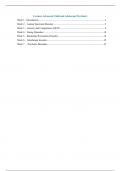
Lectures Advanced Child and Adolescent Psychiatry
Week 1 - Introduction ............................................................................................................ 2
Week 2 - Autism Spectrum Disorder .................................................................................... 3
Week 3 - Anxiety and Compulsions (OCD) ......................................................................... 6
Week 4 - Eating Disorders .................................................................................................. 10
Week 5 – Borderline Personality Disorder .......................................................................... 14
Week 6 - Attachment disorder............................................................................................. 19
Week 7 - Psychotic Disorders ............................................................................................ 23
, Week 1 - Introduction
Before the lectures → prepare by reading the literature and case study, make a summary of
the symptoms in different domains (emotional, cognitive, social, behavioural, family
context); consider primary and secondary symptoms.
Keep in mind: normal/typical development (cognitive, social, emotional) versus atypical
development. With atypical development, the most common disorders are learning disability
(e.g., dyslexia), speech-language disorders, intellectual disabilities, neurodevelopmental
disorders (e.g., ADHD, autism).
There are also complex disorders and comorbidity, like anxiety, depression, eating disorders,
attachment disorders, trauma, personality and psychotic disorders.
Clinical reasoning: the cognitive process that clinicians use to evaluate and diagnose
patients, involving decision-making. Why is this patient now referred to us with this request
for help? A case conceptualization, inventory of symptoms (biopsychosocial) and underlying
processes is made → with respect to developmental stage; emotional, cognitive, social,
behavioural, and family; protective and vulnerability factors; motivation and wish for change.
Factors that influence client outcome can be divided into four areas:
• Extra-therapeutic factors
• Expectancy effects
• Specific therapy techniques
• Common factors
Alliance and expectancies are active ingredients for treatments
Therapeutic alliance → interpersonal skills (verbal fluency, interpersonal perception,
affective modulation and expressiveness, warmth and acceptance, empathy, focus on other),
trust, being aware of the client’s age, characteristics, cultural background and context, adjust
therapy and be flexible, communicating hope and optimism, being aware of your own
psychological processes.
In this setting, working with parents and families, keep in mind that parents are competent
and experts about their child. The treatment team is expert on theoretical knowledge about the
disorder and treatment. The goal is not to cure but foster functioning and finding a new
balance for the child and family. Non-violent resistance (Chaim Omer): the parental
presence in the child’s mind, to reduce helplessness and gain authority by supporting parents.
, Week 2 - Autism Spectrum Disorder
DSM-5 categories ASD
Category A
1. Deficits in social and emotional reciprocity
2. Deficits in verbal communication behaviors that are used in social interaction
3. Deficits in the development of relationships, maintaining relationships and
understanding relationships
Category B
1. Stereotyped or repetitive motor movements, use of objects, or speech
2. Having a strict routine or ritualized patterns of behavior
3. Fixed interest that are abnormally intense or focused
4. Sensory input or unusual interest in sensory aspects of the environment lead to hyper-
or hypo reactivity
Category C
Symptoms must have been present in early development
Category D
Mentioned symptoms cause clinically significant impairment
Category E
Impairment cannot be better explained by other mental disorders or through global
developmental delay
Discussion topics → 3:1 (M:F) prevalence ratio
There is growing awareness of different phenotype of autism in males and females. But,
knowledge about the female phenotype is scarce.
Phenotype = observable characteristics of an individual. In autism, they are the behavioral
aspects. In research of ASD, it is male dominated.
Females with autism show deficits in different ways than males → more social interaction,
less face fixation compared to typically developing girls, camouflaging/masking (higher
social motivation), less externalizing behaviour, more internalizing issues.
Genetic and biological differences
To what extent are these behavioral differences consequences of genes? ASD is a
neurodevelopmental disorder, and biased towards males → female protective effect theory.
Epigenetics (influence of environment on expression of genes) are more important when
discussing the gene-environment interactions.
To what extent are these behavioral differences consequences of biological sex differences?
● Different patterns of connectivity in the brain
● Differences in visuospatial and language areas of brain
● Differences in motor brain areas
● Gray matter patterns in the motor cortex, supplementary motor area,
cerebellum, fusiform gyrus, and amygdala
● Girls with similar brain anatomy to boys showed similar deficits
Week 1 - Introduction ............................................................................................................ 2
Week 2 - Autism Spectrum Disorder .................................................................................... 3
Week 3 - Anxiety and Compulsions (OCD) ......................................................................... 6
Week 4 - Eating Disorders .................................................................................................. 10
Week 5 – Borderline Personality Disorder .......................................................................... 14
Week 6 - Attachment disorder............................................................................................. 19
Week 7 - Psychotic Disorders ............................................................................................ 23
, Week 1 - Introduction
Before the lectures → prepare by reading the literature and case study, make a summary of
the symptoms in different domains (emotional, cognitive, social, behavioural, family
context); consider primary and secondary symptoms.
Keep in mind: normal/typical development (cognitive, social, emotional) versus atypical
development. With atypical development, the most common disorders are learning disability
(e.g., dyslexia), speech-language disorders, intellectual disabilities, neurodevelopmental
disorders (e.g., ADHD, autism).
There are also complex disorders and comorbidity, like anxiety, depression, eating disorders,
attachment disorders, trauma, personality and psychotic disorders.
Clinical reasoning: the cognitive process that clinicians use to evaluate and diagnose
patients, involving decision-making. Why is this patient now referred to us with this request
for help? A case conceptualization, inventory of symptoms (biopsychosocial) and underlying
processes is made → with respect to developmental stage; emotional, cognitive, social,
behavioural, and family; protective and vulnerability factors; motivation and wish for change.
Factors that influence client outcome can be divided into four areas:
• Extra-therapeutic factors
• Expectancy effects
• Specific therapy techniques
• Common factors
Alliance and expectancies are active ingredients for treatments
Therapeutic alliance → interpersonal skills (verbal fluency, interpersonal perception,
affective modulation and expressiveness, warmth and acceptance, empathy, focus on other),
trust, being aware of the client’s age, characteristics, cultural background and context, adjust
therapy and be flexible, communicating hope and optimism, being aware of your own
psychological processes.
In this setting, working with parents and families, keep in mind that parents are competent
and experts about their child. The treatment team is expert on theoretical knowledge about the
disorder and treatment. The goal is not to cure but foster functioning and finding a new
balance for the child and family. Non-violent resistance (Chaim Omer): the parental
presence in the child’s mind, to reduce helplessness and gain authority by supporting parents.
, Week 2 - Autism Spectrum Disorder
DSM-5 categories ASD
Category A
1. Deficits in social and emotional reciprocity
2. Deficits in verbal communication behaviors that are used in social interaction
3. Deficits in the development of relationships, maintaining relationships and
understanding relationships
Category B
1. Stereotyped or repetitive motor movements, use of objects, or speech
2. Having a strict routine or ritualized patterns of behavior
3. Fixed interest that are abnormally intense or focused
4. Sensory input or unusual interest in sensory aspects of the environment lead to hyper-
or hypo reactivity
Category C
Symptoms must have been present in early development
Category D
Mentioned symptoms cause clinically significant impairment
Category E
Impairment cannot be better explained by other mental disorders or through global
developmental delay
Discussion topics → 3:1 (M:F) prevalence ratio
There is growing awareness of different phenotype of autism in males and females. But,
knowledge about the female phenotype is scarce.
Phenotype = observable characteristics of an individual. In autism, they are the behavioral
aspects. In research of ASD, it is male dominated.
Females with autism show deficits in different ways than males → more social interaction,
less face fixation compared to typically developing girls, camouflaging/masking (higher
social motivation), less externalizing behaviour, more internalizing issues.
Genetic and biological differences
To what extent are these behavioral differences consequences of genes? ASD is a
neurodevelopmental disorder, and biased towards males → female protective effect theory.
Epigenetics (influence of environment on expression of genes) are more important when
discussing the gene-environment interactions.
To what extent are these behavioral differences consequences of biological sex differences?
● Different patterns of connectivity in the brain
● Differences in visuospatial and language areas of brain
● Differences in motor brain areas
● Gray matter patterns in the motor cortex, supplementary motor area,
cerebellum, fusiform gyrus, and amygdala
● Girls with similar brain anatomy to boys showed similar deficits