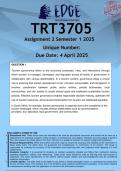
TRT3705
Assignment 2 Semester 1 2025
Unique #:
Due Date: 4 April 2025
Detailed solutions, explanations, workings
and references.
+27 81 278 3372
, QUESTION 1
Tourism governance refers to the structured processes, rules, and interactions
through which tourism is managed, developed, and regulated across all levels of
government in collaboration with various stakeholders. In a tourism context,
governance plays a crucial role in ensuring that tourism development is fair,
inclusive, accountable, and transparent. It involves coordination between public
sector entities, private businesses, local communities, and civil society to create
shared goals and implement sustainable tourism policies. Effective tourism
governance enables responsible decision-making, optimises the use of tourism
resources, and ensures that benefits from tourism are distributed equitably.
In South Africa, for example, tourism governance is essential due to the
complexity of the tourism landscape, which includes diverse stakeholders such as
accommodation providers, tour operators, local government, and communities.
The National Development Plan (NDP) recognises tourism as a key driver of
economic growth, making sound governance vital for maintaining competitiveness
and long-term sustainability. Governance mechanisms must be adaptable to
social, political, environmental, and technological changes. Without proper
governance, conflicts may arise, resources may be mismanaged, and
destinations may become unsustainable. Therefore, tourism governance is not
only about managing tourism effectively but also about fostering cooperation,
enhancing stakeholder trust, and achieving collective prosperity through
sustainable tourism practices.
QUESTION 2
Provincial governments in South Africa have a crucial role to play in the
development, regulation, and promotion of tourism within their jurisdictions. While
national government provides the overarching policy framework, provincial
governments are responsible for implementing these policies at a local level and
adapting them to suit the specific needs and conditions of their respective regions
(Unisa 2017). According to Schedule 6 of the South African Constitution, tourism
is a shared responsibility between national and provincial government, making
collaboration between the two levels of government essential (DEAT 1996).
Varsity Cube 2024 +27 81 278 3372
Assignment 2 Semester 1 2025
Unique #:
Due Date: 4 April 2025
Detailed solutions, explanations, workings
and references.
+27 81 278 3372
, QUESTION 1
Tourism governance refers to the structured processes, rules, and interactions
through which tourism is managed, developed, and regulated across all levels of
government in collaboration with various stakeholders. In a tourism context,
governance plays a crucial role in ensuring that tourism development is fair,
inclusive, accountable, and transparent. It involves coordination between public
sector entities, private businesses, local communities, and civil society to create
shared goals and implement sustainable tourism policies. Effective tourism
governance enables responsible decision-making, optimises the use of tourism
resources, and ensures that benefits from tourism are distributed equitably.
In South Africa, for example, tourism governance is essential due to the
complexity of the tourism landscape, which includes diverse stakeholders such as
accommodation providers, tour operators, local government, and communities.
The National Development Plan (NDP) recognises tourism as a key driver of
economic growth, making sound governance vital for maintaining competitiveness
and long-term sustainability. Governance mechanisms must be adaptable to
social, political, environmental, and technological changes. Without proper
governance, conflicts may arise, resources may be mismanaged, and
destinations may become unsustainable. Therefore, tourism governance is not
only about managing tourism effectively but also about fostering cooperation,
enhancing stakeholder trust, and achieving collective prosperity through
sustainable tourism practices.
QUESTION 2
Provincial governments in South Africa have a crucial role to play in the
development, regulation, and promotion of tourism within their jurisdictions. While
national government provides the overarching policy framework, provincial
governments are responsible for implementing these policies at a local level and
adapting them to suit the specific needs and conditions of their respective regions
(Unisa 2017). According to Schedule 6 of the South African Constitution, tourism
is a shared responsibility between national and provincial government, making
collaboration between the two levels of government essential (DEAT 1996).
Varsity Cube 2024 +27 81 278 3372