Lecture 20 – Max Weber
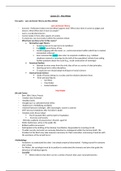
Two parts: - Law and Social Theory and Max Weber
Law and Social Theory
- Scenario - Parliament makes new law.What happens next? Effect clear when it comes to judges and
lawyers. What effect does it have on people?
- Law is a social phenomenon
- Cannot isolate it from other aspects of society
- To study law, we must study it within the societal context.
- What have we done so far in this course?
Normative Legal Theory:
Analysing law on its own terms (in isolation).
E.g kelson’s pure theory of law
Avoids engaging with the social, i.e., social environment within which law is created,
interpreted, enforced
Even someone like Austin who refers to empirical conditions (e.g., habitual
obedience towards a sovereign by the bulk of the population) refrains from asking
further questions about the social (e.g., social construction of sovereign)
American Realism
Attempt to move away from the strict idea of law as a series of rules/principles.
Opening up law to other disciplines.
To study law one should adopt techniques of social sciences
Classical Social Science:
Study of human beings in a society and the relations between them.
Three principal figures:
o Karl Marx
o Max Weber
o Emile Durkheim
Max Weber
Life and Career
- Born 1864, Erfurt, Prussia
- (modern day Germany)
- Wealthy family
- Brought up in a cultivated family milieu
- Studies law in Heidelberg and Berlin
- Married Marianne Schnitger, 1893 (sociologist, women’s activist)
- 1897-nervous breakdown after his father’s death
- Notable works (focus today)
The Protestant Ethic and the Spirit of Capitalism
Economy and Society
- 1920-dies suddenly of pneumonia in Munich, aged 56
- Public intellectual, active in the public life
- Brilliant political economist
- Participated in the drafting of the Weimar Constitution. Responsible for inserting Art.48:
- ‘If public security and order are seriously disturbed or endangered within the German Reich, the
President of the Reich may take measures necessary for their restoration, intervening if need be with
the assistance of the armed forces’
Methodology
- Verstehen: to understand the other (not simply empirical observation) Putting yourself in someone
else’s shoes
- For Weber, the sociologist must be in position to understand the interests and aims that guide the
behaviour of individual agents.
- Causality
Weber believes that there can be a variety of factors that cause social phenomena
Two parts: - Law and Social Theory and Max Weber
Law and Social Theory
- Scenario - Parliament makes new law.What happens next? Effect clear when it comes to judges and
lawyers. What effect does it have on people?
- Law is a social phenomenon
- Cannot isolate it from other aspects of society
- To study law, we must study it within the societal context.
- What have we done so far in this course?
Normative Legal Theory:
Analysing law on its own terms (in isolation).
E.g kelson’s pure theory of law
Avoids engaging with the social, i.e., social environment within which law is created,
interpreted, enforced
Even someone like Austin who refers to empirical conditions (e.g., habitual
obedience towards a sovereign by the bulk of the population) refrains from asking
further questions about the social (e.g., social construction of sovereign)
American Realism
Attempt to move away from the strict idea of law as a series of rules/principles.
Opening up law to other disciplines.
To study law one should adopt techniques of social sciences
Classical Social Science:
Study of human beings in a society and the relations between them.
Three principal figures:
o Karl Marx
o Max Weber
o Emile Durkheim
Max Weber
Life and Career
- Born 1864, Erfurt, Prussia
- (modern day Germany)
- Wealthy family
- Brought up in a cultivated family milieu
- Studies law in Heidelberg and Berlin
- Married Marianne Schnitger, 1893 (sociologist, women’s activist)
- 1897-nervous breakdown after his father’s death
- Notable works (focus today)
The Protestant Ethic and the Spirit of Capitalism
Economy and Society
- 1920-dies suddenly of pneumonia in Munich, aged 56
- Public intellectual, active in the public life
- Brilliant political economist
- Participated in the drafting of the Weimar Constitution. Responsible for inserting Art.48:
- ‘If public security and order are seriously disturbed or endangered within the German Reich, the
President of the Reich may take measures necessary for their restoration, intervening if need be with
the assistance of the armed forces’
Methodology
- Verstehen: to understand the other (not simply empirical observation) Putting yourself in someone
else’s shoes
- For Weber, the sociologist must be in position to understand the interests and aims that guide the
behaviour of individual agents.
- Causality
Weber believes that there can be a variety of factors that cause social phenomena