What is business?
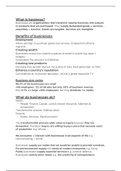
Businesses are organisations that transform inputs/resources into outputs
or products that are purchased. They supply demanded goods + services -
essentials + luxuries. Goods are tangible. Services are intangible.
Benefits of businesses
Employment
Allows earnings to purchase goods and services. Employment attracts
migrants.
Creating wealth
Businesses output has created surpluses invested in assets (eg roads +
bridges).
Corporation Tax amounts to £36billion.
Creating new products
Enriching lives eg GSK improve the quality of lives. Paxil generated +£7.5bn.
Enhance a country’s reputation
Can establish an innovative reputation. UK has a global reputation TV.
Business size varies
99.2% of UK businesses are small
<50 employees. 1/2 of UK jobs but only 33% of business revenue.
Only 0.1% are large +250 employees. But they dominate the media.
What do businesses do?
Inputs:
– People, Finance, Capital, Land & natural resources, Materials &
components
Transformation process (Adding value)
Outputs:
– Goods, Services, Waste products
The transformation process adds value to inputs because they are
demanded. Therefore buyers are willing to pay a price that exceeds costs
of production. E.g. iPhone ...
We encounter + interact with businesses in all aspects of life e.g.
communicating + online.
Businesses supply our needs that we would be unable to provide ourselves.
Private businesses supply the needs of modern economies e.g. flying.
Public businesses supply essential services e.g. national defence.
Businesses satisfy other needs e.g. the creativity of entrepreneurs.
,Employees make many decisions. Entrepreneurs make vital decisions to
turn ideas into a business.
Managers make influential decisions.
Types of businesses
Business to consumers - B2C firms. Businesses to business - B2B firms
e.g. Tata Steel.
Categorised into economy sectors:
Primary - agriculture, fishing, mining, oil and gas extraction
Secondary - manufacturing, construction and the supply of electricity, gas +
water
Tertiary - the supply of services e.g. catering, transport, education and health.
Some operate in all sectors e.g. BP
Primary - gas extraction
Secondary - processing
Tertiary - selling
The tertiary sector is increasing (e.g. GDP) because of rising incomes +
demands. While deindustrialisation has taken place because of foreign
competition.
Gross domestic product (GDP) measures the total value of the production of
an economy over a period of time, normally one year.
The relationship between mission and objectives
, Mission statements
Sets out what a firm is trying to achieve, that is, the reason it exists. It
focus on:
– Values
– Non financial goals
– Benefits to the community
– How consumers are satisfied
Everyone knows what they should do + actions should be directed towards
the same thing. This should make decision making easier: can compare
options to objectives. Mission statements can motivate - they know why
they are there + what the business is trying to achieve, giving a sense of
belonging + direction.
Some are unrealistic or PR exercises, so employees pay little attention to
them. Only valuable if everyone supports it. It can unite people + develop a
corporate spirit.
Mission statement examples:
– To bring inspiration and innovation to every athlete in the world (Nike)
– To make the world more open and connected (Facebook)
Businesses are organisations that transform inputs/resources into outputs
or products that are purchased. They supply demanded goods + services -
essentials + luxuries. Goods are tangible. Services are intangible.
Benefits of businesses
Employment
Allows earnings to purchase goods and services. Employment attracts
migrants.
Creating wealth
Businesses output has created surpluses invested in assets (eg roads +
bridges).
Corporation Tax amounts to £36billion.
Creating new products
Enriching lives eg GSK improve the quality of lives. Paxil generated +£7.5bn.
Enhance a country’s reputation
Can establish an innovative reputation. UK has a global reputation TV.
Business size varies
99.2% of UK businesses are small
<50 employees. 1/2 of UK jobs but only 33% of business revenue.
Only 0.1% are large +250 employees. But they dominate the media.
What do businesses do?
Inputs:
– People, Finance, Capital, Land & natural resources, Materials &
components
Transformation process (Adding value)
Outputs:
– Goods, Services, Waste products
The transformation process adds value to inputs because they are
demanded. Therefore buyers are willing to pay a price that exceeds costs
of production. E.g. iPhone ...
We encounter + interact with businesses in all aspects of life e.g.
communicating + online.
Businesses supply our needs that we would be unable to provide ourselves.
Private businesses supply the needs of modern economies e.g. flying.
Public businesses supply essential services e.g. national defence.
Businesses satisfy other needs e.g. the creativity of entrepreneurs.
,Employees make many decisions. Entrepreneurs make vital decisions to
turn ideas into a business.
Managers make influential decisions.
Types of businesses
Business to consumers - B2C firms. Businesses to business - B2B firms
e.g. Tata Steel.
Categorised into economy sectors:
Primary - agriculture, fishing, mining, oil and gas extraction
Secondary - manufacturing, construction and the supply of electricity, gas +
water
Tertiary - the supply of services e.g. catering, transport, education and health.
Some operate in all sectors e.g. BP
Primary - gas extraction
Secondary - processing
Tertiary - selling
The tertiary sector is increasing (e.g. GDP) because of rising incomes +
demands. While deindustrialisation has taken place because of foreign
competition.
Gross domestic product (GDP) measures the total value of the production of
an economy over a period of time, normally one year.
The relationship between mission and objectives
, Mission statements
Sets out what a firm is trying to achieve, that is, the reason it exists. It
focus on:
– Values
– Non financial goals
– Benefits to the community
– How consumers are satisfied
Everyone knows what they should do + actions should be directed towards
the same thing. This should make decision making easier: can compare
options to objectives. Mission statements can motivate - they know why
they are there + what the business is trying to achieve, giving a sense of
belonging + direction.
Some are unrealistic or PR exercises, so employees pay little attention to
them. Only valuable if everyone supports it. It can unite people + develop a
corporate spirit.
Mission statement examples:
– To bring inspiration and innovation to every athlete in the world (Nike)
– To make the world more open and connected (Facebook)