lOMoARcPSD|11232395
NR 324 ADULT HEALTH EXAM 3 STUDY GUIDE
Name:
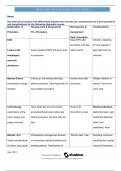
Describe the procedure and differentiate between the nursing care, assessment pre & post procedure
and complications for the following diagnostic exams.
Explanation of Nursing Care & Assessment Nursing Care & Complications
Procedure Pre- Procedure Assessment
Post- Procedure
EGD Keep NPO after Infection, bleeding.
procedure until gag Pt may aspirate if
Looks at the Instruct patients NPO 6-8 hours prior reflex returns gag reflex has not
esophagus, to procedure returned
stomach,
duodenum
Barium Enema Instruct pt. low residue diet days monitor stool after Allergic reaction to
examination of large before procedure. Clear liquid diet 24 procedure barium. Tear in the
intestine hours before procedure colon wall.
Colonoscopy Clear liquid diet 24 hours before observe for Bowel perforation,
examination of the procedure Bowel prep before day discomfort or pain abdominal pain, rigid
colon, biopsy and before procedure. No food with red board like abdomen
polyps removed dye. (hard, and
distended), fever.
Billroth I & II Preoperative management focuses Monitor labs, Vital Dumping syndrome
Treats complications on correcting nutritional deficits and resulting from partial
of ulcers, and cancer treating anemia. Transfusions of removal of stomach.
July 2021
Downloaded by Purity Kimani ()
, lOMoARcPSD|11232395
NR 324 ADULT HEALTH EXAM 3 STUDY GUIDE
packed RBCs correct the anemia. If Malnutrition
gastric outlet obstruction occurs,
gastric decompression may be
needed before surgery.
Hernia: describe the etiology, assessment findings, diagnostics & labs, nursing interventions,
nutrition, medications, & client teaching.
Etiology: Structural changes (weaken diaphragm muscles around the esophagogastric opening) occur with
aging. Factors that ↑ intraabdominal pressure predispose patients ( obesity, pregnancy, ascites, tumors,
intense physical exertion, heavy lifting on a continual basis.)
Seniors: incidence of hiatal hernia and GERD ↑ with age. Associated with weak diaphragm, obesity, kyphosis,
(wearing girdles). ↑ intraabdominal pressure. Seniors take drugs known to ↓ LES pressure (e.g., nitrates,
calcium channel blockers, antidepressants). NSAIDs and potassium, irritate the esophageal
mucosa↔ medication-induced esophagitis.
Hiatal Hernia - A portion of the stomach that goes thru an opening in the diaphragm, causing strangulation.
The most common abnormality found on x-ray of the upper GI tract.
Assessment findings: Asymptomatic or resemble GERD
Complications: Strangulation, GERD, esophagitis, hemorrhage, ulcerations
Diagnostics & labs: esophagram (barium swallow)
Management: similar to GERD, surgery
Understand the difference between sliding/rolling hernia. Which is a medical emergency and why?
Sliding: The junction of the stomach and esophagus is above the diaphragm, and a part of the stomach slides
through the hiatal opening in the diaphragm. This occurs when the patient is supine. The hernia usually goes
back into the abdominal cavity when the patient is standing upright. This is the most common type.
Paraesophageal or rolling: The fundus and greater curvature of the stomach roll up through the diaphragm,
forming a pocket alongside the esophagus. The esophagogastric junction stays in the normal position.
Acute paraesophageal hernia is a medical emergency.
Sliding Hernia Rolling Hernia
July 2021
Downloaded by Purity Kimani ()
NR 324 ADULT HEALTH EXAM 3 STUDY GUIDE
Name:
Describe the procedure and differentiate between the nursing care, assessment pre & post procedure
and complications for the following diagnostic exams.
Explanation of Nursing Care & Assessment Nursing Care & Complications
Procedure Pre- Procedure Assessment
Post- Procedure
EGD Keep NPO after Infection, bleeding.
procedure until gag Pt may aspirate if
Looks at the Instruct patients NPO 6-8 hours prior reflex returns gag reflex has not
esophagus, to procedure returned
stomach,
duodenum
Barium Enema Instruct pt. low residue diet days monitor stool after Allergic reaction to
examination of large before procedure. Clear liquid diet 24 procedure barium. Tear in the
intestine hours before procedure colon wall.
Colonoscopy Clear liquid diet 24 hours before observe for Bowel perforation,
examination of the procedure Bowel prep before day discomfort or pain abdominal pain, rigid
colon, biopsy and before procedure. No food with red board like abdomen
polyps removed dye. (hard, and
distended), fever.
Billroth I & II Preoperative management focuses Monitor labs, Vital Dumping syndrome
Treats complications on correcting nutritional deficits and resulting from partial
of ulcers, and cancer treating anemia. Transfusions of removal of stomach.
July 2021
Downloaded by Purity Kimani ()
, lOMoARcPSD|11232395
NR 324 ADULT HEALTH EXAM 3 STUDY GUIDE
packed RBCs correct the anemia. If Malnutrition
gastric outlet obstruction occurs,
gastric decompression may be
needed before surgery.
Hernia: describe the etiology, assessment findings, diagnostics & labs, nursing interventions,
nutrition, medications, & client teaching.
Etiology: Structural changes (weaken diaphragm muscles around the esophagogastric opening) occur with
aging. Factors that ↑ intraabdominal pressure predispose patients ( obesity, pregnancy, ascites, tumors,
intense physical exertion, heavy lifting on a continual basis.)
Seniors: incidence of hiatal hernia and GERD ↑ with age. Associated with weak diaphragm, obesity, kyphosis,
(wearing girdles). ↑ intraabdominal pressure. Seniors take drugs known to ↓ LES pressure (e.g., nitrates,
calcium channel blockers, antidepressants). NSAIDs and potassium, irritate the esophageal
mucosa↔ medication-induced esophagitis.
Hiatal Hernia - A portion of the stomach that goes thru an opening in the diaphragm, causing strangulation.
The most common abnormality found on x-ray of the upper GI tract.
Assessment findings: Asymptomatic or resemble GERD
Complications: Strangulation, GERD, esophagitis, hemorrhage, ulcerations
Diagnostics & labs: esophagram (barium swallow)
Management: similar to GERD, surgery
Understand the difference between sliding/rolling hernia. Which is a medical emergency and why?
Sliding: The junction of the stomach and esophagus is above the diaphragm, and a part of the stomach slides
through the hiatal opening in the diaphragm. This occurs when the patient is supine. The hernia usually goes
back into the abdominal cavity when the patient is standing upright. This is the most common type.
Paraesophageal or rolling: The fundus and greater curvature of the stomach roll up through the diaphragm,
forming a pocket alongside the esophagus. The esophagogastric junction stays in the normal position.
Acute paraesophageal hernia is a medical emergency.
Sliding Hernia Rolling Hernia
July 2021
Downloaded by Purity Kimani ()