

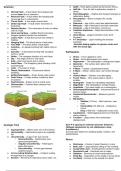
Structure ● Uplift – Rock layers pushed up by tectonic forces.
● Half-life – Time for half a radioactive sample to
● Normal Fault – A fault where the hanging wall decay.
moves down due to extension. ● Parent/Daughter – Original and decayed isotopes in
● Reverse Fault – A fault where the hanging wall radiometric dating.
moves up due to compression. ● Precambrian – Before complex life; mostly
● Thrust Fault – A low-angle reverse fault. microbes.
● Strike-slip Fault – A fault where movement is ● Paleozoic – Age of fish, early land plants/animals.
horizontal. ● Mesozoic – Age of dinosaurs and early mammals.
● Relative Motion – The movement of rocks on either ● Cenozoic – Age of mammals, current era.
side of a fault. ● Cambrian Explosion – Rapid diversification of life
● Horst and Graben – Uplifted (horst) and down- ~540 Ma.
dropped (graben) blocks from extension. ● Great Dying – Largest extinction event (end-
● Listric Fault – A fault that curves from steep to Permian).
shallow. ● K-T Boundary – Layer marking the dinosaur
● Hanging Wall – The block above a fault plane. extinction.
● Foot Wall – The block below a fault plane. Absolute dating applies to igneous rocks and
● Anticline – An upward-arching fold; oldest rocks in tells the actual age.
center.
● Syncline – A downward-arching fold; youngest Earthquakes
rocks in center.
● Strike – The compass direction of a rock layer. ● Stress – Force applied to rocks.
● Dip – The angle of tilt of a rock layer. ● Strain – Rock deformation from stress.
● Fold – Bent rock layers due to stress. ● Hypocenter – The earthquake’s underground origin.
● Axial Plane – The imaginary plane dividing a fold ● Epicenter – The surface point above the
symmetrically. hypocenter.
● Limb – The sides of a fold. ● P Wave – Fastest, compressional wave.
● Plastic Deformation – Rocks bend without ● S Wave – Slower, shear wave, can't travel through
breaking. liquid.
● Brittle Deformation – Rocks break under stress. ● Surface Wave – Slowest, most damaging.
● Fault Scarp – A steep surface created by fault ● Travel Times – Time waves take to reach a
movement. location.
● Fault Breccia – Broken rock at a fault zone. ● Nomogram – Graph for calculating magnitude.
● Slickensides – Polished fault surfaces from ● Magnitude – The earthquake’s energy release.
movement. ● Amplitude – The wave height on a seismogram.
● Seismograph/Seismogram – Instrument/record of
seismic waves.
● Geophone/Seismometer – Measures ground
motion.
● EQ Depths –
○ Shallow (<70 km) – Most common, near
crust.
○ Intermediate (70-300 km) – Subduction
zones.
○ Deep (>300 km) – Subduction zones only.
● Liquefaction – Waterlogged ground turns fluid-like
during shaking.
● Tsunami – Large waves from underwater
displacement.
Geologic Time (Use P-S spacing to estimate epicenter distance.)
(Mitigate liquefaction by soil stabilization, deep
● Superposition – Oldest rocks are on the bottom. foundations.)
● Horizontality – Sedimentary layers are originally Survival rates depend on building quality, location, and
flat. preparedness.
● Unconformity – A gap in the rock record:
○ Nonconformity – Sedimentary over Rivers
igneous/metamorphic.
○ Angular Unconformity – Tilted layers ● Discharge – Volume of water flowing in a river.
below flat layers. ● Bed Load – Large particles rolling on the riverbed.
○ Disconformity – A time gap between ● Suspended Load – Small particles carried in water.
sediment layers. ● Dissolved Load – Dissolved ions in water.
● Cross-cutting Relationships – A feature cutting ● Saltation – Bouncing of sand-sized particles.
through layers is younger. ● Point Bar – Deposition on the inside of a river bend.
● Erosion – Removal of material by wind, water, etc. ● Cut Bank – Erosion on the outside of a bend.
● Half-life – Time for half a radioactive sample to
● Normal Fault – A fault where the hanging wall decay.
moves down due to extension. ● Parent/Daughter – Original and decayed isotopes in
● Reverse Fault – A fault where the hanging wall radiometric dating.
moves up due to compression. ● Precambrian – Before complex life; mostly
● Thrust Fault – A low-angle reverse fault. microbes.
● Strike-slip Fault – A fault where movement is ● Paleozoic – Age of fish, early land plants/animals.
horizontal. ● Mesozoic – Age of dinosaurs and early mammals.
● Relative Motion – The movement of rocks on either ● Cenozoic – Age of mammals, current era.
side of a fault. ● Cambrian Explosion – Rapid diversification of life
● Horst and Graben – Uplifted (horst) and down- ~540 Ma.
dropped (graben) blocks from extension. ● Great Dying – Largest extinction event (end-
● Listric Fault – A fault that curves from steep to Permian).
shallow. ● K-T Boundary – Layer marking the dinosaur
● Hanging Wall – The block above a fault plane. extinction.
● Foot Wall – The block below a fault plane. Absolute dating applies to igneous rocks and
● Anticline – An upward-arching fold; oldest rocks in tells the actual age.
center.
● Syncline – A downward-arching fold; youngest Earthquakes
rocks in center.
● Strike – The compass direction of a rock layer. ● Stress – Force applied to rocks.
● Dip – The angle of tilt of a rock layer. ● Strain – Rock deformation from stress.
● Fold – Bent rock layers due to stress. ● Hypocenter – The earthquake’s underground origin.
● Axial Plane – The imaginary plane dividing a fold ● Epicenter – The surface point above the
symmetrically. hypocenter.
● Limb – The sides of a fold. ● P Wave – Fastest, compressional wave.
● Plastic Deformation – Rocks bend without ● S Wave – Slower, shear wave, can't travel through
breaking. liquid.
● Brittle Deformation – Rocks break under stress. ● Surface Wave – Slowest, most damaging.
● Fault Scarp – A steep surface created by fault ● Travel Times – Time waves take to reach a
movement. location.
● Fault Breccia – Broken rock at a fault zone. ● Nomogram – Graph for calculating magnitude.
● Slickensides – Polished fault surfaces from ● Magnitude – The earthquake’s energy release.
movement. ● Amplitude – The wave height on a seismogram.
● Seismograph/Seismogram – Instrument/record of
seismic waves.
● Geophone/Seismometer – Measures ground
motion.
● EQ Depths –
○ Shallow (<70 km) – Most common, near
crust.
○ Intermediate (70-300 km) – Subduction
zones.
○ Deep (>300 km) – Subduction zones only.
● Liquefaction – Waterlogged ground turns fluid-like
during shaking.
● Tsunami – Large waves from underwater
displacement.
Geologic Time (Use P-S spacing to estimate epicenter distance.)
(Mitigate liquefaction by soil stabilization, deep
● Superposition – Oldest rocks are on the bottom. foundations.)
● Horizontality – Sedimentary layers are originally Survival rates depend on building quality, location, and
flat. preparedness.
● Unconformity – A gap in the rock record:
○ Nonconformity – Sedimentary over Rivers
igneous/metamorphic.
○ Angular Unconformity – Tilted layers ● Discharge – Volume of water flowing in a river.
below flat layers. ● Bed Load – Large particles rolling on the riverbed.
○ Disconformity – A time gap between ● Suspended Load – Small particles carried in water.
sediment layers. ● Dissolved Load – Dissolved ions in water.
● Cross-cutting Relationships – A feature cutting ● Saltation – Bouncing of sand-sized particles.
through layers is younger. ● Point Bar – Deposition on the inside of a river bend.
● Erosion – Removal of material by wind, water, etc. ● Cut Bank – Erosion on the outside of a bend.


