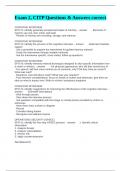
Exam 2, CITP Questions & Answers correct
COGNITIVE INTERVIEW
EPO #1: Identify generally accepted principles of memory. - answer · Elements of
memory are see, feel, smell, and taste
· Phases of memory are encoding, storage, and retrieval
COGNITIVE INTERVIEW
EPO #2: Identify the process of the cognitive interview. - answer · Build and maintain
rapport
· Use a preamble to prepare the interviewee for guided memory retrieval
· Guide the interviewee through multiple retrievals
· Ask the interviewee specific, close ended, follow up questions
COGNITIVE INTERVIEW
EPO #3: Identify memory retrieval techniques designed to elicit specific information from
a victim or witness. - answer · For physical appearance: who did they remind you of
· For speech: did their voice remind you of someone, why? Did they have an accent?
What was said?
· Reactions: how did others react? What was your reaction?
· Post interview considerations: focus on needs of victims and witnesses, give them an
idea on what to expect next. Refer to victims' assistance programs.
COGNITIVE INTERVIEW
EPO #4: Identify suggestions for improving the effectiveness of the cognitive interview. -
answer · Eliminate interruptions
· Wait through pauses
· Slow down the interview process
· Ask questions compatible with the image or mental picture provided by victims or
witnesses.
· Have them draw a photo or diagram
· Record
· Consider taking breaks
· Recognize and address trauma
OPERATIONS SECURITY (OPSEC)
EPO #1: Identify the five-step OPSEC process. - answer 1. Identify critical
information
2. Analyze threats
3. Analyze vulnerabilities
4. Assess risk
5. Apply countermeasures
INFORMANTS
, EPO #1: Identify informant sources available to the Federal law enforcement officer. -
answer · Subcategories of informants: anonymous informant, non-confidential
informant, and unwitting informant.
· Types of informants: criminal or criminal associate, professional informant, informant
within industry (gun store owner, financial industry), and private citizen.
INFORMANTS
EPO #2: Identify the elements of developing and controlling informants. - answer ·
Confidentiality and addressing motivations are important to encourage cooperation and
develop informants
· Know the elements of and avoid actions that could be entrapment
· Do not speculate on what the AUSA will do in exchange for cooperation or inflate
potential rewards/payments
· Avoid getting involved with their personal problems
· Otherwise Illegal Activity (OIA)
INFORMANTS
EPO #3: Identify methods of documenting informants and informant contacts. - answer
· Documenting is respective of agency policy and possibly category of informant.
· Maintain informant files as required
· Use Informant Agreements when needed
· Debrief informants and provide further instructions
· Terminate or deactivate informants when no longer needed or if deemed unacceptable
DOCUMENTATION / REPORT WRITING
EPO #1: Identify requirements and uses of law enforcement notes. - answer · Uses:
to aid in memory when preparing reports, to review during prosecution, or record
contacts and activities
· Requirements: original notes must be retained and not altered, any changes i.e.
incorrect date or misspelled word should be made as soon as possible after the event.
DOCUMENTATION / REPORT WRITING
EPO #2: Identify the uses and essential elements of narrative reports. - answer · Are
used to describe evidence of potential violations, not investigative techniques. Narrative
reports provide a basis for action and permanent record of investigative activity.
· Five essential elements:
1. Accurate: free of errors. Omit opinions, conclusions, and inferences.
2. Complete: All information that is relevant and material must be included. All evidence
should be included even if the writer does not think it will be admissible.
3. Concise: Information not related to 5 w's should be removed, omit prepositional
phrases, and write in active voice
4. Clear: use names instead of pronouns, concrete expressions instead of
approximations, use simple writing, and follow a logical order
Objective: fair, objective, impartial, unbiased, and unemotional.
DOCUMENTATION / REPORT WRITING
COGNITIVE INTERVIEW
EPO #1: Identify generally accepted principles of memory. - answer · Elements of
memory are see, feel, smell, and taste
· Phases of memory are encoding, storage, and retrieval
COGNITIVE INTERVIEW
EPO #2: Identify the process of the cognitive interview. - answer · Build and maintain
rapport
· Use a preamble to prepare the interviewee for guided memory retrieval
· Guide the interviewee through multiple retrievals
· Ask the interviewee specific, close ended, follow up questions
COGNITIVE INTERVIEW
EPO #3: Identify memory retrieval techniques designed to elicit specific information from
a victim or witness. - answer · For physical appearance: who did they remind you of
· For speech: did their voice remind you of someone, why? Did they have an accent?
What was said?
· Reactions: how did others react? What was your reaction?
· Post interview considerations: focus on needs of victims and witnesses, give them an
idea on what to expect next. Refer to victims' assistance programs.
COGNITIVE INTERVIEW
EPO #4: Identify suggestions for improving the effectiveness of the cognitive interview. -
answer · Eliminate interruptions
· Wait through pauses
· Slow down the interview process
· Ask questions compatible with the image or mental picture provided by victims or
witnesses.
· Have them draw a photo or diagram
· Record
· Consider taking breaks
· Recognize and address trauma
OPERATIONS SECURITY (OPSEC)
EPO #1: Identify the five-step OPSEC process. - answer 1. Identify critical
information
2. Analyze threats
3. Analyze vulnerabilities
4. Assess risk
5. Apply countermeasures
INFORMANTS
, EPO #1: Identify informant sources available to the Federal law enforcement officer. -
answer · Subcategories of informants: anonymous informant, non-confidential
informant, and unwitting informant.
· Types of informants: criminal or criminal associate, professional informant, informant
within industry (gun store owner, financial industry), and private citizen.
INFORMANTS
EPO #2: Identify the elements of developing and controlling informants. - answer ·
Confidentiality and addressing motivations are important to encourage cooperation and
develop informants
· Know the elements of and avoid actions that could be entrapment
· Do not speculate on what the AUSA will do in exchange for cooperation or inflate
potential rewards/payments
· Avoid getting involved with their personal problems
· Otherwise Illegal Activity (OIA)
INFORMANTS
EPO #3: Identify methods of documenting informants and informant contacts. - answer
· Documenting is respective of agency policy and possibly category of informant.
· Maintain informant files as required
· Use Informant Agreements when needed
· Debrief informants and provide further instructions
· Terminate or deactivate informants when no longer needed or if deemed unacceptable
DOCUMENTATION / REPORT WRITING
EPO #1: Identify requirements and uses of law enforcement notes. - answer · Uses:
to aid in memory when preparing reports, to review during prosecution, or record
contacts and activities
· Requirements: original notes must be retained and not altered, any changes i.e.
incorrect date or misspelled word should be made as soon as possible after the event.
DOCUMENTATION / REPORT WRITING
EPO #2: Identify the uses and essential elements of narrative reports. - answer · Are
used to describe evidence of potential violations, not investigative techniques. Narrative
reports provide a basis for action and permanent record of investigative activity.
· Five essential elements:
1. Accurate: free of errors. Omit opinions, conclusions, and inferences.
2. Complete: All information that is relevant and material must be included. All evidence
should be included even if the writer does not think it will be admissible.
3. Concise: Information not related to 5 w's should be removed, omit prepositional
phrases, and write in active voice
4. Clear: use names instead of pronouns, concrete expressions instead of
approximations, use simple writing, and follow a logical order
Objective: fair, objective, impartial, unbiased, and unemotional.
DOCUMENTATION / REPORT WRITING