
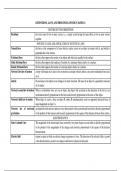
DEFINITIONS, LAWS, AND PRINCIPLES: PHYSICS (PAPER 1)
VECTORS IN TWO DIMENTIONS
Resultant the vector sum of two or more vectors, i.e., a single vector having the same effect as two or more vectors
together.
NEWTON’S LAWS AND APPLICATION OF NEWTON’S LAWS
Normal force the force or the component of a force which a surface exerts on an object in contact with it, and which is
perpendicular to the surface.
Frictional force the force that opposes the motion of an object and which acts parallel to the surface.
Static frictional force the force that opposes the tendency of motion of a stationary object relative to a surface.
Kinetic frictional force the force that opposes the motion of a moving object relative to a surface.
Newton's first law of motion a body will remain in its state of rest or motion at constant velocity unless a non-zero resultant/net force acts
on it.
Inertia the resistance of an object to any change in its state of motion. The mass of an object is a quantitative measure
of its inertia.
Newton's second law of motion When a resultant/net force acts on an object, the object will accelerate in the direction of the force at an
acceleration directly proportional to the force and inversely proportional to the mass of the object.
Newton's third law of motion When object A exerts a force on object B, object B simultaneously exerts an oppositely directed force of
equal magnitude on object A.
Newton's law of universal each particle in the universe attracts every other particle with a gravitational force that is directly proportional
gravitation to the product of their masses and inversely proportional to the square of the distance between their centres.
ELECTROSTATICS
State Coulomb's law The magnitude of the electrostatic force exerted by two point charges on each other is directly proportional
to the product of the magnitudes of the charges and inversely proportional to the square of the distance
between them.
Electric field region in space in which an electric charge experiences a force. The direction of the electric field at a point
is the direction that a positive test charge would move if placed at that point.
VECTORS IN TWO DIMENTIONS
Resultant the vector sum of two or more vectors, i.e., a single vector having the same effect as two or more vectors
together.
NEWTON’S LAWS AND APPLICATION OF NEWTON’S LAWS
Normal force the force or the component of a force which a surface exerts on an object in contact with it, and which is
perpendicular to the surface.
Frictional force the force that opposes the motion of an object and which acts parallel to the surface.
Static frictional force the force that opposes the tendency of motion of a stationary object relative to a surface.
Kinetic frictional force the force that opposes the motion of a moving object relative to a surface.
Newton's first law of motion a body will remain in its state of rest or motion at constant velocity unless a non-zero resultant/net force acts
on it.
Inertia the resistance of an object to any change in its state of motion. The mass of an object is a quantitative measure
of its inertia.
Newton's second law of motion When a resultant/net force acts on an object, the object will accelerate in the direction of the force at an
acceleration directly proportional to the force and inversely proportional to the mass of the object.
Newton's third law of motion When object A exerts a force on object B, object B simultaneously exerts an oppositely directed force of
equal magnitude on object A.
Newton's law of universal each particle in the universe attracts every other particle with a gravitational force that is directly proportional
gravitation to the product of their masses and inversely proportional to the square of the distance between their centres.
ELECTROSTATICS
State Coulomb's law The magnitude of the electrostatic force exerted by two point charges on each other is directly proportional
to the product of the magnitudes of the charges and inversely proportional to the square of the distance
between them.
Electric field region in space in which an electric charge experiences a force. The direction of the electric field at a point
is the direction that a positive test charge would move if placed at that point.


