Nutrition behaviour:
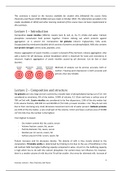
Lecture 1:
Why eat what we eat: psychology, sociology, nutrition/psychology, agriculture/economy
Emotional responses to food start early
Values of food: early days:
Maintenance of body
Emotion
Expression of societal issues and policies
Social meaning
Most meals in social contact
Engel’s law: proportion of income people spend on food decrease with increased income
Today; diet wars:
The problem with blaming food:
Consumers are bombarded with what (not) to eat
Mass hysteria drives internet traffic-clickbait stories about how the modern food
environment is killing us has the dual effect of:
Creating uncertainty and a lack of trust
Makes consumers feel powerless
Consumers; often confused about where food comes from
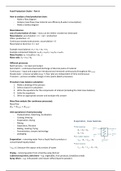
Acceptable macronutrient range:
Narrow steep peak with smaller tails for protein
Fat and carbs are broader
Protein intake is consistent
As gross domestic product increase, carbs go down slightly, and fat intake rises slightly. Protein
remains incredibly stable across earnings.
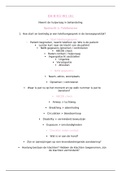
Psychological and physiological theories and of food intake:
Overview of theories:
-Early:
Externality: differential sensitivity> people with obesity less sensitive to hunger/satiation
Restraint
Boundary model: cognitive restraint fails (yoyo)
,-Later:
Dietary restraint
Disinhibition/ emotional eating
Sensitivity to hunger
Theory of planned behaviour
-Current:
Goal conflict theory of obesity
Reward deficit hypothesis
Bio-behavioural model
Carb-insulin/ energy balance
Theory of planned behaviour:
Behaviour is rational
No unconscious motives, desires
Behaviour is preceded by the intention to perform a behaviour
Intention to behave is determined by attitude, social norm, and perceived efficacy to realize
social behaviour.
Attitude, social norm and efficacy are determined by consideration of the advantages and
disadvantages.
Leads to intention-behaviour gap
Goal conflict theory:
Find balance control weight-consume food
2 incompatible goals: eating enjoyment and weight control
Chronic dieters fail in food-rich environment
Behavioural susceptibility hypothesis: Genetic susceptibility and environmental influences
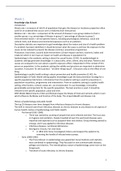
Lecture 2:
Eating behaviour is learned
Theory of energy balance:
1. Set-point theory
a. Short/long term regulation
2. Satiety cascade
Sensory stimulation> perception> evaluation> sensory satiation> variety
Sensory-energy conditioning:
Hunger> high energy intake> satiated> liking++
, Hunger> low energy intake> hunger> liking-
Hunger> seafood> sick> liking—
Hunger vs satiation:
People are more sensitive to deficiency of energy than a surplus of energy. We tolerate over-
consumption but correct hunger.
Set-point theory:
Body weight and adiposity are set. Body will return to setpoint. Setpoint is a range. Corrected
by changing appetite.
Leptin up when adiposity goes up (corrects energy intake).
Physiological vs cognitive setpoint
Set-point theory reduces role of food environment
Environmental factors initiate eating most of the time
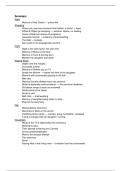
The satiety cascade:
Hunger> satiation> satiety> hunger>….
Food choice and intake are more strongly influenced by sensory and cognitive aspects
Satiation: experience of eating (measured by how much people eat)
Satiety: nutrient properties of food (measured with a fixed portion)
Fibre is also a high satiety food as well as protein
Aroma, taste and texture determine food choice. Liking and disliking is important drive to eat
Sensory specific satiety: appeal of food starts to decrease (biological stimulation for variety)
Vision and energy intake:
Volume
Variety
Familiarity
Unit bias:
The tendency to want to finish a given unit
Smell and energy intake:
You get hungry for that food when you smell that food
Taste and energy intake:
Umami, savoury> protein
Sweet> carbs, energy
Fat sensation> fat
Lecture 1:
Why eat what we eat: psychology, sociology, nutrition/psychology, agriculture/economy
Emotional responses to food start early
Values of food: early days:
Maintenance of body
Emotion
Expression of societal issues and policies
Social meaning
Most meals in social contact
Engel’s law: proportion of income people spend on food decrease with increased income
Today; diet wars:
The problem with blaming food:
Consumers are bombarded with what (not) to eat
Mass hysteria drives internet traffic-clickbait stories about how the modern food
environment is killing us has the dual effect of:
Creating uncertainty and a lack of trust
Makes consumers feel powerless
Consumers; often confused about where food comes from
Acceptable macronutrient range:
Narrow steep peak with smaller tails for protein
Fat and carbs are broader
Protein intake is consistent
As gross domestic product increase, carbs go down slightly, and fat intake rises slightly. Protein
remains incredibly stable across earnings.
Psychological and physiological theories and of food intake:
Overview of theories:
-Early:
Externality: differential sensitivity> people with obesity less sensitive to hunger/satiation
Restraint
Boundary model: cognitive restraint fails (yoyo)
,-Later:
Dietary restraint
Disinhibition/ emotional eating
Sensitivity to hunger
Theory of planned behaviour
-Current:
Goal conflict theory of obesity
Reward deficit hypothesis
Bio-behavioural model
Carb-insulin/ energy balance
Theory of planned behaviour:
Behaviour is rational
No unconscious motives, desires
Behaviour is preceded by the intention to perform a behaviour
Intention to behave is determined by attitude, social norm, and perceived efficacy to realize
social behaviour.
Attitude, social norm and efficacy are determined by consideration of the advantages and
disadvantages.
Leads to intention-behaviour gap
Goal conflict theory:
Find balance control weight-consume food
2 incompatible goals: eating enjoyment and weight control
Chronic dieters fail in food-rich environment
Behavioural susceptibility hypothesis: Genetic susceptibility and environmental influences
Lecture 2:
Eating behaviour is learned
Theory of energy balance:
1. Set-point theory
a. Short/long term regulation
2. Satiety cascade
Sensory stimulation> perception> evaluation> sensory satiation> variety
Sensory-energy conditioning:
Hunger> high energy intake> satiated> liking++
, Hunger> low energy intake> hunger> liking-
Hunger> seafood> sick> liking—
Hunger vs satiation:
People are more sensitive to deficiency of energy than a surplus of energy. We tolerate over-
consumption but correct hunger.
Set-point theory:
Body weight and adiposity are set. Body will return to setpoint. Setpoint is a range. Corrected
by changing appetite.
Leptin up when adiposity goes up (corrects energy intake).
Physiological vs cognitive setpoint
Set-point theory reduces role of food environment
Environmental factors initiate eating most of the time
The satiety cascade:
Hunger> satiation> satiety> hunger>….
Food choice and intake are more strongly influenced by sensory and cognitive aspects
Satiation: experience of eating (measured by how much people eat)
Satiety: nutrient properties of food (measured with a fixed portion)
Fibre is also a high satiety food as well as protein
Aroma, taste and texture determine food choice. Liking and disliking is important drive to eat
Sensory specific satiety: appeal of food starts to decrease (biological stimulation for variety)
Vision and energy intake:
Volume
Variety
Familiarity
Unit bias:
The tendency to want to finish a given unit
Smell and energy intake:
You get hungry for that food when you smell that food
Taste and energy intake:
Umami, savoury> protein
Sweet> carbs, energy
Fat sensation> fat