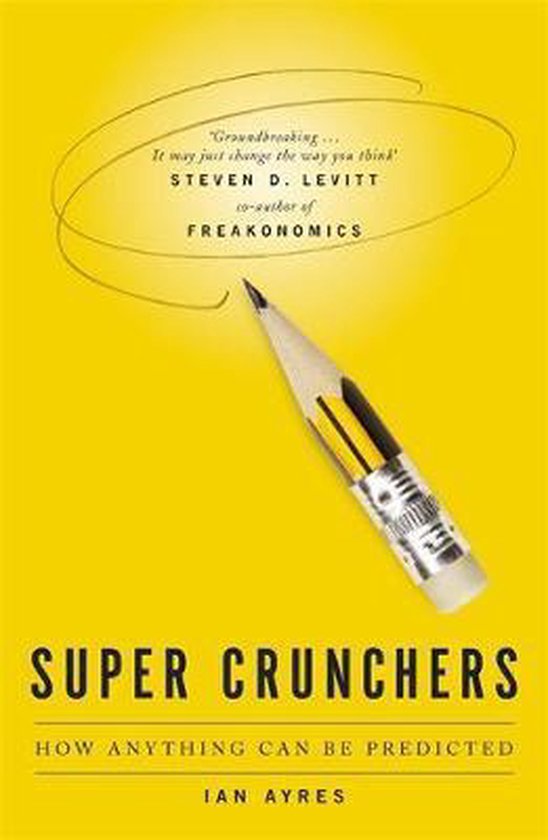
0HM270 – SuperCrunchers University of Technology, Eindhoven
Lecture 1: Introduction to SuperCrunchers
SuperCrunching is study of how quantitative analysis of social behaviour and natural
experiment can be creatively deployed to reveal insights in all areas of life, often in unexpected
ways. With examples such as predicting gestation period more precisely, predicting the box
office success of films, predicting the price of Bordeaux wine based on weather data, collecting
data on the effectiveness of teaching methods, choosing baseball players based on statistics
and A/B testing to determine the most effective advertisements, Ayres explains in his
SuperCrunchers-book how statistical evidence can be used as a supplement or substitute for
human intuition. The primary mathematical approaches that are often used here are common
multiple regression analyses. Thus, in summary supercrunching is using large datasets to
predict something that normally even experts cannot predict very well where the focus is
largely on the comparison of experts and models in a (natural) experimental setting.
A famous supercrunching example is that of the Cook County
hospital which is an emergency department in Chicago, Illinois
with over 250.000 patients per year of which many have no
health insurance, a lack of hospital rooms and a heavily
overworked staff. One of the most common health problems with
which new patients arrived at Cook County was acute chest pain
which is normally diagnosed using a large variety of symptomatic
measures (e.g. blood pressure, fluid in the lungs, pain location,
previous underlying conditions, cholesterol level, drug use, smoking, overweight, stress, etc.)
after which doctors categorized diagnoses into high risk, medium risk or no risk based on the
amount of symptoms present. The hospital’s new director, Brendan Reilly, found using a
quantitative statistical analysis performed by Goldman and colleagues that basically only 4 of
these symptoms truly matter (i.e. ECG, blood pressure, fluid in the lungs and an unstable angina)
as shown in the clinical prediction rule for major cardiac complications in chest pain patients
on the right (95% accuracy for the scheme compared to 82% accuracy for humans). Even though
it would seem as though such a prediction rule scheme would solve inaccurate diagnoses
leading to an under capacity at Cook County hospital, implementation was problematic as
physicians protested implementation and didn’t even agree with one another on their
diagnoses.
Similar prediction rule schemes like that for diagnosis cardiac complications have also shown
to surpass human prediction (albeit not always properly implemented in institutions), like
schemes for survival probability in medical procedures, probability of recidivism, probability of
success of a starting firm, choice of job candidates, diagnosing schizophrenia and predicting
school success. As can be concluded from the above, models often beat humans. This is partially
due to a variety of cognitive biases that characterize human thinking and decision-making,
including the following:
Page | 1
Lecture 1: Introduction to SuperCrunchers
SuperCrunching is study of how quantitative analysis of social behaviour and natural
experiment can be creatively deployed to reveal insights in all areas of life, often in unexpected
ways. With examples such as predicting gestation period more precisely, predicting the box
office success of films, predicting the price of Bordeaux wine based on weather data, collecting
data on the effectiveness of teaching methods, choosing baseball players based on statistics
and A/B testing to determine the most effective advertisements, Ayres explains in his
SuperCrunchers-book how statistical evidence can be used as a supplement or substitute for
human intuition. The primary mathematical approaches that are often used here are common
multiple regression analyses. Thus, in summary supercrunching is using large datasets to
predict something that normally even experts cannot predict very well where the focus is
largely on the comparison of experts and models in a (natural) experimental setting.
A famous supercrunching example is that of the Cook County
hospital which is an emergency department in Chicago, Illinois
with over 250.000 patients per year of which many have no
health insurance, a lack of hospital rooms and a heavily
overworked staff. One of the most common health problems with
which new patients arrived at Cook County was acute chest pain
which is normally diagnosed using a large variety of symptomatic
measures (e.g. blood pressure, fluid in the lungs, pain location,
previous underlying conditions, cholesterol level, drug use, smoking, overweight, stress, etc.)
after which doctors categorized diagnoses into high risk, medium risk or no risk based on the
amount of symptoms present. The hospital’s new director, Brendan Reilly, found using a
quantitative statistical analysis performed by Goldman and colleagues that basically only 4 of
these symptoms truly matter (i.e. ECG, blood pressure, fluid in the lungs and an unstable angina)
as shown in the clinical prediction rule for major cardiac complications in chest pain patients
on the right (95% accuracy for the scheme compared to 82% accuracy for humans). Even though
it would seem as though such a prediction rule scheme would solve inaccurate diagnoses
leading to an under capacity at Cook County hospital, implementation was problematic as
physicians protested implementation and didn’t even agree with one another on their
diagnoses.
Similar prediction rule schemes like that for diagnosis cardiac complications have also shown
to surpass human prediction (albeit not always properly implemented in institutions), like
schemes for survival probability in medical procedures, probability of recidivism, probability of
success of a starting firm, choice of job candidates, diagnosing schizophrenia and predicting
school success. As can be concluded from the above, models often beat humans. This is partially
due to a variety of cognitive biases that characterize human thinking and decision-making,
including the following:
Page | 1