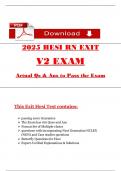
2025 HESI RN EXIT
V2 EXAM
Actual Qs & Ans to Pass the Exam
This Exit Hesi Test contains:
passing score Guarantee
The Exam has 160 Ques and Ans
Format Set of Multiple-choice
questions with incorporating Next Generation NCLEX
(NGN) and Case studies questions
Butterfly Questions for Hesi
Expert-Verified Explanations & Solutions
,1. **A 35-year-old client with sickle cell crisis is talking on the telephone
but stops as the nurse enters the room to request something for pain. The
nurse should:**
A) Administer a placebo
B) Encourage increased fluid intake
C) Administer the prescribed analgesia
D) Recommend relaxation exercises for pain control
**Answer:** C) Administer the prescribed analgesia
****Expert Explanation:**Sickle cell crisis causes severe pain;
therefore, timely administration of prescribed analgesia is crucial. It is the
most effective intervention to manage acute pain, while other options are
adjunctive and may not sufficiently address the immediate need for pain
relief.
2. **While caring for a toddler with croup, which initial sign of croup
requires the nurse's immediate attention?**
A) Respiratory rate of 42
B) Lethargy for the past hour
C) Apical pulse of 54
D) Coughing up copious secretions
**Answer:** A) Respiratory rate of 42
****Expert Explanation:**An increased respiratory rate can signal
respiratory distress in a toddler with croup. Early recognition of respiratory
changes and prompt intervention is critical in managing croup effectively to
prevent further complications.
3. **A client is admitted with low T3 and T4 levels and an elevated TSH
level. On initial assessment, the nurse would anticipate which of the
following assessment findings?**
A) Lethargy
, B) Heat intolerance
C) Diarrhea
D) Skin eruptions
**Answer:** A) Lethargy
****Expert Explanation:**Lethargy is a predominant symptom of
hypothyroidism associated with low T3 and T4 levels. Other symptoms
often include fatigue and cold intolerance, while heat intolerance and
diarrhea typically relate to hyperthyroidism.
4. **In planning care for a 6-month-old infant, what must the nurse
provide to assist in the development of trust?**
A) Food
B) Warmth
C) Security
D) Comfort
**Answer:** C) Security
****Expert Explanation:**Infants develop trust through consistent
and reliable caregiving that meets their needs. Among these, security—
representing the emotional and physical environment—plays a vital role in
developing trust. Infants who feel secure are more likely to trust their
caregivers and their surroundings.
5. **A nurse has just received a medication order which is not legible.
Which statement best reflects assertive communication?**
A) "I cannot give this medication as it is written. I have no idea of what
you mean."
B) "Would you please clarify what you have written so I am sure I am
reading it correctly?"
C) "I am having difficulty reading your handwriting. It would save me
time if you would be more careful."
D) "Please print in the future so I do not have to spend extra time
attempting to read your writing."
, **Answer:** B) "Would you please clarify what you have written so I am
sure I am reading it correctly?"
****Expert Explanation:**This response is assertive because it
requests clarification in a polite, professional manner without attributing
blame. It ensures that the nurse accurately understands the order to
administer medication safely.
6. **What is the most important consideration when teaching parents how
to reduce risks in the home?**
A) Age and knowledge level of the parents
B) Proximity to emergency services
C) Number of children in the home
D) Age of children in the home
**Answer:** D) Age of children in the home
****Expert Explanation:**The ages of children in the home dictate the
types of risks present and appropriate safety measures. Tailoring education
based on age ensures that parents can implement effective safety practices
relevant to their child’s developmental stage.
7. **The emergency room nurse admits a child who experienced a seizure at
school. The father comments that this is the first occurrence and denies any
family history of epilepsy. What is the best response by the nurse?**
A) "Do not worry. Epilepsy can be treated with medications."
B) "The seizure may or may not mean your child has epilepsy."
C) "Since this was the first convulsion, it may not happen again."
D) "Long-term treatment will prevent future seizures."
**Answer:** B) "The seizure may or may not mean your child has
epilepsy."
****Expert Explanation:**This response acknowledges the uncertainty
surrounding the seizure's significance while providing accurate
information. It is essential for the nurse to communicate the need for
further evaluation before drawing conclusions.
V2 EXAM
Actual Qs & Ans to Pass the Exam
This Exit Hesi Test contains:
passing score Guarantee
The Exam has 160 Ques and Ans
Format Set of Multiple-choice
questions with incorporating Next Generation NCLEX
(NGN) and Case studies questions
Butterfly Questions for Hesi
Expert-Verified Explanations & Solutions
,1. **A 35-year-old client with sickle cell crisis is talking on the telephone
but stops as the nurse enters the room to request something for pain. The
nurse should:**
A) Administer a placebo
B) Encourage increased fluid intake
C) Administer the prescribed analgesia
D) Recommend relaxation exercises for pain control
**Answer:** C) Administer the prescribed analgesia
****Expert Explanation:**Sickle cell crisis causes severe pain;
therefore, timely administration of prescribed analgesia is crucial. It is the
most effective intervention to manage acute pain, while other options are
adjunctive and may not sufficiently address the immediate need for pain
relief.
2. **While caring for a toddler with croup, which initial sign of croup
requires the nurse's immediate attention?**
A) Respiratory rate of 42
B) Lethargy for the past hour
C) Apical pulse of 54
D) Coughing up copious secretions
**Answer:** A) Respiratory rate of 42
****Expert Explanation:**An increased respiratory rate can signal
respiratory distress in a toddler with croup. Early recognition of respiratory
changes and prompt intervention is critical in managing croup effectively to
prevent further complications.
3. **A client is admitted with low T3 and T4 levels and an elevated TSH
level. On initial assessment, the nurse would anticipate which of the
following assessment findings?**
A) Lethargy
, B) Heat intolerance
C) Diarrhea
D) Skin eruptions
**Answer:** A) Lethargy
****Expert Explanation:**Lethargy is a predominant symptom of
hypothyroidism associated with low T3 and T4 levels. Other symptoms
often include fatigue and cold intolerance, while heat intolerance and
diarrhea typically relate to hyperthyroidism.
4. **In planning care for a 6-month-old infant, what must the nurse
provide to assist in the development of trust?**
A) Food
B) Warmth
C) Security
D) Comfort
**Answer:** C) Security
****Expert Explanation:**Infants develop trust through consistent
and reliable caregiving that meets their needs. Among these, security—
representing the emotional and physical environment—plays a vital role in
developing trust. Infants who feel secure are more likely to trust their
caregivers and their surroundings.
5. **A nurse has just received a medication order which is not legible.
Which statement best reflects assertive communication?**
A) "I cannot give this medication as it is written. I have no idea of what
you mean."
B) "Would you please clarify what you have written so I am sure I am
reading it correctly?"
C) "I am having difficulty reading your handwriting. It would save me
time if you would be more careful."
D) "Please print in the future so I do not have to spend extra time
attempting to read your writing."
, **Answer:** B) "Would you please clarify what you have written so I am
sure I am reading it correctly?"
****Expert Explanation:**This response is assertive because it
requests clarification in a polite, professional manner without attributing
blame. It ensures that the nurse accurately understands the order to
administer medication safely.
6. **What is the most important consideration when teaching parents how
to reduce risks in the home?**
A) Age and knowledge level of the parents
B) Proximity to emergency services
C) Number of children in the home
D) Age of children in the home
**Answer:** D) Age of children in the home
****Expert Explanation:**The ages of children in the home dictate the
types of risks present and appropriate safety measures. Tailoring education
based on age ensures that parents can implement effective safety practices
relevant to their child’s developmental stage.
7. **The emergency room nurse admits a child who experienced a seizure at
school. The father comments that this is the first occurrence and denies any
family history of epilepsy. What is the best response by the nurse?**
A) "Do not worry. Epilepsy can be treated with medications."
B) "The seizure may or may not mean your child has epilepsy."
C) "Since this was the first convulsion, it may not happen again."
D) "Long-term treatment will prevent future seizures."
**Answer:** B) "The seizure may or may not mean your child has
epilepsy."
****Expert Explanation:**This response acknowledges the uncertainty
surrounding the seizure's significance while providing accurate
information. It is essential for the nurse to communicate the need for
further evaluation before drawing conclusions.