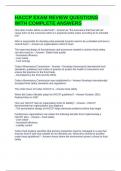
HACCP EXAM REVIEW QUESTIONS
WITH COMPLETE ANSWERS
How does Codex define a safe food? - Answer-as "the assurance that food will not
cause harm to the consumer when it is prepared and/or eaten according to its intended
use"
Who is responsible for deciding what potential hazards need to be controlled and how to
control them? - Answer-an organizations HACCP team
The improved design of food products and processes needed to achieve food safety
can also result in: - Answer-- Better food quality
- Increased efficiency
- Less waste
- Cost savings
Codex Alimentarius Commission - Answer-- Develops harmonized international food
standards, guidelines and codes of practice to protect the health of consumers and
ensure fair practices in the food trade.
- Developed by the FAO and the WHO
Codex Alimentarius Commission was established to - Answer-Develops internationally
accepted food safety standards and regulations.
The entire focus of Codex HACCP is - Answer-food safety
When did Codex officially adopt its HACCP guidelines? - Answer-October 1991;
finalized them in 1997
How can HACCP help an organization limits its liability? - Answer-- HACCP
demonstrated an organizations due diligence
- The preventative design of HACCP helps eliminate problems before they begin
Foodservice organizations can obtain the following benefits from implementing a
HACCP plan: - Answer-- Food safety
- Less waste
- Increased efficiency
- Liability control
Codex food hygiene specifies that primary production must be managed in a way that
ensures food is safe and suitable for its intended use. What ares should be avoided
under these guidelines? - Answer-Areas where the environment poses a threat to food
safety
, Agents that might contaminate air, soil, water, or foods during primary production must
be strictly controlled. These include, but are not limited to: - Answer-- Feedstuffs
- Fertilizers
- Pests
- Pesticides
- Veterinary drugs
What types of practices and measures must be adopted to ensure that food is produced
under appropriate hygienic conditions? - Answer-- Facilities and equipment should be
routinely cleaned and maintained
- Workers should maintain an appropriate degree of personal hygiene
- Harmful substances should be stored safely
- Waste materials should be disposed of properly
By implementing procedures to monitor food handling, storage, and transport, you can -
Answer-prevent food spoilage and deterioration by controlling time, temperature,
humidity, and other relevant factors
Which factors contribute to the deterioration and spoilage of food products? - Answer-
time, temperature, and humidity
The location, design, and construction of a foodservice facility can impact food safety.
Care must be taken to avoid possible contamination, including: - Answer-- Airborne
contamination
- Cross-contamination from surfaces and materials
Work surfaces, especially those that come in contact with food should be: - Answer--
Durable
- Non toxic
- Easy to maintain
- Clean
- Disinfect
Foodservice facilities should be design to control ___________, and have effective
protection against - Answer-temperature and humidity; pests
What can have an impact on food safety? - Answer-Facilities design, facilities location,
and construction materials
Production equipment be conveniently and logically located in an effort to: - Answer--
increase efficiency
- prevent foods from being handled more than necessary
- eliminate cross contamination
*appropriate positioning of equipment and the provision of sufficient cold storage are
critical
WITH COMPLETE ANSWERS
How does Codex define a safe food? - Answer-as "the assurance that food will not
cause harm to the consumer when it is prepared and/or eaten according to its intended
use"
Who is responsible for deciding what potential hazards need to be controlled and how to
control them? - Answer-an organizations HACCP team
The improved design of food products and processes needed to achieve food safety
can also result in: - Answer-- Better food quality
- Increased efficiency
- Less waste
- Cost savings
Codex Alimentarius Commission - Answer-- Develops harmonized international food
standards, guidelines and codes of practice to protect the health of consumers and
ensure fair practices in the food trade.
- Developed by the FAO and the WHO
Codex Alimentarius Commission was established to - Answer-Develops internationally
accepted food safety standards and regulations.
The entire focus of Codex HACCP is - Answer-food safety
When did Codex officially adopt its HACCP guidelines? - Answer-October 1991;
finalized them in 1997
How can HACCP help an organization limits its liability? - Answer-- HACCP
demonstrated an organizations due diligence
- The preventative design of HACCP helps eliminate problems before they begin
Foodservice organizations can obtain the following benefits from implementing a
HACCP plan: - Answer-- Food safety
- Less waste
- Increased efficiency
- Liability control
Codex food hygiene specifies that primary production must be managed in a way that
ensures food is safe and suitable for its intended use. What ares should be avoided
under these guidelines? - Answer-Areas where the environment poses a threat to food
safety
, Agents that might contaminate air, soil, water, or foods during primary production must
be strictly controlled. These include, but are not limited to: - Answer-- Feedstuffs
- Fertilizers
- Pests
- Pesticides
- Veterinary drugs
What types of practices and measures must be adopted to ensure that food is produced
under appropriate hygienic conditions? - Answer-- Facilities and equipment should be
routinely cleaned and maintained
- Workers should maintain an appropriate degree of personal hygiene
- Harmful substances should be stored safely
- Waste materials should be disposed of properly
By implementing procedures to monitor food handling, storage, and transport, you can -
Answer-prevent food spoilage and deterioration by controlling time, temperature,
humidity, and other relevant factors
Which factors contribute to the deterioration and spoilage of food products? - Answer-
time, temperature, and humidity
The location, design, and construction of a foodservice facility can impact food safety.
Care must be taken to avoid possible contamination, including: - Answer-- Airborne
contamination
- Cross-contamination from surfaces and materials
Work surfaces, especially those that come in contact with food should be: - Answer--
Durable
- Non toxic
- Easy to maintain
- Clean
- Disinfect
Foodservice facilities should be design to control ___________, and have effective
protection against - Answer-temperature and humidity; pests
What can have an impact on food safety? - Answer-Facilities design, facilities location,
and construction materials
Production equipment be conveniently and logically located in an effort to: - Answer--
increase efficiency
- prevent foods from being handled more than necessary
- eliminate cross contamination
*appropriate positioning of equipment and the provision of sufficient cold storage are
critical