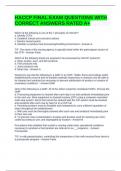
HACCP FINAL EXAM QUESTIONS WITH
CORRECT ANSWERS RATED A+
Which of the following is one of the 7 principles of HACCP?
a. Identify CCPs
b. Establish critical and corrective actions
c. Monitor hazard points
d. Maintain a sanitary food processing/handling environment - Answer-A
T/F: The name of the issuing agency is typically listed within the part/subpart section of
the CFR - Answer-False
Which of the following foods are required to be processed by HACCP systems?
a. Meat, poultry, juice, and fish products
b. Fish products only
c. Juice products only
d. Meat only - Answer-A
Would you say that the following is a GMP or an SOP: "Walls, floors and ceilings within
establishments must be built of durable materials impervious to moisture and be able to
be cleaned and sanitized as necessary to prevent adulteration of product or creation of
unsanitary conditions" - Answer-GMP
Only of the following is a GMP. All of the others would be considered SOPs. Choose the
GMP.
a. Processing equipment is cleaned after each day's run and sanitized immediately prior
to the next use. Most equipment is cleaned-in-place (CIP) using a computer-controlled
multi-step system. Items that cannot be cleaned with the CIP system must be cleaned
and sanitized after each use by hand or in a COP tub
b. Plumbing systems must be installed and maintained to carry sufficient quantities of
water throughout the establishment
c. Milk cans must be thoroughly cleaned after each use and sanitized immediately prior
to their next use
d. To prevent cross-contamination, brushes and buckets used for cleaning are color-
coded according to use, and segregated by location - Answer-B
Procedures that establish that a plant is running under basic operational conditions
necessary to produce a food product are referred to as __ programs. - Answer-
Prerequisite
T/F: In milk pasteurization, controlling the temperature of the milk received from farms is
a prerequisite program - Answer-False
, Which of the following are outcomes of FSMA signed by President Obama in 2011?
Select all outcomes
a. Preventive Controls for Human Food
b. Sanitation Performance Standards
c. Hazard Analysis and CCPs
d. Produce Safety Standards - Answer-A and D
Match the following industries with their CFR guidelines:
a. FSIS for meat and poultry
b. FDA for juice
c. FDA for seafood - Answer-a. 9 CFR 416
b. 21 CFR 120
c. 21 CFR 123
Written GMPs and SOPs are helpful because:
a. They serve as training documents
b. They control for hazards in the environment
c. They provide records and accountability in the case of an audit
d. A and B only
e. A and C only - Answer-E
Which is/are best described as dealing with broad issues such as building and
equipment design, employee hygiene, and pest control?
a. GMPs
b. SOPs
c. CCPs
d. LEMP - Answer-A
Which of the following are ways to control allergens through PRPs? Select one or more
a. Complete and accurate labeling
b. Preventing cross contact
c. Verification of suppliers via letters of guarantee or Certificates of Analysis
d. Careful planning and oversight of production order
e. Preventing cross contamination
f. Careful documentation of GMPs - Answer-A, B, C, D
Place each item into its appropriate column of regulating agency (FDA, Both, FSIS)
a. Each establishment must evaluate effectiveness of SOPs
b. Employee clothing and protective gear
c. Have a written SOP
d. Addresses sanitation conditions before, during, and after processing
e. Daily monitoring of compliance and implementation of SOPs
f. Requires both monitoring and corrective actions when standards are maintained
g. Specifically requires SOPs to address conditions like water quality and contact
surfaces
h. Does not explicitly state which areas are covered by SOP
CORRECT ANSWERS RATED A+
Which of the following is one of the 7 principles of HACCP?
a. Identify CCPs
b. Establish critical and corrective actions
c. Monitor hazard points
d. Maintain a sanitary food processing/handling environment - Answer-A
T/F: The name of the issuing agency is typically listed within the part/subpart section of
the CFR - Answer-False
Which of the following foods are required to be processed by HACCP systems?
a. Meat, poultry, juice, and fish products
b. Fish products only
c. Juice products only
d. Meat only - Answer-A
Would you say that the following is a GMP or an SOP: "Walls, floors and ceilings within
establishments must be built of durable materials impervious to moisture and be able to
be cleaned and sanitized as necessary to prevent adulteration of product or creation of
unsanitary conditions" - Answer-GMP
Only of the following is a GMP. All of the others would be considered SOPs. Choose the
GMP.
a. Processing equipment is cleaned after each day's run and sanitized immediately prior
to the next use. Most equipment is cleaned-in-place (CIP) using a computer-controlled
multi-step system. Items that cannot be cleaned with the CIP system must be cleaned
and sanitized after each use by hand or in a COP tub
b. Plumbing systems must be installed and maintained to carry sufficient quantities of
water throughout the establishment
c. Milk cans must be thoroughly cleaned after each use and sanitized immediately prior
to their next use
d. To prevent cross-contamination, brushes and buckets used for cleaning are color-
coded according to use, and segregated by location - Answer-B
Procedures that establish that a plant is running under basic operational conditions
necessary to produce a food product are referred to as __ programs. - Answer-
Prerequisite
T/F: In milk pasteurization, controlling the temperature of the milk received from farms is
a prerequisite program - Answer-False
, Which of the following are outcomes of FSMA signed by President Obama in 2011?
Select all outcomes
a. Preventive Controls for Human Food
b. Sanitation Performance Standards
c. Hazard Analysis and CCPs
d. Produce Safety Standards - Answer-A and D
Match the following industries with their CFR guidelines:
a. FSIS for meat and poultry
b. FDA for juice
c. FDA for seafood - Answer-a. 9 CFR 416
b. 21 CFR 120
c. 21 CFR 123
Written GMPs and SOPs are helpful because:
a. They serve as training documents
b. They control for hazards in the environment
c. They provide records and accountability in the case of an audit
d. A and B only
e. A and C only - Answer-E
Which is/are best described as dealing with broad issues such as building and
equipment design, employee hygiene, and pest control?
a. GMPs
b. SOPs
c. CCPs
d. LEMP - Answer-A
Which of the following are ways to control allergens through PRPs? Select one or more
a. Complete and accurate labeling
b. Preventing cross contact
c. Verification of suppliers via letters of guarantee or Certificates of Analysis
d. Careful planning and oversight of production order
e. Preventing cross contamination
f. Careful documentation of GMPs - Answer-A, B, C, D
Place each item into its appropriate column of regulating agency (FDA, Both, FSIS)
a. Each establishment must evaluate effectiveness of SOPs
b. Employee clothing and protective gear
c. Have a written SOP
d. Addresses sanitation conditions before, during, and after processing
e. Daily monitoring of compliance and implementation of SOPs
f. Requires both monitoring and corrective actions when standards are maintained
g. Specifically requires SOPs to address conditions like water quality and contact
surfaces
h. Does not explicitly state which areas are covered by SOP