Main Topics Notes
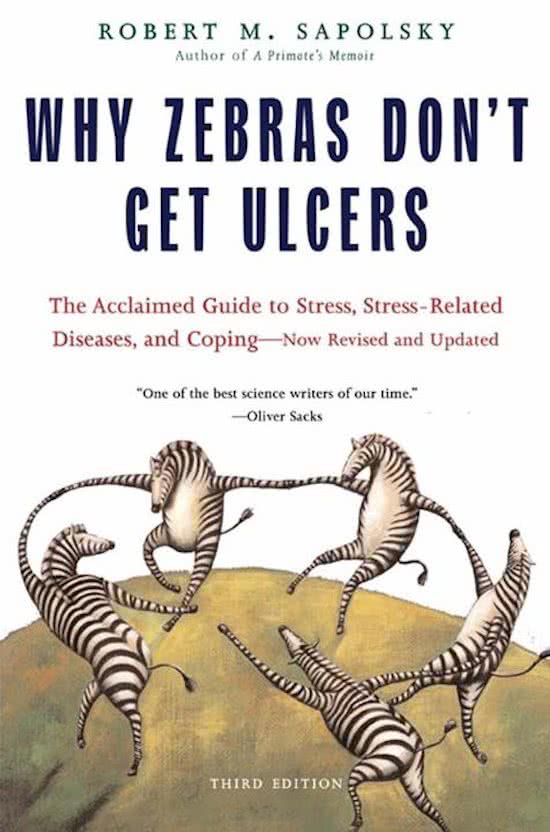
1. Why Don't Zebras Get - not so much about infectious diseases, or of malnutrition or hygiene
Ulcers? - we slowly fall apart: heart disease, cancer, immune, cerebrovascular; stress
- acute physical crises (zebras hurt by lions); chronic physical stress; psychological and
social disruptions (thoughts can equally race our body, disaster when chronic)
- body seeks homeostasis: optimal level of physiology
- stressor: what unbalances homeostasis; stress-response to reestablish it
- also anticipatory stress-response (can be protective, preparative; but if we cannot do
anything about it, may lead to anxiety, neurosis…)
- 1930s, Hans Selye: began stress physiology, chased rats around lab for injections,
even control groups had ulcers; 1) body has same stress response to varied stressors,
2) if stressors last too long, they may increase risk of disease that make you sick
allostasis - vs homeostasis (narrow changes for equal stability); 1) "constancy through change"
(stability varies across situations); 2) brain coordinates body-wide changes; 3) also in
anticipation to stressor
- rapid mobilization of glucose and protein from storage + inhibition of storage
- heart rate, blood pressure, breathing rate increase to deliver energy and oxygen
faster to muscles
- shuts down long-term projects (digestion, reproduction, growth, immunity, pain)
- cognitive and sensory shi s: better memory, sharper senses
- fight-or-flight syndrome, stages: 1. alarm → 2. adaptation/resistance → 3. exhaustion
(stress-response becomes + damaging than stressor itself if chronical): easy fatigue,
diabetes, cardiovascular problems, stress dwarfism, less sex drive, risk of infections
- costs of balancing the torrents of stress hormones (elephants on seesaw): loss of
potential energy, + wear and tear from the action of so many hormones (= allostatic
load), + it's delicate to try to balance hormones back w/ synchronicity
2. Glands, Gooseflesh &
Hormones
autonomic nervous system - projects to organs; relatively involuntary, but some control (eg. toilet training)
- sympathetic NS: branch out from spine to every organ, vessel, sweat gland;
mediates 4 F's behavior (flight, fight, fright and sex); release adrenaline (epinephrine, to
adrenal glands) and noradrenaline (norepinephrine, to all body)
- parasympathetic NS: rest & digest; growth, energy storage; does opposite to
sympathetic, same part in brain inhibits the other
brain - real master gland; neural route (autonomic NS) & hormones
- Guillemin and Schally competed in extracting, purifying, isolating the first brain
hormone (controls thyroid through pituitary) from slaughtered animals
- hypothalamus (releasing & inhibiting hormones) → pituitary → peripheral glands
hormones of - glucocorticoids: steroid hormones (androgens, mineralocorticoids, glucocorticoids,
stress-response estrogens, progestins); act slowly; together w/ epinephrine & norepinephrine (fast)
- CRH from brain (corticotropin releasing hormone) → triggers pituitary release
ACTH (corticotropin) → triggers adrenal gland release glucocorticoids
- pancreas release glucagon (w/ glucocorticoids, raise glucose in bloodstream)
- pituitary release prolactin: suppression of reproduction
- pituitary release antidiuretic hormone (cardiovascular stress-response)
- brain and pituitary release endorphins and enkephalins (blunt pain perception)
- secretion of various hormones also inhibited (reproductive, growth, energy storage)
- Taylor: it's ≠ for females: tend & befriend, oxytocin; BUT: both patterns of behaviors
complications happen in both sexes
- if glucocorticoids take so long, how are they useful in acute stress crises?
- timing, quantity, duration of hormones vary per type of stressor too
- stress = every possible threat to attainment of psychobiological goals
1. The ins and outs of the - stress response = negative <3 response to stressor, psychobiological in nature
mind's effects on the body - stress to health: ⅔ of doctor visits; increases risk for diseases, cardiovascular (CVD)
, routes stress→ disease 1- stress→ health behavior (indirect; smoke, alcohol, junk food); 2- psychobiological
effects (direct to disease); 3- lower cognitive capacities (→ health behavior)
- stressor → primary appraisal (automatic, unconscious) → acute stress response (~coping)
→ chronic stress response (secondary appraisal) → exhaustion
evolution - functional response to physical or psychol. thereat; psychological factors influence
via same biological route! (quantitatively ≠, but qualitatively =)
basal psychol. stress factors - dimensions: *adversity (threat), *uncontrollability & unpredictability (the core), *duration
- response patterns: defence (flight-or-flight, regain decreased control) & defeat
(conserve energy, withdraw, loss of control)
- stress response = exercise response + associated negative <3 (a quantitative ≠), only
qualitatively different when it persists → chronic peripheral cardiovascular resistance
- chronic stress is recent invention of mankind; (brief is functional, good)
- in humans: preparation (≠ exercise response) but no action! (outdated response)
stress vs. other risks factors - biological vulnerabilities: heritable, acquired phys. conditions, disease agents
- physical vulnerabilities: physical stressors (exposures, violence,
undernourishment..)
- psychol. vulnerabilities: psy. stressors (SES..), health cognitions, health behaviors
types of stressors - 10% of health problems can be explained by psychol. factors
- psychol. traumas (rape, death, humiliation); life events (+ or -); daily hassles (build up,
no control); chronic stressors, rumination (social, cogn. representations cause response)
modulators of response - mediator (part of the causal chain, B) vs modulator (affect by affecting mediator B)
- A (stressor) → B (psychophysiological response) → C (disease)
- social support: loneliness is stressor itself; <3 support, helping, health behaviors…
- outlet of frustration: in theory: 1- doesn't end threat; empirically: only if against the
source, retaliate (otherwise rehearses, increases anger)
- personality (hostility): threat biased, see threat everywhere, distrust, + CVD
13. Why is psychological - hormonal secretion is linear, proportionate to stress intensity; input-output model,
stress stressful? but not so simple: the physiological stress-response can be modulated and triggered
by psychological factors (eg. appraisal)
- outlets for frustration: distracts from stressor, psychologically positive
- social support: protective
- predictability: rat getting electric shocks hears warning bell → fewer ulcers; rat
getting the same amount of food in random times → up cortisol; predictive info lets
us choose the best coping strategy; → only in a midrange of frequencies and
intensities of stressors, and w/ certain lag times and levels of accurate info
- control: belief of having control rather than exercising it; low demand and low
control are worse than high demand and high control; except: inappropriately high
sense of control in awful events (could have avoided it?)
- perception of things worsening: perception of improving helps tremendously
- the optimal amount of loss of control and predictability is stimulation (happy)
15. Personality, - tells the difference between being threatened or not, taking initiative if threatened,
Temperament, & their telling the difference between winning or losing, outlets frustration → lower resting
stress-related glucocorticoids levels
consequences - lower cortisol for the ones more capable of forming friendships, social affiliation
psychiatric disorders - abnormal stress response. depressed: don't even attempt to mount a coping
response (hopelessness), overabundance of glucocorticoids (giving up)
- anxiety disorders: overestimate risks (cognitive distortions); constant mobilization
of stress-response for coping, overactivation of sympathetic NS, overabundance of
catecholamines; exaggerated startle response
- mild to severe stress enhances implicit, unconscious autonomic learning
- internal sensory input to amygdala biases it to decide for anxiety; uses CRH as
neurotransmitter to activate hypothalamus
- major traumatic stressor → disrupts hippocampus and enhances amygdala
Type A - competitive, overachieving, time-pressured (rampant insecurity), impatient, hostile
1. Why Don't Zebras Get - not so much about infectious diseases, or of malnutrition or hygiene
Ulcers? - we slowly fall apart: heart disease, cancer, immune, cerebrovascular; stress
- acute physical crises (zebras hurt by lions); chronic physical stress; psychological and
social disruptions (thoughts can equally race our body, disaster when chronic)
- body seeks homeostasis: optimal level of physiology
- stressor: what unbalances homeostasis; stress-response to reestablish it
- also anticipatory stress-response (can be protective, preparative; but if we cannot do
anything about it, may lead to anxiety, neurosis…)
- 1930s, Hans Selye: began stress physiology, chased rats around lab for injections,
even control groups had ulcers; 1) body has same stress response to varied stressors,
2) if stressors last too long, they may increase risk of disease that make you sick
allostasis - vs homeostasis (narrow changes for equal stability); 1) "constancy through change"
(stability varies across situations); 2) brain coordinates body-wide changes; 3) also in
anticipation to stressor
- rapid mobilization of glucose and protein from storage + inhibition of storage
- heart rate, blood pressure, breathing rate increase to deliver energy and oxygen
faster to muscles
- shuts down long-term projects (digestion, reproduction, growth, immunity, pain)
- cognitive and sensory shi s: better memory, sharper senses
- fight-or-flight syndrome, stages: 1. alarm → 2. adaptation/resistance → 3. exhaustion
(stress-response becomes + damaging than stressor itself if chronical): easy fatigue,
diabetes, cardiovascular problems, stress dwarfism, less sex drive, risk of infections
- costs of balancing the torrents of stress hormones (elephants on seesaw): loss of
potential energy, + wear and tear from the action of so many hormones (= allostatic
load), + it's delicate to try to balance hormones back w/ synchronicity
2. Glands, Gooseflesh &
Hormones
autonomic nervous system - projects to organs; relatively involuntary, but some control (eg. toilet training)
- sympathetic NS: branch out from spine to every organ, vessel, sweat gland;
mediates 4 F's behavior (flight, fight, fright and sex); release adrenaline (epinephrine, to
adrenal glands) and noradrenaline (norepinephrine, to all body)
- parasympathetic NS: rest & digest; growth, energy storage; does opposite to
sympathetic, same part in brain inhibits the other
brain - real master gland; neural route (autonomic NS) & hormones
- Guillemin and Schally competed in extracting, purifying, isolating the first brain
hormone (controls thyroid through pituitary) from slaughtered animals
- hypothalamus (releasing & inhibiting hormones) → pituitary → peripheral glands
hormones of - glucocorticoids: steroid hormones (androgens, mineralocorticoids, glucocorticoids,
stress-response estrogens, progestins); act slowly; together w/ epinephrine & norepinephrine (fast)
- CRH from brain (corticotropin releasing hormone) → triggers pituitary release
ACTH (corticotropin) → triggers adrenal gland release glucocorticoids
- pancreas release glucagon (w/ glucocorticoids, raise glucose in bloodstream)
- pituitary release prolactin: suppression of reproduction
- pituitary release antidiuretic hormone (cardiovascular stress-response)
- brain and pituitary release endorphins and enkephalins (blunt pain perception)
- secretion of various hormones also inhibited (reproductive, growth, energy storage)
- Taylor: it's ≠ for females: tend & befriend, oxytocin; BUT: both patterns of behaviors
complications happen in both sexes
- if glucocorticoids take so long, how are they useful in acute stress crises?
- timing, quantity, duration of hormones vary per type of stressor too
- stress = every possible threat to attainment of psychobiological goals
1. The ins and outs of the - stress response = negative <3 response to stressor, psychobiological in nature
mind's effects on the body - stress to health: ⅔ of doctor visits; increases risk for diseases, cardiovascular (CVD)
, routes stress→ disease 1- stress→ health behavior (indirect; smoke, alcohol, junk food); 2- psychobiological
effects (direct to disease); 3- lower cognitive capacities (→ health behavior)
- stressor → primary appraisal (automatic, unconscious) → acute stress response (~coping)
→ chronic stress response (secondary appraisal) → exhaustion
evolution - functional response to physical or psychol. thereat; psychological factors influence
via same biological route! (quantitatively ≠, but qualitatively =)
basal psychol. stress factors - dimensions: *adversity (threat), *uncontrollability & unpredictability (the core), *duration
- response patterns: defence (flight-or-flight, regain decreased control) & defeat
(conserve energy, withdraw, loss of control)
- stress response = exercise response + associated negative <3 (a quantitative ≠), only
qualitatively different when it persists → chronic peripheral cardiovascular resistance
- chronic stress is recent invention of mankind; (brief is functional, good)
- in humans: preparation (≠ exercise response) but no action! (outdated response)
stress vs. other risks factors - biological vulnerabilities: heritable, acquired phys. conditions, disease agents
- physical vulnerabilities: physical stressors (exposures, violence,
undernourishment..)
- psychol. vulnerabilities: psy. stressors (SES..), health cognitions, health behaviors
types of stressors - 10% of health problems can be explained by psychol. factors
- psychol. traumas (rape, death, humiliation); life events (+ or -); daily hassles (build up,
no control); chronic stressors, rumination (social, cogn. representations cause response)
modulators of response - mediator (part of the causal chain, B) vs modulator (affect by affecting mediator B)
- A (stressor) → B (psychophysiological response) → C (disease)
- social support: loneliness is stressor itself; <3 support, helping, health behaviors…
- outlet of frustration: in theory: 1- doesn't end threat; empirically: only if against the
source, retaliate (otherwise rehearses, increases anger)
- personality (hostility): threat biased, see threat everywhere, distrust, + CVD
13. Why is psychological - hormonal secretion is linear, proportionate to stress intensity; input-output model,
stress stressful? but not so simple: the physiological stress-response can be modulated and triggered
by psychological factors (eg. appraisal)
- outlets for frustration: distracts from stressor, psychologically positive
- social support: protective
- predictability: rat getting electric shocks hears warning bell → fewer ulcers; rat
getting the same amount of food in random times → up cortisol; predictive info lets
us choose the best coping strategy; → only in a midrange of frequencies and
intensities of stressors, and w/ certain lag times and levels of accurate info
- control: belief of having control rather than exercising it; low demand and low
control are worse than high demand and high control; except: inappropriately high
sense of control in awful events (could have avoided it?)
- perception of things worsening: perception of improving helps tremendously
- the optimal amount of loss of control and predictability is stimulation (happy)
15. Personality, - tells the difference between being threatened or not, taking initiative if threatened,
Temperament, & their telling the difference between winning or losing, outlets frustration → lower resting
stress-related glucocorticoids levels
consequences - lower cortisol for the ones more capable of forming friendships, social affiliation
psychiatric disorders - abnormal stress response. depressed: don't even attempt to mount a coping
response (hopelessness), overabundance of glucocorticoids (giving up)
- anxiety disorders: overestimate risks (cognitive distortions); constant mobilization
of stress-response for coping, overactivation of sympathetic NS, overabundance of
catecholamines; exaggerated startle response
- mild to severe stress enhances implicit, unconscious autonomic learning
- internal sensory input to amygdala biases it to decide for anxiety; uses CRH as
neurotransmitter to activate hypothalamus
- major traumatic stressor → disrupts hippocampus and enhances amygdala
Type A - competitive, overachieving, time-pressured (rampant insecurity), impatient, hostile