100% satisfaction guarantee Immediately available after payment Both online and in PDF No strings attached 4.2 TrustPilot
logo-home
Exam (elaborations)

DOT Medical Examiner Review Questions and Complete Solutions Graded A+

Rating
-
Sold
-
Pages
10
Grade
A+
Uploaded on
15-03-2025
Written in
2024/2025

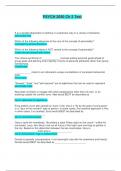
  To promote the safety of America's roadways through the promulgation and implementation of medical regulations, guidelines and policies that ensure commercial motor vehicle drivers engaged in interstate commerce are physically qualified to do so. Whose mission is this? - Answer: The mission of the Office of Medical Programs To improve highway safety by producing trained, certified medical examiners who can effectively determine if a commercial motor vehicle driver's health meets Federal Motor Carrier Safety Administration Standards. Whose mission is this? - Answer: National Registry of Certified Medical Examiners Who can be a medical examiner? - Answer: PAs, NPs, physicians and chiropractors. T/F...When a driver returns from an illness or injury that interferes with driving ability, the driver must undergo a medical examination if the medical examiner's certificate has not expired - Answer: True What is title 49? - Answer: Transportation What is part 391? - Answer: Qualifications of Drivers and Longer Combination Vehicle What is subpart E of Part 391? - Answer: Physical Qualifications and Examninations What are the four non-discretionary (disqualifying) standards? - Answer: 1. Vision 2. Hearing 3. Epilepsy 4. Diabetes Mellitus What is 49 CFR 391.41? - Answer: Describes the physical qualification requirements for drivers. The 13 standards are used to determine medical fitness for duty. (9 discretionary and 4 non-discretionary) What is 49 CFR 391.49? - Answer: Describes the skill performance evaluation certification program, which is an alternative physical qualification standard for the driver with a fixed musculoskeletal deficit of an extremity who cannot physically qualify to drive under 391.41 (b)(1) or (b)(2). What is 49 CFR 391.62? - Answer: Describes limited exemptions for intra-city zone drivers. What is 49 CFR 391.64? - Answer: Describes grandfathering for certain drivers who participated in vision and diabetes waiver study programs. What is an exemption? - Answer: An exemption provides temporary relief from one or more of the FMCSRs for commercial drivers. Relief from a regulation is for 2 years and may be renewed. Currently the FMSCA has two medical Driver Exemption Programs. What are they? - Answer: 1. Federal Vision Exemption Program (1998) 2. Diabetes Exemption Program (September 2003) T/F The medical examiner cannot issue an exemption - Answer: True T/F Both federal exemptions require the driver to have an annual medical examination for maintenance and renewal of the exemption. - Answer: True What is 49 CFR 391.43? - Answer: Certificate of physical examination. Describes your responsibilities as a FMCSA medical examiner. What is the purpose of Interstate Commercial Driver Physical Examination? - Answer: As a medical examiner, your fundamental obligation is to establish whether a driver has a disease, disorder, or injury resulting in a higher than acceptable likelihood for gradual or sudden incapacitation or sudden death, thus endangering public safety. When conducting a physical examination to determine if the driver is medically fit to perform the job of commercial driving, you must consider what 3 things? - Answer: 1. Physical condition 2. Mental condition 3. Medical treatment How do you distinguish between medical standards (49 CFR 391.41) and medical guidelines? - Answer: Regulations/standards are laws and must be followed. Whereas guidelines, such as advisory criteria and medical conference reports are recommendations. T/F A complete physical examination is required for new certification and recertification - Answer: True If a driver is on dialysis can they be certified? - Answer: No What is the maximum amount of time you can certify a driver? - Answer: 2 years How long do you retain the driver medical records for? - Answer: 3 years What is 49 CFR 391.41 (b) (10)? - Answer: Vision What qualifies for vision? - Answer: Has distant visual acuity of at least 20/40 (Snellen) in each eye without corrective lenses or visual acuity separately corrected to 20/40 (Snellen) or better with corrective lenses, distant binocular acuity of at least 20/40 (Snellen) in both eyes with or without corrective lenses, field of vision of at least 70 degrees in the horizontal median in each eye, and the ability to recognize the colors of traffic signals and devices showing standard red, green, and amber. T/F Monocular vision is disqualifying - Answer: True What is the requirement for central distant visual acuity and distant binocular visual acuity? - Answer: At least 20/40 in each eye What is the requirement for peripheral vision? - Answer: At least 70 degrees in the horizontal meridian for each eye What is the color vision requirement? - Answer: Ability to recognize and distinguish among red, amber and green. *True color perception is not required* What eye conditions should you refer? - Answer: 1. Cataracts 2. Glaucoma 3. Macular degeneration 4. Retinopathy What is a early symptom of cataracts? - Answer: Glare, particularly during night driving in the face of oncoming headlights. Glare, diminished overall acuity, contrast, and color resolution are compounded by the light scattering effect of the cataracts. T/F Glaucoma can cause deficits in peripheral vison - Answer: True.....Snellen acuity test results may not be affected, but peripheral field test results may show deficits T/F Visual loss caused by glaucoma cannot be restored - Answer: True T/F Antiglaucoma agents may have side effects that impact vision and interfere with safe driving. - Answer: True What condition is a leading cause of untreatable legal blindness in the US? - Answer: Macular degeneration How is vision affected in Macular degeneration? - Answer: May cause rapid loss of central vision. Peripheral vision is generally spared. Medical guidelines for the driver with diabetes mellitus - Answer: 1. Annual medical examination 2. Annual ophthalmologist or optometrist eye evaluation 3. Disqualification for a diagnosis of unstable proliferative retinopathy. The driver with monocular vision who is otherwise qualified may want to apply for a Federal vision exemption. - Answer: IF a driver presents a valid vision exemption and a copy of the specialist eye examination report, how long can you certify for? - Answer: 1 year What are the provisions included in the vision exemption? - Answer: 1. Annual medical examination 2. Eye exam by an ophthalmologist or an optometrist What are the hearing requirements? - Answer: 1. Perceive a forced whispered voice, in one ear, at not less than five feet. 2. Have an average hearing loss, in one ear, less than or equal to 40 decibels. *Disqualify when both the forced whisper test AND the audiometric test are failed T/F Uncontrolled vertigo is disqualifying - Answer: True....The driver may be certified after completing at least 2 months symptom free with a diagnosis of: BPPV, acute and chronic peripheral vestibulopathy T/F Insulin is a disqualifier - Answer: True T/F FMCSA believes that 1 year maximum certification time is reasonable when the driver has a diagnosis of diabetes - Answer: True T/F Incretin mimetics such as exenatide (Byetta) are not insulin and can be used without an exemption - Answer: True Maximum certification with incretins? - Answer: 1 year T/F The driver with a diabetes exemption must carry a source of rapidly absorbable glucose while driving - Answer: True Waiting period for a driver with diabetes that was previously diagnosed and on treatment that did not include the use of insulin - Answer: 1 month Waiting period for a driver with diabetes that is newly diagnosed and was not on prior treatment - Answer: 2 months What blood glucose level is generally considered safe for commercial driving? - Answer: 100 mg/dl-400mg/dl Maximum certification for oral hypoglycemics - Answer: 1 year T/F The driver with a diabetes exemption must carry a source of rapidly absorbable glucose while driving - Answer: True What is 49 CFR 391.43? - Answer: Blood Pressure An individual diagnosed with Stage 1 HTN (140/90-159/99) maybe certified for how long? - Answer: 1 year A driver with Stage 1 HTN at recertification has a BP equal to or less than 140/90 maybe certified for how long? If there BP is >140/90 but <160/100 how long can you certify? - Answer: 1 year and 3 months An individual diagnosed with Stage 2 HTN (160/100-179/109) should be certified for how long? - Answer: one-time certificate for 3-months. *Once the driver has reduced their BP to equal to or less than 140/90, he or she may be recertified annually thereafter. An individual with Stage 3 HTN (>180/100) should be certified for how long? - Answer: Should not be certified until his or her BP is reduced to 140/90 or less, and may be recertified every 6 months. Waiting period for secondary HTN post-surgical correction? - Answer: 3 months....Maximum certification period 1 year What workload capacity should a driver have? - Answer: >6 METs on exercise tolerance test Heavy and very heavy work requires greater than 6 METs and includes carrying heavy objects and climbing stairs rapidly - Answer: Maximum certification for AAA - Answer: 1 year Waiting period for driver started on anti-coagulation? - Answer: 1 month stabilized Intermittent claudication waiting period for post-surgical repair? - Answer: 3 months........*Maximum certification 1 year* If the driver has intermittent claudication with pain at rest should they be certified? - Answer: No Driver has active PE can they be certified? - Answer: NO...they have to wait 3 months with no PE and then can be certified for 1 year If the driver has an ICD can they be certified? - Answer: Recommend not to certify If the driver has a newly placed pacemaker is there a waiting period to certify them? - Answer: Yes...they have to wait one month post-implantation if underlying disease is sinus node dysfunction and AV Block....3 months if it is due to neurocardiogenic syncope and hypersensitive carotid sinus with syncope Post-CABG surgery waiting period - Answer: Minimum - 3 months regardless of type of CABG surgery performed Post-CABG maximum certification period - Answer: 1 year T/F The driver who is post-CABG must have stress test annually after 5 years of CABG - Answer: True Post-percutaneous coronary intervention waiting period - Answer: Minimum 1 week Initial certification of Post-percutaneous coronary intervention - Answer: Up to 6 months...Recertify up to 1 year if ETT results are satisfactory T/F A driver with post-PCI should have a ETT 3-6 months post PCI following initial certification and bring results to a 6 month follow-up examination - Answer: True Minimum waiting period post heart transplant - Answer: 1 year post transplant.....*max certification period is 6 months* Can you certify a driver with hypertrophic cardiomyopathy? - Answer: Recommend not to certify Maximum certification period for driver with mild aortic regurgitation - Answer: 1 year Waiting period of certification for sleep apnea - Answer: 1. 1 month after starting CPAP 2. 3 months symptom free after surgical treatment Maximum certification for OSA - Answer: 1 year T/F Medications used to treat respiratory tract congestion, such as prescriptions and/or over-the-counter antihistamines or narcotic antitussives, can cause drowsiness and loss of attention. You should educate the driver to refrain from operating a vehicle for at least 12 hours after taking a medication with sedating side effects. - Answer: True T/F If FEV1 < 65% of that predicted, ABG measurements should be evaluated - Answer: True What four specific urinalysis tests results are required for driver physical examination? - Answer: 1. Specific gravity 2. Protein 3. Blood 4. Glucose Can a driver with epilepsy be certified? - Answer: No..Disqualify When can someone with epilepsy be certified? - Answer: If they are off ant-seizure medication and seizure free for 10 years T/F The use of either benzodiazepines or phenothiazines for the treatment of vertigo would render the driver medically unqualified - Answer: True Recommend not to certify if driver has a diagnosis of dementia - Answer: T/F Recommend not certifying driver if they use a first generation antidepressant - Answer: True Waiting period for a driver following a severe depressive episode, a suicide attempt, or a manic episode - Answer: 1 year Waiting period for a driver following a nonpsychotic major depression unaccompanied by suicidal behavior - Answer: 6 months Can a driver be certified with a diagnosis of schizophrenia - Answer: No Before qualifying a driver with ADHD who is using a CNS stimulant what must you consider? - Answer: 1. Request evaluation from the treating provider 2. Verify the diagnosis of adult ADHD 3. Use caution when determining the side effects of medication If a driver undergoes ECT for depression how long should they be symptom free before obtaining certification? - Answer: 6 months

Show more Read less
Institution
NRCME DOT
Course
NRCME DOT


Whoops! We can’t load your doc right now. Try again or contact support.

Written for

Institution
NRCME DOT
Course
NRCME DOT

Document information

Uploaded on
March 15, 2025
Number of pages
10
Written in
2024/2025
Type
Exam (elaborations)
Contains
Questions & answers

Subjects

Content preview

DOT MEDICAL EXAMINER
REVIEW QUESTIONS AND
COMPLETE SOLUTIONS GRADED
A+


Your Exam Plug


, To promote the safety of America's roadways through the promulgation and implementation of medical
regulations, guidelines and policies that ensure commercial motor vehicle drivers engaged in interstate
commerce are physically qualified to do so. Whose mission is this? - Answer: The mission of the Office of
Medical Programs


To improve highway safety by producing trained, certified medical examiners who can effectively
determine if a commercial motor vehicle driver's health meets Federal Motor Carrier Safety
Administration Standards. Whose mission is this? - Answer: National Registry of Certified Medical
Examiners


Who can be a medical examiner? - Answer: PAs, NPs, physicians and chiropractors.


T/F...When a driver returns from an illness or injury that interferes with driving ability, the driver must
undergo a medical examination if the medical examiner's certificate has not expired - Answer: True


What is title 49? - Answer: Transportation


What is part 391? - Answer: Qualifications of Drivers and Longer Combination Vehicle


What is subpart E of Part 391? - Answer: Physical Qualifications and Examninations


What are the four non-discretionary (disqualifying) standards? - Answer: 1. Vision

2. Hearing

3. Epilepsy

4. Diabetes Mellitus


What is 49 CFR 391.41? - Answer: Describes the physical qualification requirements for drivers. The 13
standards are used to determine medical fitness for duty. (9 discretionary and 4 non-discretionary)


What is 49 CFR 391.49? - Answer: Describes the skill performance evaluation certification program,
which is an alternative physical qualification standard for the driver with a fixed musculoskeletal deficit
of an extremity who cannot physically qualify to drive under 391.41 (b)(1) or (b)(2).

Get to know the seller

Seller avatar
Reputation scores are based on the amount of documents a seller has sold for a fee and the reviews they have received for those documents. There are three levels: Bronze, Silver and Gold. The better the reputation, the more your can rely on the quality of the sellers work.
YourExamplug Grand Canyon University
View profile
Follow You need to be logged in order to follow users or courses
Sold
173
Member since
1 year
Number of followers
26
Documents
14388
Last sold
1 day ago
Your Exm Plug

Assignments, Case Studies, Research, Essay writing service, Questions and Answers, Discussions etc. for students who want to see results twice as fast. I have done papers of various topics and complexities. I am punctual and always submit work on-deadline. I write engaging and informative content on all subjects. Send me your research papers, case studies, psychology papers, etc, and I’ll do them to the best of my abilities. Writing is my passion when it comes to academic work. I’ve got a good sense of structure and enjoy finding interesting ways to deliver information in any given paper. I love impressing clients with my work, and I am very punctual about deadlines. Send me your assignment and I’ll take it to the next level. I strive for my content to be of the highest quality. Your wishes come first— send me your requirements and I’ll make a piece of work with fresh ideas, consistent structure, and following the academic formatting rules. For every student you refer to me with an order that is completed and paid transparently, I will do one assignment for you, free of charge!!!!!!!!!!!!

Read more Read less
4.3

67 reviews

5
38
4
16
3
7
2
4
1
2

Recently viewed by you

Why students choose Stuvia

Created by fellow students, verified by reviews

Quality you can trust: written by students who passed their tests and reviewed by others who've used these notes.

Didn't get what you expected? Choose another document

No worries! You can instantly pick a different document that better fits what you're looking for.

Pay as you like, start learning right away

No subscription, no commitments. Pay the way you're used to via credit card and download your PDF document instantly.

Student with book image

“Bought, downloaded, and aced it. It really can be that simple.”

Alisha Student

Frequently asked questions