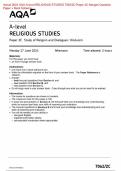
2024_OCR: AS Level Religious Studies H173/07 Developments in Hindu Thought
(Merged Question Paper & Marking Scheme)
Key Areas to Revise:
The Nature of God in Hinduism
Brahman: Explore Brahman as the formless, ultimate, and all-pervading reality in Hindu thought.
Atman: Examine the connection between Atman (the individual soul) and Brahman, as well as
the concept of self-realization.
The Trimurti: Study the roles of the three principal deities—Brahma (the Creator), Vishnu (the
Preserver), and Shiva (the Destroyer)—and their influence on the cosmic cycle.
The Hindu Concept of the Self
Atman and Moksha: Investigate the nature of Atman (the true self) and Moksha (liberation from
the cycle of samsara).
The Five Koshas: Understand the five layers of the self, ranging from the physical body to the
innermost spiritual essence.
Karma and Reincarnation: Examine the impact of karma on samsara (the cycle of rebirth) and
the significance of living a righteous life.
The Paths to Liberation
Jnana Yoga (Path of Knowledge): Delve into the pursuit of knowledge and wisdom to realize
the oneness of Atman and Brahman.
Bhakti Yoga (Path of Devotion): Explore the path of devotion to a personal god, including
practices such as prayer, rituals, and temple worship.
Karma Yoga (Path of Action): Understand the importance of selfless action and fulfilling one's
duty (dharma) without attachment to the results.
Raja Yoga (Path of Meditation): Review the practice of meditation and mental discipline as
means to attain spiritual insight.
The Hindu Scriptures
Vedas: Examine the Vedas, particularly the Rigveda, as the oldest and most authoritative
scriptures in Hinduism.
Upanishads: Study the Upanishads as philosophical texts that delve into the nature of reality, the
self, and Brahman.
Bhagavad Gita: Focus on the teachings of the Bhagavad Gita, especially the dialogue between
Arjuna and Krishna on dharma, karma, and devotion.
Ramayana and Mahabharata: Understand the moral and ethical lessons embedded in these
epic tales
, Oxford Cambridge and RSA
Monday 3 June 2024 – Afternoon
AS Level Religious Studies
H173/07 Developments in Hindu thought
Time allowed: 1 hour 15 minutes
*9083889850*
You must have:
• the OCR 12-page Answer Booklet
INSTRUCTIONS
• Use black ink.
• Write your answer to each question in the Answer Booklet. The question numbers must
be clearly shown.
• Fill in the boxes on the front of the Answer Booklet.
• Answer any two questions.
INFORMATION
• The total mark for this paper is 60.
• The marks for each question are shown in brackets [ ].
• Quality of extended response will be assessed in questions marked with an asterisk (*).
• This document has 4 pages.
ADVICE
• Read each question carefully before you start your answer.
© OCR 2024 [601/8869/8] OCR is an exempt Charity
DC (ST) 300673/2 Turn over
, 2
BLANK PAGE
© OCR 2024 H173/07 Jun24
(Merged Question Paper & Marking Scheme)
Key Areas to Revise:
The Nature of God in Hinduism
Brahman: Explore Brahman as the formless, ultimate, and all-pervading reality in Hindu thought.
Atman: Examine the connection between Atman (the individual soul) and Brahman, as well as
the concept of self-realization.
The Trimurti: Study the roles of the three principal deities—Brahma (the Creator), Vishnu (the
Preserver), and Shiva (the Destroyer)—and their influence on the cosmic cycle.
The Hindu Concept of the Self
Atman and Moksha: Investigate the nature of Atman (the true self) and Moksha (liberation from
the cycle of samsara).
The Five Koshas: Understand the five layers of the self, ranging from the physical body to the
innermost spiritual essence.
Karma and Reincarnation: Examine the impact of karma on samsara (the cycle of rebirth) and
the significance of living a righteous life.
The Paths to Liberation
Jnana Yoga (Path of Knowledge): Delve into the pursuit of knowledge and wisdom to realize
the oneness of Atman and Brahman.
Bhakti Yoga (Path of Devotion): Explore the path of devotion to a personal god, including
practices such as prayer, rituals, and temple worship.
Karma Yoga (Path of Action): Understand the importance of selfless action and fulfilling one's
duty (dharma) without attachment to the results.
Raja Yoga (Path of Meditation): Review the practice of meditation and mental discipline as
means to attain spiritual insight.
The Hindu Scriptures
Vedas: Examine the Vedas, particularly the Rigveda, as the oldest and most authoritative
scriptures in Hinduism.
Upanishads: Study the Upanishads as philosophical texts that delve into the nature of reality, the
self, and Brahman.
Bhagavad Gita: Focus on the teachings of the Bhagavad Gita, especially the dialogue between
Arjuna and Krishna on dharma, karma, and devotion.
Ramayana and Mahabharata: Understand the moral and ethical lessons embedded in these
epic tales
, Oxford Cambridge and RSA
Monday 3 June 2024 – Afternoon
AS Level Religious Studies
H173/07 Developments in Hindu thought
Time allowed: 1 hour 15 minutes
*9083889850*
You must have:
• the OCR 12-page Answer Booklet
INSTRUCTIONS
• Use black ink.
• Write your answer to each question in the Answer Booklet. The question numbers must
be clearly shown.
• Fill in the boxes on the front of the Answer Booklet.
• Answer any two questions.
INFORMATION
• The total mark for this paper is 60.
• The marks for each question are shown in brackets [ ].
• Quality of extended response will be assessed in questions marked with an asterisk (*).
• This document has 4 pages.
ADVICE
• Read each question carefully before you start your answer.
© OCR 2024 [601/8869/8] OCR is an exempt Charity
DC (ST) 300673/2 Turn over
, 2
BLANK PAGE
© OCR 2024 H173/07 Jun24