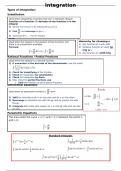
Integration
Types of Integration:
Substitution
Used when integrating a function that isn’t a standard integral
Function of a function OR derivate of one function is in the
integral
1) Identify the function to be substituted [u=f (x )]
du
2) Find and rearrange to dx=¿ …
dx
3) Substitute dx=… into the integral
Parts
4) Cancel/factorise so that a standard integral remains
Used when the integral is the product of two functions and Hierarchy for choosing u
there is no substitution available 1) Any function of x with anln
Formula: 2) Simplest function of x with no
dv du trig or e
∫ u dx dx=uv−∫ v dx dx 3) Any function of x with trig
Rational Functions / Partial Fractions or e
Used when the integral is a rational function
1) If numerator is the derivate of the denominator, use the result:
f ' ( x)
∫ f (x)
dx=ln |f ( x )|+ c
2) Check for simplifying of the fraction
3) Check for integration by substitution
4) Check for Integration by Parts
5) Else, check for partial fractions use
a. Split the fraction up using partial fractions
Differential Equations
Used when an expression contains a
dy
term.
∫ lnx dx
dx
du 1
u=lnx =
1) Split the derivate so dx is on one side and dy is on the other dx x
2) Rearrange so all x terms are with the dx and all y terms are with
→ xlnx−∫ 1 dx
the dy dv
v=x =1
3) Integrate both sides with respect to y on the dy side and x on the dx
dx side ¿ xlnx−x+ c
Parametric Equations
The area under the curve x=f (t) and y=f (t ) between the points t1
and t2 is:
t2
dx
∫ y dt
t1
Standard Integrals
1 1 1
∫ ekx +d dx= k e kx+d + c ∫ kx +d dx= k ln|kx+ d|+c
1 1
∫ cos ( kx +d ) dx= k sin ( kx + d )+ c ∫ sin ( kx+ d ) dx =¿− k cos ( kx +d ) + c ¿
∫ (kx +d )n dx=( 1k )( n+1
1
) ( kx +d )n+1 + c
Types of Integration:
Substitution
Used when integrating a function that isn’t a standard integral
Function of a function OR derivate of one function is in the
integral
1) Identify the function to be substituted [u=f (x )]
du
2) Find and rearrange to dx=¿ …
dx
3) Substitute dx=… into the integral
Parts
4) Cancel/factorise so that a standard integral remains
Used when the integral is the product of two functions and Hierarchy for choosing u
there is no substitution available 1) Any function of x with anln
Formula: 2) Simplest function of x with no
dv du trig or e
∫ u dx dx=uv−∫ v dx dx 3) Any function of x with trig
Rational Functions / Partial Fractions or e
Used when the integral is a rational function
1) If numerator is the derivate of the denominator, use the result:
f ' ( x)
∫ f (x)
dx=ln |f ( x )|+ c
2) Check for simplifying of the fraction
3) Check for integration by substitution
4) Check for Integration by Parts
5) Else, check for partial fractions use
a. Split the fraction up using partial fractions
Differential Equations
Used when an expression contains a
dy
term.
∫ lnx dx
dx
du 1
u=lnx =
1) Split the derivate so dx is on one side and dy is on the other dx x
2) Rearrange so all x terms are with the dx and all y terms are with
→ xlnx−∫ 1 dx
the dy dv
v=x =1
3) Integrate both sides with respect to y on the dy side and x on the dx
dx side ¿ xlnx−x+ c
Parametric Equations
The area under the curve x=f (t) and y=f (t ) between the points t1
and t2 is:
t2
dx
∫ y dt
t1
Standard Integrals
1 1 1
∫ ekx +d dx= k e kx+d + c ∫ kx +d dx= k ln|kx+ d|+c
1 1
∫ cos ( kx +d ) dx= k sin ( kx + d )+ c ∫ sin ( kx+ d ) dx =¿− k cos ( kx +d ) + c ¿
∫ (kx +d )n dx=( 1k )( n+1
1
) ( kx +d )n+1 + c