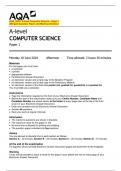
AQA_2024: A-level Computer Science - Paper 2
(Merged Question Paper and Marking Scheme)
Please write clearly in block capitals.
Centre number Candidate number
Surname
Forename(s)
Candidate signature
I declare this is my own work.
A-level
COMPUTER SCIENCE
Paper 2
Tuesday 18 June 2024 Afternoon Time allowed: 2 hours 30 minutes
Materials
For Examiner’s Use
For this paper you must have:
a calculator. Question Mark
1
Instructions
Use black ink or black ball-point pen. 2
Fill in the boxes at the top of this page. 3
Answer all questions. 4
You must answer the questions in the spaces provided. Do not write outside
5
the box around each page or on blank pages.
If you need extra space for your answer(s), use the lined pages at the end of 6
this book. Write the question number against your answer(s). 7
Do all rough work in this book. Cross through any work you do not want to
8
be marked.
9
Information 10
The marks for questions are shown in brackets.
11
The maximum mark for this paper is 100.
TOTAL
Advice
In some questions you are required to indicate your answer by completely
shading a lozenge alongside the appropriate answer as shown.
If you want to change your answer you must cross out your original answer as
shown.
If you wish to return to an answer previously crossed out, ring the answer
you now wish to select as shown.
,For A-level Computer Science Paper 2, which focuses on Computational Thinking, Algorithms, and
Problem Solving, here’s a concise revision guide for the key areas:
1. Computational Thinking:
Problem Decomposition: Break down complex problems into simpler sub-problems. Ensure you can
methodically approach and solve problems step-by-step.
Pattern Recognition: Identify patterns or repetitions in data or problems. Apply solutions to similar
problems using existing algorithms.
Abstraction: Simplify complex problems by focusing on essential details and removing unnecessary
ones. Understand data abstraction and procedural abstraction.
Algorithm Design: Write and refine algorithms to solve problems. Represent algorithms using
pseudocode and flowcharts.
2. Algorithms:
Sorting Algorithms:
o Bubble sort, merge sort, quick sort, and insertion sort. Know how to implement these and
understand their time complexities.
o Big O notation for sorting: Bubble sort (O(n²)), Merge sort (O(n log n)), Quick sort (average O(n
log n), worst O(n²)).
Searching Algorithms:
o Linear search (O(n)) and binary search (O(log n))—understand when to use each and their
time complexities.
Algorithm Efficiency: Understand how to analyze and optimize algorithms for both time complexity
and space complexity using Big O notation.
3. Recursion:
Basic Recursive Functions: Understand how recursion works in problems like calculating factorials,
the Fibonacci sequence, or performing searches.
Base Case and Recursive Case: Identify the base case (end condition) and recursive case in a
function.
Efficiency: Know how recursion can be less efficient than iteration and how to optimize it using
techniques like memoization.
4. Data Structures:
Arrays: Know how to declare, manipulate, and iterate over arrays. Understand searching, sorting, and
inserting data in arrays.
Lists: Understand linked lists (both singly and doubly linked), operations like insertion, deletion, and
traversal.
Stacks: LIFO structure—practice operations like push, pop, and peek.
Queues: FIFO structure—understand enqueue, dequeue, and circular queues.
5. Advanced Data Structures:
Trees: Focus on binary trees, binary search trees, and tree traversal methods: in-order, pre-order,
and post-order.
Graphs: Understand graph representations like adjacency lists and adjacency matrices. Know graph
traversal techniques like depth-first search (DFS) and breadth-first search (BFS).
6. File Handling:
Understand how to open, read, write, and close files. Be familiar with handling text and binary files and
know common file formats.
IB/G/Jun24/G4003/E12 7517/2
, 2
Do not write
outside the
Answer all questions. box
0 1 Anti-virus software and user training are measures that can be used to reduce the
threat posed by viruses.
Describe four other measures that can be used to reduce the threat posed by
viruses.
[4 marks]
4
IB/G/Jun24/7517/2
, 3
Do not write
outside the
Turn over for the next question box
DO NOT WRITE ON THIS PAGE
ANSWER IN THE SPACES PROVIDED
Turn over ►
IB/G/Jun24/7517/2
(Merged Question Paper and Marking Scheme)
Please write clearly in block capitals.
Centre number Candidate number
Surname
Forename(s)
Candidate signature
I declare this is my own work.
A-level
COMPUTER SCIENCE
Paper 2
Tuesday 18 June 2024 Afternoon Time allowed: 2 hours 30 minutes
Materials
For Examiner’s Use
For this paper you must have:
a calculator. Question Mark
1
Instructions
Use black ink or black ball-point pen. 2
Fill in the boxes at the top of this page. 3
Answer all questions. 4
You must answer the questions in the spaces provided. Do not write outside
5
the box around each page or on blank pages.
If you need extra space for your answer(s), use the lined pages at the end of 6
this book. Write the question number against your answer(s). 7
Do all rough work in this book. Cross through any work you do not want to
8
be marked.
9
Information 10
The marks for questions are shown in brackets.
11
The maximum mark for this paper is 100.
TOTAL
Advice
In some questions you are required to indicate your answer by completely
shading a lozenge alongside the appropriate answer as shown.
If you want to change your answer you must cross out your original answer as
shown.
If you wish to return to an answer previously crossed out, ring the answer
you now wish to select as shown.
,For A-level Computer Science Paper 2, which focuses on Computational Thinking, Algorithms, and
Problem Solving, here’s a concise revision guide for the key areas:
1. Computational Thinking:
Problem Decomposition: Break down complex problems into simpler sub-problems. Ensure you can
methodically approach and solve problems step-by-step.
Pattern Recognition: Identify patterns or repetitions in data or problems. Apply solutions to similar
problems using existing algorithms.
Abstraction: Simplify complex problems by focusing on essential details and removing unnecessary
ones. Understand data abstraction and procedural abstraction.
Algorithm Design: Write and refine algorithms to solve problems. Represent algorithms using
pseudocode and flowcharts.
2. Algorithms:
Sorting Algorithms:
o Bubble sort, merge sort, quick sort, and insertion sort. Know how to implement these and
understand their time complexities.
o Big O notation for sorting: Bubble sort (O(n²)), Merge sort (O(n log n)), Quick sort (average O(n
log n), worst O(n²)).
Searching Algorithms:
o Linear search (O(n)) and binary search (O(log n))—understand when to use each and their
time complexities.
Algorithm Efficiency: Understand how to analyze and optimize algorithms for both time complexity
and space complexity using Big O notation.
3. Recursion:
Basic Recursive Functions: Understand how recursion works in problems like calculating factorials,
the Fibonacci sequence, or performing searches.
Base Case and Recursive Case: Identify the base case (end condition) and recursive case in a
function.
Efficiency: Know how recursion can be less efficient than iteration and how to optimize it using
techniques like memoization.
4. Data Structures:
Arrays: Know how to declare, manipulate, and iterate over arrays. Understand searching, sorting, and
inserting data in arrays.
Lists: Understand linked lists (both singly and doubly linked), operations like insertion, deletion, and
traversal.
Stacks: LIFO structure—practice operations like push, pop, and peek.
Queues: FIFO structure—understand enqueue, dequeue, and circular queues.
5. Advanced Data Structures:
Trees: Focus on binary trees, binary search trees, and tree traversal methods: in-order, pre-order,
and post-order.
Graphs: Understand graph representations like adjacency lists and adjacency matrices. Know graph
traversal techniques like depth-first search (DFS) and breadth-first search (BFS).
6. File Handling:
Understand how to open, read, write, and close files. Be familiar with handling text and binary files and
know common file formats.
IB/G/Jun24/G4003/E12 7517/2
, 2
Do not write
outside the
Answer all questions. box
0 1 Anti-virus software and user training are measures that can be used to reduce the
threat posed by viruses.
Describe four other measures that can be used to reduce the threat posed by
viruses.
[4 marks]
4
IB/G/Jun24/7517/2
, 3
Do not write
outside the
Turn over for the next question box
DO NOT WRITE ON THIS PAGE
ANSWER IN THE SPACES PROVIDED
Turn over ►
IB/G/Jun24/7517/2