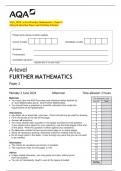
AQA_2024: A-level Further Mathematics - Paper 3
Statistics.
(Merged Question Paper and Marking Scheme)
Please write clearly in block capitals.
Centre number Candidate number
Surname
Forename(s)
Candidate signature
I declare this is my own work.
A-level
FURTHER MATHEMATICS
Paper 3 Statistics
Friday 7 June 2024 Afternoon Time allowed: 2 hours
Materials For Examiner’s Use
You must have the AQA Formulae and statistical tables booklet for
A‑ level Mathematics and A‑ level Further Mathematics. Question Mark
You should have a graphical or scientific calculator that meets the
1
requirements of the specification.
You must ensure you have the other optional Question Paper/Answer Book 2
for which you are entered (either Discrete or Mechanics). You will have
2 hours to complete both papers. 3
4
Instructions
Use black ink or black ball‑ point pen. Pencil should only be used for drawing. 5
Fill in the boxes at the top of this page.
6
Answer all questions.
You must answer each question in the space provided for that question. 7
If you require extra space for your answer(s), use the lined pages at the end
of this book. Write the question number against your answer(s). 8
Do not write outside the box around each page or on blank pages. 9
Show all necessary working; otherwise marks for method may be lost.
Do all rough work in this book. Cross through any work that you do not want 10
to be marked.
TOTAL
Information
The marks for questions are shown in brackets.
The maximum mark for this paper is 50.
Advice
Unless stated otherwise, you may quote formulae, without proof, from the booklet.
You do not necessarily need to use all the space provided.
,For A-Level Further Mathematics - Paper 3: Statistics, focus on the following key areas:
1. Probability:
Conditional Probability: Understand conditional probability and how to use Bayes’ Theorem to solve
problems involving dependent events.
Discrete and Continuous Random Variables: Study probability distributions such as binomial,
Poisson, and normal distributions.
Expectations and Variance: Calculate the expected value, variance, and standard deviation for both
discrete and continuous distributions.
2. Discrete Random Variables:
Binomial Distribution: Be able to apply the binomial distribution to solve problems involving
independent trials with two possible outcomes.
Poisson Distribution: Understand the Poisson distribution for modeling rare events in a fixed interval of
time or space, and apply the mean λ to calculate probabilities.
Geometric Distribution: Solve problems involving the geometric distribution, which models the number
of trials until the first success.
3. Continuous Random Variables:
Normal Distribution: Understand the properties of the normal distribution, including Z-scores and
standardization, and be able to find probabilities and percentiles.
Exponential Distribution: Understand the exponential distribution as it relates to the time between
events in a Poisson process, and calculate probabilities for the distribution.
4. Sampling and Estimation:
Sampling Distributions: Know the concept of sampling distributions, including the Central Limit
Theorem, and apply this to estimate population parameters.
Estimation: Calculate and interpret point estimates and confidence intervals for population means and
proportions.
Standard Error: Understand and calculate the standard error of the mean, and use it to form confidence
intervals and perform hypothesis testing.
5. Hypothesis Testing:
Null and Alternative Hypotheses: Understand the process of hypothesis testing, including how to set up
null and alternative hypotheses.
Test Statistics: Use appropriate test statistics, such as the Z-test, t-test, Chi-squared test, and F-test, to
conduct hypothesis testing and determine p-values.
Critical Regions and Significance: Know how to define critical regions for hypothesis tests and interpret
significance levels (e.g., 5% or 1%).
6. Chi-Squared Tests:
Goodness of Fit: Understand the chi-squared goodness of fit test to compare observed and expected
frequencies.
Test for Independence: Use the chi-squared test for independence to determine if two categorical
variables are independent in contingency tables.
G/LM/Jun24/G4006/V6 7367/3S
, 2
Do not write
outside the
box
Answer all questions in the spaces provided.
1 The random variable X has a Poisson distribution with mean 16
Find the standard deviation of X
Circle your answer.
[1 mark]
4 8 16 256
2 The random variable T has an exponential distribution with mean 2
Find P(T ≤ 1.4)
Circle your answer.
[1 mark]
e–2.8 e– 0.7 1 – e– 0.7 1 – e–2.8
G/Jun24/7367/3S
, 3
Do not write
outside the
box
3 The continuous random variable Y has cumulative distribution function
– 10y2 + 10 y – 16 2≤y<5
{
F( y) = 2
9 9 9
1 y≥5
Find the median of Y
Circle your answer.
[1 mark]
10 – 3√ 2 7 10 + 3√ 2
2
2 2 2
Turn over for the next question
Turn over U
G/Jun24/7367/3S
Statistics.
(Merged Question Paper and Marking Scheme)
Please write clearly in block capitals.
Centre number Candidate number
Surname
Forename(s)
Candidate signature
I declare this is my own work.
A-level
FURTHER MATHEMATICS
Paper 3 Statistics
Friday 7 June 2024 Afternoon Time allowed: 2 hours
Materials For Examiner’s Use
You must have the AQA Formulae and statistical tables booklet for
A‑ level Mathematics and A‑ level Further Mathematics. Question Mark
You should have a graphical or scientific calculator that meets the
1
requirements of the specification.
You must ensure you have the other optional Question Paper/Answer Book 2
for which you are entered (either Discrete or Mechanics). You will have
2 hours to complete both papers. 3
4
Instructions
Use black ink or black ball‑ point pen. Pencil should only be used for drawing. 5
Fill in the boxes at the top of this page.
6
Answer all questions.
You must answer each question in the space provided for that question. 7
If you require extra space for your answer(s), use the lined pages at the end
of this book. Write the question number against your answer(s). 8
Do not write outside the box around each page or on blank pages. 9
Show all necessary working; otherwise marks for method may be lost.
Do all rough work in this book. Cross through any work that you do not want 10
to be marked.
TOTAL
Information
The marks for questions are shown in brackets.
The maximum mark for this paper is 50.
Advice
Unless stated otherwise, you may quote formulae, without proof, from the booklet.
You do not necessarily need to use all the space provided.
,For A-Level Further Mathematics - Paper 3: Statistics, focus on the following key areas:
1. Probability:
Conditional Probability: Understand conditional probability and how to use Bayes’ Theorem to solve
problems involving dependent events.
Discrete and Continuous Random Variables: Study probability distributions such as binomial,
Poisson, and normal distributions.
Expectations and Variance: Calculate the expected value, variance, and standard deviation for both
discrete and continuous distributions.
2. Discrete Random Variables:
Binomial Distribution: Be able to apply the binomial distribution to solve problems involving
independent trials with two possible outcomes.
Poisson Distribution: Understand the Poisson distribution for modeling rare events in a fixed interval of
time or space, and apply the mean λ to calculate probabilities.
Geometric Distribution: Solve problems involving the geometric distribution, which models the number
of trials until the first success.
3. Continuous Random Variables:
Normal Distribution: Understand the properties of the normal distribution, including Z-scores and
standardization, and be able to find probabilities and percentiles.
Exponential Distribution: Understand the exponential distribution as it relates to the time between
events in a Poisson process, and calculate probabilities for the distribution.
4. Sampling and Estimation:
Sampling Distributions: Know the concept of sampling distributions, including the Central Limit
Theorem, and apply this to estimate population parameters.
Estimation: Calculate and interpret point estimates and confidence intervals for population means and
proportions.
Standard Error: Understand and calculate the standard error of the mean, and use it to form confidence
intervals and perform hypothesis testing.
5. Hypothesis Testing:
Null and Alternative Hypotheses: Understand the process of hypothesis testing, including how to set up
null and alternative hypotheses.
Test Statistics: Use appropriate test statistics, such as the Z-test, t-test, Chi-squared test, and F-test, to
conduct hypothesis testing and determine p-values.
Critical Regions and Significance: Know how to define critical regions for hypothesis tests and interpret
significance levels (e.g., 5% or 1%).
6. Chi-Squared Tests:
Goodness of Fit: Understand the chi-squared goodness of fit test to compare observed and expected
frequencies.
Test for Independence: Use the chi-squared test for independence to determine if two categorical
variables are independent in contingency tables.
G/LM/Jun24/G4006/V6 7367/3S
, 2
Do not write
outside the
box
Answer all questions in the spaces provided.
1 The random variable X has a Poisson distribution with mean 16
Find the standard deviation of X
Circle your answer.
[1 mark]
4 8 16 256
2 The random variable T has an exponential distribution with mean 2
Find P(T ≤ 1.4)
Circle your answer.
[1 mark]
e–2.8 e– 0.7 1 – e– 0.7 1 – e–2.8
G/Jun24/7367/3S
, 3
Do not write
outside the
box
3 The continuous random variable Y has cumulative distribution function
– 10y2 + 10 y – 16 2≤y<5
{
F( y) = 2
9 9 9
1 y≥5
Find the median of Y
Circle your answer.
[1 mark]
10 – 3√ 2 7 10 + 3√ 2
2
2 2 2
Turn over for the next question
Turn over U
G/Jun24/7367/3S