Managing in Globalized Economy
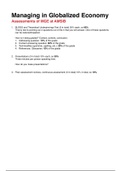
Assessments of MGE at AMSIB
1. BLOGS and Theoretical Underpinnings Test (3 in total) 20% each, so 60%
Theory test & pointing out 2 questions out of the 4 that you will answer. One of these questions
can be restored/repaired.
How is it being graded? Context, content, conclusion.
1. Addressing question: 10% of the grade
2. Content answering question: 60% of the grade
3. Technicalities (grammar, spelling, etc.): 20% of the grade
4. References, Glossaries: 10% of the grade
2. Presentations (3 in total) 10% each, so 30%
Three minutes per person speaking time.
How do you make presentations?
3. Peer assessment reviews, continuous assessment (3 in total) 10% in total, so 10%
, Wednesday 19th of April:
Strategy
• Where are you know (current situation, strength & weaknesses) , what do you want to achieve
(opportunities & threats), how do you achieve that. Answering how.
• Strategy changes while moving forward.
• A firm’s theory about how to compete successfully. Strategies are trade offs.
• Localized strategy (Net income will decline, not cost efficient) global strategy (economies of
scale, lowering of costs)
• Three schools of thought
1. Strategy as plan (Learn before doing)
2. Strategy as action (Oh this is not working, lets diverse)
Page 12, German and French Military Strategy
3. Strategy as integration
• Why do firms differ?
A. Different landscapes/cultures. Also capitalism, socialism… etc.
B. Different ways of conducting business (inter-firm network in Asia, Acquisitions in the West).
C. Informal substitutes (Family, friends) in Asia, Institutional (banks) funding in the West.
• How do firms behave?
A. Industry-based competition (we are not looking in to this one)
B. Firm-specific resources and capabilities
C. Institutional conditions and transitions.
• What determines the scope of the firm?
- Growth
- Contraction
(Downsizing, Downs-coping, Withdrawal) Difference between downsizing and downs-coping:
downsizing is reducing the number of employees, downscaling is producing less products.
- Product scope
(Conglomeration, differentiation of products)
- Geographic scope
How far do we go? What countries do we target? What countries do we not target?
• What determines the success and failures of firms around the globe?
- Competitiveness of the firm
- Capabilities of people in the firm
- Institutional forces
(Conditions and transitions and “Rules of the Game”)
- Adopting *Triple Bottom Line (TBL) for performance measurement and management.
- Performance evaluation
(Balanced scorecard | EFQM model | Intellectual Assets Monitor)
Assessments of MGE at AMSIB
1. BLOGS and Theoretical Underpinnings Test (3 in total) 20% each, so 60%
Theory test & pointing out 2 questions out of the 4 that you will answer. One of these questions
can be restored/repaired.
How is it being graded? Context, content, conclusion.
1. Addressing question: 10% of the grade
2. Content answering question: 60% of the grade
3. Technicalities (grammar, spelling, etc.): 20% of the grade
4. References, Glossaries: 10% of the grade
2. Presentations (3 in total) 10% each, so 30%
Three minutes per person speaking time.
How do you make presentations?
3. Peer assessment reviews, continuous assessment (3 in total) 10% in total, so 10%
, Wednesday 19th of April:
Strategy
• Where are you know (current situation, strength & weaknesses) , what do you want to achieve
(opportunities & threats), how do you achieve that. Answering how.
• Strategy changes while moving forward.
• A firm’s theory about how to compete successfully. Strategies are trade offs.
• Localized strategy (Net income will decline, not cost efficient) global strategy (economies of
scale, lowering of costs)
• Three schools of thought
1. Strategy as plan (Learn before doing)
2. Strategy as action (Oh this is not working, lets diverse)
Page 12, German and French Military Strategy
3. Strategy as integration
• Why do firms differ?
A. Different landscapes/cultures. Also capitalism, socialism… etc.
B. Different ways of conducting business (inter-firm network in Asia, Acquisitions in the West).
C. Informal substitutes (Family, friends) in Asia, Institutional (banks) funding in the West.
• How do firms behave?
A. Industry-based competition (we are not looking in to this one)
B. Firm-specific resources and capabilities
C. Institutional conditions and transitions.
• What determines the scope of the firm?
- Growth
- Contraction
(Downsizing, Downs-coping, Withdrawal) Difference between downsizing and downs-coping:
downsizing is reducing the number of employees, downscaling is producing less products.
- Product scope
(Conglomeration, differentiation of products)
- Geographic scope
How far do we go? What countries do we target? What countries do we not target?
• What determines the success and failures of firms around the globe?
- Competitiveness of the firm
- Capabilities of people in the firm
- Institutional forces
(Conditions and transitions and “Rules of the Game”)
- Adopting *Triple Bottom Line (TBL) for performance measurement and management.
- Performance evaluation
(Balanced scorecard | EFQM model | Intellectual Assets Monitor)