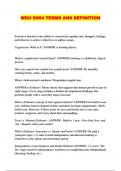
WGU D664 TERMS AND DEFINITION
Executive function is the ability to consciously regulate one's thoughts, feelings,
and behavior to achieve objectives or address issues.
Cognitivism: What is it? ANSWER A learning theory.
What is cognitivism's central thesis? ANSWER Learning is a deliberate, logical
process.
How can cognitivism explain how people learn? ANSWER: By mentally
creating frames, maps, and models.
What is behaviorism's antithesis? Respondent cognitivism.
ANSWER to Erikson's Theory theory that suggests that human growth occurs in
eight stages. Every stage includes a distinct developmental challenge that
presents people with a crisis they must overcome.
What is Erikson's concept of trust against mistrust? ANSWER From birth to one
year, children learn to depend on their caretakers for basic requirements, which
builds trust. However, if these needs are not consistently met, it can cause
mistrust, suspicion, and worry about their surroundings.
Trust vs. Mistrust (Erikson) - ANSWER - Birth to 1 year - Give food, love, and
care - Require safety and comfort
What is Erikson's Autonomy vs. Shame and Doubt? ANSWER The path a
youngster (ages 1-3) takes toward independence and decision-making is
referred to as the shame and uncertainty period.
Independence versus Disgrace and Doubt (Erikson) ANSWER: 1-3 years; "Me
Do" stage; need for independence; insistence on completing tasks independently
(dressing, feeding, etc.)
Executive function is the ability to consciously regulate one's thoughts, feelings,
and behavior to achieve objectives or address issues.
Cognitivism: What is it? ANSWER A learning theory.
What is cognitivism's central thesis? ANSWER Learning is a deliberate, logical
process.
How can cognitivism explain how people learn? ANSWER: By mentally
creating frames, maps, and models.
What is behaviorism's antithesis? Respondent cognitivism.
ANSWER to Erikson's Theory theory that suggests that human growth occurs in
eight stages. Every stage includes a distinct developmental challenge that
presents people with a crisis they must overcome.
What is Erikson's concept of trust against mistrust? ANSWER From birth to one
year, children learn to depend on their caretakers for basic requirements, which
builds trust. However, if these needs are not consistently met, it can cause
mistrust, suspicion, and worry about their surroundings.
Trust vs. Mistrust (Erikson) - ANSWER - Birth to 1 year - Give food, love, and
care - Require safety and comfort
What is Erikson's Autonomy vs. Shame and Doubt? ANSWER The path a
youngster (ages 1-3) takes toward independence and decision-making is
referred to as the shame and uncertainty period.
Independence versus Disgrace and Doubt (Erikson) ANSWER: 1-3 years; "Me
Do" stage; need for independence; insistence on completing tasks independently
(dressing, feeding, etc.)