Database Basics
Wednesday, April 3, 2024 10:30 AM
I. Database
a. A collection of structured info
b. Most are stored on computer files
c. Info that's part of a database
i. A simple list of names and email addresses
ii. Google's collection of user queries
iii. Ecommerce site, inventory lists and consumer lists
d. Created and managed by individuals and organizations
e. Data management/file management/database management: tasks
associated with creating, maintaining, and accessing the info in
databases.
II. Operational and Analytical Databases
a. Operational database- used to collect, modify, and maintain data on a
daily basis
b. Analytical database - used to collect data that will be used for spotting
trends that offer insights for tactical and strategic business decisions
c. Operational databases tasks:
i. Collect and store data
1) Data added to database when consumers carry out activities
such as making purchases and subscribing to social media
sites
ii. View data
1) Consumers may be able to access own back account data, but
not allowed to access data in other accounts
iii. Find data
1) Searches can be used to find specific piece of data, or can be
used as filters to view a subset of data that meets certain
requirements
iv. Update data
1) Keeping data up to date by entering current addresses,
inventory quantities, or new account passwords. May include
validation routines
v. Organize data
1) Alphabetized, numeric order, grouped, subtotaled
vi. Distribute data
1) Mail merge or other computerized tech, offer efficient ways
to distribute info to customers, employees, press, govt
agencies.
vii. Move or remove data
1) Old data removed or archived
d. Analytical databases - store data used by corporate execs, strategic
planners, other workers to examine sales performance, otr business
metrics
i. Provide more analytics efficiently, flexibly
e. Access analytical databases using executive dashboards, performs tasks
i. Data mining - computer algorithms that analyze info to discover
previously unknown and potentially useful info, including
relationships and patterns
1) Find relationships and patterns using data mining
ii. Predictive analytics - a branch of data mining that analyzes current
and historical data to predict future trends
1) Make predictions using predictive analytics
iii. OLAP (online analytical processing) - a data analysis technique used
by decision makers to quickly get answers to complex queries
1) Examine multiple factors using OLAP
III. Database Models
a. Unstructured file- every document has unique structure and contains diff
kinds of data
b. Structured file- uses a uniform format to store data for each person or
thing in file
c. Underlying structure of a database is referred to as a database model
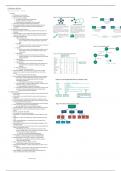
d. One of the simplest models for storing data is flat file, consists of a single,
2-dimensional table of data elements
i. Spreadsheets are stored as flat files displayed as rows and columns
e. Field - contains the smallest unit of meaningful info
i. Basic building block for a structured file or database
f. Variable-length field - like an accordion, expands to fit the data you enter
g. Fixed-length field - contains a predetermined number of characters
(bytes)
h. Record - a collection of data fields
i. The template for a record is a record type
j. Relationship - an association btwn data that's stored in different record
types
k. Cardinality - number of associations that can exist between two record
types
l. Entity- relationship diagram - relationship btwn record types can be
depicted graphically
m. Many database models keep track of relationships among data, are diff
techniques to do it
n. Hierarchical database - allows one-to-one and one-to-many relationships
linked in a hierarchical structure
i. Offer lightning quick searches and utilize a min amount of disk
space for storage, they're rarely used today for business, consumer,
n other mainstream database applications
1) Remain in use only for specialized applications
o. Graph database - offers an alternative way to track relationships
i. Structure resembles sociograms w their interlinked nodes
p. Relational database- stores data in a collection of related tables
i. Relationships are specified by joining common data stored in
records from different tables
q. Table - a sequence of records, similar to a flat file
i. All the records in table are of the same record type
r. Multidimensional database - organizes relationships over three or more
dimensions
i. Dimension- a layer based on a data element, like product, place, or
customer, that can be used to categorize data
s. Object database - stores data as objects, which can be grouped into
classes and defined by attributes and methods
t. Document-oriented database- stores unstructured data, the text of a
Databases Page 1
, t. Document-oriented database- stores unstructured data, the text of a
speech
u. XML (eXtensible Markup Language) - popular tool used to format
document databases
Databases Page 2
Wednesday, April 3, 2024 10:30 AM
I. Database
a. A collection of structured info
b. Most are stored on computer files
c. Info that's part of a database
i. A simple list of names and email addresses
ii. Google's collection of user queries
iii. Ecommerce site, inventory lists and consumer lists
d. Created and managed by individuals and organizations
e. Data management/file management/database management: tasks
associated with creating, maintaining, and accessing the info in
databases.
II. Operational and Analytical Databases
a. Operational database- used to collect, modify, and maintain data on a
daily basis
b. Analytical database - used to collect data that will be used for spotting
trends that offer insights for tactical and strategic business decisions
c. Operational databases tasks:
i. Collect and store data
1) Data added to database when consumers carry out activities
such as making purchases and subscribing to social media
sites
ii. View data
1) Consumers may be able to access own back account data, but
not allowed to access data in other accounts
iii. Find data
1) Searches can be used to find specific piece of data, or can be
used as filters to view a subset of data that meets certain
requirements
iv. Update data
1) Keeping data up to date by entering current addresses,
inventory quantities, or new account passwords. May include
validation routines
v. Organize data
1) Alphabetized, numeric order, grouped, subtotaled
vi. Distribute data
1) Mail merge or other computerized tech, offer efficient ways
to distribute info to customers, employees, press, govt
agencies.
vii. Move or remove data
1) Old data removed or archived
d. Analytical databases - store data used by corporate execs, strategic
planners, other workers to examine sales performance, otr business
metrics
i. Provide more analytics efficiently, flexibly
e. Access analytical databases using executive dashboards, performs tasks
i. Data mining - computer algorithms that analyze info to discover
previously unknown and potentially useful info, including
relationships and patterns
1) Find relationships and patterns using data mining
ii. Predictive analytics - a branch of data mining that analyzes current
and historical data to predict future trends
1) Make predictions using predictive analytics
iii. OLAP (online analytical processing) - a data analysis technique used
by decision makers to quickly get answers to complex queries
1) Examine multiple factors using OLAP
III. Database Models
a. Unstructured file- every document has unique structure and contains diff
kinds of data
b. Structured file- uses a uniform format to store data for each person or
thing in file
c. Underlying structure of a database is referred to as a database model
d. One of the simplest models for storing data is flat file, consists of a single,
2-dimensional table of data elements
i. Spreadsheets are stored as flat files displayed as rows and columns
e. Field - contains the smallest unit of meaningful info
i. Basic building block for a structured file or database
f. Variable-length field - like an accordion, expands to fit the data you enter
g. Fixed-length field - contains a predetermined number of characters
(bytes)
h. Record - a collection of data fields
i. The template for a record is a record type
j. Relationship - an association btwn data that's stored in different record
types
k. Cardinality - number of associations that can exist between two record
types
l. Entity- relationship diagram - relationship btwn record types can be
depicted graphically
m. Many database models keep track of relationships among data, are diff
techniques to do it
n. Hierarchical database - allows one-to-one and one-to-many relationships
linked in a hierarchical structure
i. Offer lightning quick searches and utilize a min amount of disk
space for storage, they're rarely used today for business, consumer,
n other mainstream database applications
1) Remain in use only for specialized applications
o. Graph database - offers an alternative way to track relationships
i. Structure resembles sociograms w their interlinked nodes
p. Relational database- stores data in a collection of related tables
i. Relationships are specified by joining common data stored in
records from different tables
q. Table - a sequence of records, similar to a flat file
i. All the records in table are of the same record type
r. Multidimensional database - organizes relationships over three or more
dimensions
i. Dimension- a layer based on a data element, like product, place, or
customer, that can be used to categorize data
s. Object database - stores data as objects, which can be grouped into
classes and defined by attributes and methods
t. Document-oriented database- stores unstructured data, the text of a
Databases Page 1
, t. Document-oriented database- stores unstructured data, the text of a
speech
u. XML (eXtensible Markup Language) - popular tool used to format
document databases
Databases Page 2