Social Networking
Monday, February 26, 2024 2:17 PM
I. Social Media Mix
a. Social media - online services, facilitate communication
and interaction among people who want to share info
abt their lives, issues, events using multimedia mix of
text, pics, video, and audio.
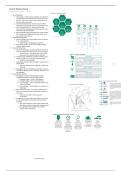
b. Social media honeycomb - provides visual model for
classifying and comparing various social media services
c. Social networking service - personal profiles and
interconnection among subscribers who want to share
information about themselves.
d. Social networking can be traced back to online services,
like CompuServe, Prodigy, and America Online, which
are not part of the internet.
II. Social Networking Basics
a. Person's presence on a social media service is referred
to as - online identity
i. Each identity is encapsulated in a profile
b. Social media profile - set of info provided to friends,
contacts, and the public
III. Geosocial Networking
a. Geosocial networking - provides a platform for users to
carry out interactions based on their current locations
i. Social discovery - uses geolocation to meet with
people who are nearby and similar interests
b. Crowdsourcing - individuals contribute computer time,
expertise, opinions, or money to a defined project
i. Customer reviews/ratings
c. Geocoding - process of determining the coordinates of a
specific place p
i. like street address or the longitude or latitude of
a location
d. Geotagging - process of adding location data to photos,
web sites, HTML documents, audio files, blog posts, and
text messages
IV. Social Network Analytics
a. Sociologists use social network diagrams called
sociograms to depict connections btwn people
i. Sociogram nodes - circles in the diagrams
ii. Sociogram edges - lines connecting nodes
iii. Two-way edges - when two people consider each
other to be friends
iv. One-way edge - a relationship is not reciprocal, no
follow back
b. Binary adjacency matrix - set of cells containing a 0 if
there is no connection btwn 2 people and 1 if there is a
connection
i. Alternative method for depicting social
connections
c. Sociograms and other analytic tools help us to discover
n understand quality and quantity of personal social
networks
i. Class size paradox b/c of the reason students feel
that they are always in larger than average classes
ii. The explanation that people tend to choose
popular classes and friends
Social Media Page 1
, Content Communities
Sunday, March 24, 2024 10:04 PM
I. Evolution
a. Social media sites like Wikipedia, Youtube, flickr, etc, were designed as
repositories for user-generated content
i. Called content communities
1) May focus on text=based info, or other media like photos,
video, or music
b. Bulletin board systems (BBS) of 1970s contained user-generated content
and could be considered forerunners for today's content communities
and social networks
i. Wikipedia launched in 2001
ii. Youtube launched in 2005
iii. First instance of an online video going viral
II. Media Content Communities
a. Are so popular most people w/ internet connection have logged in to take
look at videos from youtube and flickr
b. Most require to registration before files can be uploaded although open
access is allowed
c. They offer basic tools for uploading media files from a computer, and
handle uploads from mobile devices
d. Metadata tag- keyword that describes info like the content of a media
element
e. Formal tagging - methods add info to a tag according to a set of tagging
standards
III. Intellectual Property
a. All creations matrialize from the mind or intellect are considered
intellectual property
i. Inventors, artists, writers, etc are entitled to their intellectual
property
ii. Four categories: patents, trademarks, copyrights, and trade secrets
b. Trademark - any word, name, symbol, or design used in commerce to
identify and distinguish the goods of one company from those of another
c. Copyright- form of legal protection that grants author of original work an
exclusive right to copy, distribute, sell, n modify work
d. Public domain- status of works w/ expired copyrights or whose creators
forfeited their copyright
IV. Creative Commons license (CCC) - based on 5 rights that copyright holders can
grant or deny others
a. Copyleft- designed to make a work freely available for distribution and
modification under condition that all derivative works use same license.
b. Fair use- allows for limited use of copyrighted material w/o obtaining
permission from the copyright holder
c. US regulations include 4 factors that characterize fair use:
i. Purpose and character of the use
ii. Nature of the copyrighted work
iii. Amount of copyrighted work that is used
iv. Effect on the value of the copyrighted work
d. Derivative work - modifies a copyrighted work but doesn't substantially
change its content or purpose
i. Translations and adaptations
e. Transformative work - repackages a copyrighted work to add a new
meaning or produce a work that's used for a purpose different from
original work
i. Parodies are considered transformative works
Social Media Page 2
Monday, February 26, 2024 2:17 PM
I. Social Media Mix
a. Social media - online services, facilitate communication
and interaction among people who want to share info
abt their lives, issues, events using multimedia mix of
text, pics, video, and audio.
b. Social media honeycomb - provides visual model for
classifying and comparing various social media services
c. Social networking service - personal profiles and
interconnection among subscribers who want to share
information about themselves.
d. Social networking can be traced back to online services,
like CompuServe, Prodigy, and America Online, which
are not part of the internet.
II. Social Networking Basics
a. Person's presence on a social media service is referred
to as - online identity
i. Each identity is encapsulated in a profile
b. Social media profile - set of info provided to friends,
contacts, and the public
III. Geosocial Networking
a. Geosocial networking - provides a platform for users to
carry out interactions based on their current locations
i. Social discovery - uses geolocation to meet with
people who are nearby and similar interests
b. Crowdsourcing - individuals contribute computer time,
expertise, opinions, or money to a defined project
i. Customer reviews/ratings
c. Geocoding - process of determining the coordinates of a
specific place p
i. like street address or the longitude or latitude of
a location
d. Geotagging - process of adding location data to photos,
web sites, HTML documents, audio files, blog posts, and
text messages
IV. Social Network Analytics
a. Sociologists use social network diagrams called
sociograms to depict connections btwn people
i. Sociogram nodes - circles in the diagrams
ii. Sociogram edges - lines connecting nodes
iii. Two-way edges - when two people consider each
other to be friends
iv. One-way edge - a relationship is not reciprocal, no
follow back
b. Binary adjacency matrix - set of cells containing a 0 if
there is no connection btwn 2 people and 1 if there is a
connection
i. Alternative method for depicting social
connections
c. Sociograms and other analytic tools help us to discover
n understand quality and quantity of personal social
networks
i. Class size paradox b/c of the reason students feel
that they are always in larger than average classes
ii. The explanation that people tend to choose
popular classes and friends
Social Media Page 1
, Content Communities
Sunday, March 24, 2024 10:04 PM
I. Evolution
a. Social media sites like Wikipedia, Youtube, flickr, etc, were designed as
repositories for user-generated content
i. Called content communities
1) May focus on text=based info, or other media like photos,
video, or music
b. Bulletin board systems (BBS) of 1970s contained user-generated content
and could be considered forerunners for today's content communities
and social networks
i. Wikipedia launched in 2001
ii. Youtube launched in 2005
iii. First instance of an online video going viral
II. Media Content Communities
a. Are so popular most people w/ internet connection have logged in to take
look at videos from youtube and flickr
b. Most require to registration before files can be uploaded although open
access is allowed
c. They offer basic tools for uploading media files from a computer, and
handle uploads from mobile devices
d. Metadata tag- keyword that describes info like the content of a media
element
e. Formal tagging - methods add info to a tag according to a set of tagging
standards
III. Intellectual Property
a. All creations matrialize from the mind or intellect are considered
intellectual property
i. Inventors, artists, writers, etc are entitled to their intellectual
property
ii. Four categories: patents, trademarks, copyrights, and trade secrets
b. Trademark - any word, name, symbol, or design used in commerce to
identify and distinguish the goods of one company from those of another
c. Copyright- form of legal protection that grants author of original work an
exclusive right to copy, distribute, sell, n modify work
d. Public domain- status of works w/ expired copyrights or whose creators
forfeited their copyright
IV. Creative Commons license (CCC) - based on 5 rights that copyright holders can
grant or deny others
a. Copyleft- designed to make a work freely available for distribution and
modification under condition that all derivative works use same license.
b. Fair use- allows for limited use of copyrighted material w/o obtaining
permission from the copyright holder
c. US regulations include 4 factors that characterize fair use:
i. Purpose and character of the use
ii. Nature of the copyrighted work
iii. Amount of copyrighted work that is used
iv. Effect on the value of the copyrighted work
d. Derivative work - modifies a copyrighted work but doesn't substantially
change its content or purpose
i. Translations and adaptations
e. Transformative work - repackages a copyrighted work to add a new
meaning or produce a work that's used for a purpose different from
original work
i. Parodies are considered transformative works
Social Media Page 2