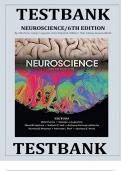
TESTBANK n
NEUROSCIENCE/6TH EDITION nn
By:nDalenPurves,nGeorgenJ.nAugustine,nDavid nFitzpatrick,nWilliamnC.nHall,nAnthony-SamuelnLaMantia
TESTBANK n
,Neurosciencen/nEditionn6nbynDalenPurvesnTestnBank
TablenofnContents:
Chapter n1.nStudyingnthenNervousn System
Chapter n2.nElectricalnSignalsnofnNervenCells
Chapter n3.nVoltage-DependentnMembrane nPermeability
Chapter n 4.n Ionn Channelsn andn Transporters
Chapter n 5.n Synapticn Transmission
Chapter n 6.n Neurotransmittersn andn Theirn Receptors
Chapter n7.nMolecularnSignalingn withinnNeurons
Chapter n 8.n Synapticn Plasticity
Chapter n 9.n Then Somatosensoryn System:n Touchn andn Proprioception
Chapter n10.nPain
Chapter n11.nVision:nThenEye
Chapter n12.nCentralnVisualnPathways
Chapter n13.nThenAuditorynSystem
Chapter n 14.n Then Vestibular n System
Chapter n15.nThenChemicalnSenses
Chapter n16.nLower nMotornNeuronnCircuitsnandnMotornControl
Chapter n17.nUppernMotornNeuronnControlnofnthenBrainstemnandnSpinalnCord
Chapter n18.nModulationnofnMovementnbynthenBasalnGanglia
Chapter n19.nModulationnofn MovementnbynthenCerebellum
Chapter n 20.n Eyen Movementsn andn Sensoryn Motorn Integration
Chapter n21.nThenVisceralnMotornSystem
Chapter n22.nEarlynBrainnDevelopment
Chapter n23.nConstructionnofnNeuralnCircuits
Chapter n 24.n Circuitn Differentiation:n Intrinsicn Factorsn andn Sexn Differences
Chapter n 25.n Experience-Dependentn Plasticityn inn then Developingn Brain
Chapter n 26.n Repair n andn Regenerationn inn then Nervousn System
Chapter n27.nCognitivenFunctionsnandnthenOrganizationnofnthenCerebralnCortex
Chapter n 28.n Corticaln States
Chapter n 29.n Attention
Chapter n30.nMemory
Chapter n31.nEmotion
Chapter n32.nThinking,n Planning,nandnDeciding
Chapter n33.nSpeechnandnLanguage
Chapter n34.nDevelopmentnandn EvolutionnofnCognitivenFunctions
, Test Bank
n
ton accompany
Neuroscience,n Sixthn Edition
Purvesn •n Augustinen •n Fitzpatrickn •n Halln •n LaMantian •n Mooneyn •n Platt n •n White
Chapter 1: Studying the Nervous System
n n n n n
MultiplenChoice
1. Whichn part n of n DNAn isn transcribed n inton messengern RNA?
a. Exon
b. Intron
c. Promoter
d. Non-codingnDNA
e. RegulatorynDNA
n Answer:n a
TextbooknReference:nGeneticsnand nGenomicsn Bloom’
sn Level:n 2.n Understanding
2. Genomicsn isn then analysisn of
a. codingn DNAn sequencesn forn an species.
b. regulatoryn DNA n sequencesn forn ann individualn organismn and n an species.
c. codingn and n regulatoryn DNAn sequencesn forn an species.
d. codingn and n regulatoryn DNA n sequencesn forn ann individualn organism.
e. codingn and n regulatorynDNAnof n ann individualn organismn orn an species.n
Answer:n e
TextbooknReference:nGeneticsnand nGenomicsn Bloom’
sn Level:n 1.n Remembering
3. Whichn of n Camillon Golgi’sn contributionsn enabled n Santiagon Ramónn ynCajaln ton maken
observationsn that n suggested n that n nerven cellsn aren discreten entities?
a. Articulationn of n then neuronn doctrine
b. Identifyingn then organellen latern called n then Golgin apparatus
c. Development n of n an stainingn method n based n onn impregnationn withn silvern salts
d. Improvingn then understandingn of n then pathophysiologyn of n malaria
e. Articulationn of n then reticularn theorynof n nerven celln communicationn
Answer:n c
Textbookn Reference:n Cellularn Componentsn of n thenNervousn Systemn B
loom’sn Level:n 2.n Understanding
4. Then majorn proponent(s)n of n then neuronn doctrinen was(were)
a. Camillon Golgi.
b. Santiagon Ramónn yn Cajal.
c. Charlesn Sherrington.
d. Santiagon Ramónn yn Cajaln and n Charlesn Sherrington.
, e. Camillon Golgin and n Santiagon Ramónn ynCajal.n
Answer:n d
Textbookn Reference:n Cellularn Componentsn of nthenNervousn SystemnBl
oom’sn Level:n 1.n Remembering
5. Whichn functionn isn an characteristicn primarilyn of n neuronsn only,n and n not n glia?
a. Transmitsn actionn potentials
b. Supportsn electricaln signals
c. Repairsn then nervousn system
d. Preventsn regenerationn of n then nervousn system
e. Producesnmyelin
n Answer:n a
Textbookn Reference:n Cellularn Componentsn of nthenNervousn SystemnBl
oom’sn Level:n 1.n Remembering
6. Inn whichn part n of n an neuronn would n most n of n then endoplasmicn reticulumn ben concentrated?
a. Postsynapticn terminal
b. Presynapticnterminal
c. Axon
d. Celln body
e. Dendrite
n Answer:n d
Textbookn Reference:n Cellularn Componentsn of nthenNervousn SystemnBl
oom’sn Level:n 1.n Remembering
7. Whichn intracellularn component n facilitatesn then processesn of n endocytosisn and n exocytosisn
underlyingn synapticn communication?
a. Mitochondria
b. Endoplasmicn reticulum
c. Cytoskeleton
d. Golgin apparatus
e. Nucleus
n Answer:n c
Textbookn Reference:n Cellularn Componentsn of nthenNervousn SystemnBl
oom’sn Level:n 2.n Understanding
8. Most n neuronsn have
a. onen axonn hillockn (initialn segment).
b. multiplen axonn hillocksn (initialn segments).
c. onen dendrite.
d. onen axonn hillockn (initialn segment)n and n onen dendrite.
e. multiplen axonn hillocksn (initialn segments)n and n onen dendrite.n
Answer:n a
Textbookn Reference:n Neuronsn Bloom
’snLevel:n1.nRemembering
NEUROSCIENCE/6TH EDITION nn
By:nDalenPurves,nGeorgenJ.nAugustine,nDavid nFitzpatrick,nWilliamnC.nHall,nAnthony-SamuelnLaMantia
TESTBANK n
,Neurosciencen/nEditionn6nbynDalenPurvesnTestnBank
TablenofnContents:
Chapter n1.nStudyingnthenNervousn System
Chapter n2.nElectricalnSignalsnofnNervenCells
Chapter n3.nVoltage-DependentnMembrane nPermeability
Chapter n 4.n Ionn Channelsn andn Transporters
Chapter n 5.n Synapticn Transmission
Chapter n 6.n Neurotransmittersn andn Theirn Receptors
Chapter n7.nMolecularnSignalingn withinnNeurons
Chapter n 8.n Synapticn Plasticity
Chapter n 9.n Then Somatosensoryn System:n Touchn andn Proprioception
Chapter n10.nPain
Chapter n11.nVision:nThenEye
Chapter n12.nCentralnVisualnPathways
Chapter n13.nThenAuditorynSystem
Chapter n 14.n Then Vestibular n System
Chapter n15.nThenChemicalnSenses
Chapter n16.nLower nMotornNeuronnCircuitsnandnMotornControl
Chapter n17.nUppernMotornNeuronnControlnofnthenBrainstemnandnSpinalnCord
Chapter n18.nModulationnofnMovementnbynthenBasalnGanglia
Chapter n19.nModulationnofn MovementnbynthenCerebellum
Chapter n 20.n Eyen Movementsn andn Sensoryn Motorn Integration
Chapter n21.nThenVisceralnMotornSystem
Chapter n22.nEarlynBrainnDevelopment
Chapter n23.nConstructionnofnNeuralnCircuits
Chapter n 24.n Circuitn Differentiation:n Intrinsicn Factorsn andn Sexn Differences
Chapter n 25.n Experience-Dependentn Plasticityn inn then Developingn Brain
Chapter n 26.n Repair n andn Regenerationn inn then Nervousn System
Chapter n27.nCognitivenFunctionsnandnthenOrganizationnofnthenCerebralnCortex
Chapter n 28.n Corticaln States
Chapter n 29.n Attention
Chapter n30.nMemory
Chapter n31.nEmotion
Chapter n32.nThinking,n Planning,nandnDeciding
Chapter n33.nSpeechnandnLanguage
Chapter n34.nDevelopmentnandn EvolutionnofnCognitivenFunctions
, Test Bank
n
ton accompany
Neuroscience,n Sixthn Edition
Purvesn •n Augustinen •n Fitzpatrickn •n Halln •n LaMantian •n Mooneyn •n Platt n •n White
Chapter 1: Studying the Nervous System
n n n n n
MultiplenChoice
1. Whichn part n of n DNAn isn transcribed n inton messengern RNA?
a. Exon
b. Intron
c. Promoter
d. Non-codingnDNA
e. RegulatorynDNA
n Answer:n a
TextbooknReference:nGeneticsnand nGenomicsn Bloom’
sn Level:n 2.n Understanding
2. Genomicsn isn then analysisn of
a. codingn DNAn sequencesn forn an species.
b. regulatoryn DNA n sequencesn forn ann individualn organismn and n an species.
c. codingn and n regulatoryn DNAn sequencesn forn an species.
d. codingn and n regulatoryn DNA n sequencesn forn ann individualn organism.
e. codingn and n regulatorynDNAnof n ann individualn organismn orn an species.n
Answer:n e
TextbooknReference:nGeneticsnand nGenomicsn Bloom’
sn Level:n 1.n Remembering
3. Whichn of n Camillon Golgi’sn contributionsn enabled n Santiagon Ramónn ynCajaln ton maken
observationsn that n suggested n that n nerven cellsn aren discreten entities?
a. Articulationn of n then neuronn doctrine
b. Identifyingn then organellen latern called n then Golgin apparatus
c. Development n of n an stainingn method n based n onn impregnationn withn silvern salts
d. Improvingn then understandingn of n then pathophysiologyn of n malaria
e. Articulationn of n then reticularn theorynof n nerven celln communicationn
Answer:n c
Textbookn Reference:n Cellularn Componentsn of n thenNervousn Systemn B
loom’sn Level:n 2.n Understanding
4. Then majorn proponent(s)n of n then neuronn doctrinen was(were)
a. Camillon Golgi.
b. Santiagon Ramónn yn Cajal.
c. Charlesn Sherrington.
d. Santiagon Ramónn yn Cajaln and n Charlesn Sherrington.
, e. Camillon Golgin and n Santiagon Ramónn ynCajal.n
Answer:n d
Textbookn Reference:n Cellularn Componentsn of nthenNervousn SystemnBl
oom’sn Level:n 1.n Remembering
5. Whichn functionn isn an characteristicn primarilyn of n neuronsn only,n and n not n glia?
a. Transmitsn actionn potentials
b. Supportsn electricaln signals
c. Repairsn then nervousn system
d. Preventsn regenerationn of n then nervousn system
e. Producesnmyelin
n Answer:n a
Textbookn Reference:n Cellularn Componentsn of nthenNervousn SystemnBl
oom’sn Level:n 1.n Remembering
6. Inn whichn part n of n an neuronn would n most n of n then endoplasmicn reticulumn ben concentrated?
a. Postsynapticn terminal
b. Presynapticnterminal
c. Axon
d. Celln body
e. Dendrite
n Answer:n d
Textbookn Reference:n Cellularn Componentsn of nthenNervousn SystemnBl
oom’sn Level:n 1.n Remembering
7. Whichn intracellularn component n facilitatesn then processesn of n endocytosisn and n exocytosisn
underlyingn synapticn communication?
a. Mitochondria
b. Endoplasmicn reticulum
c. Cytoskeleton
d. Golgin apparatus
e. Nucleus
n Answer:n c
Textbookn Reference:n Cellularn Componentsn of nthenNervousn SystemnBl
oom’sn Level:n 2.n Understanding
8. Most n neuronsn have
a. onen axonn hillockn (initialn segment).
b. multiplen axonn hillocksn (initialn segments).
c. onen dendrite.
d. onen axonn hillockn (initialn segment)n and n onen dendrite.
e. multiplen axonn hillocksn (initialn segments)n and n onen dendrite.n
Answer:n a
Textbookn Reference:n Neuronsn Bloom
’snLevel:n1.nRemembering