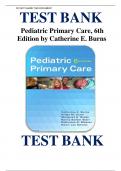
TEST BANK
Pediatric Primary Care, 6th
Edition by Catherine E. Burns
TEST BANK
, Complete Test Bank For Pediatric Primary Care, 6th Edition
A Complete Test Bank for Pediatric Primary Care, 6th Edition by Dawn Lee Garzon
Maaks, Catherine E. Burns , Ardys M. Dunn
Unit One: Pediatric Primary Care Foundations
1.Health Status of Children: Global and Local
Perspectives 2.Child and Family Health Assessment
3.Cultural Perspectives for Pediatric Primary Care
Unit Two: Management of Development
4.Developmental Management in Pediatric Primary
Care 5.Developmental Management of Infants
6.Developmental Management in Early Childhood
7.Developmental Management of School-Age Children
8.Developmental Management of Adolescents
Unit Three: Approaches to Health Management
in Pediatric Primary Care
9. Introduction to Functional Health Patterns and Health
Promotion
10. Breastfeeding
11.Nutrition
12.Elimination Patterns
13.Physical Activity and Sports for Children and
Adolescents 14.Sleep and Rest
15.Sexuality
16.Values and Beliefs
17.Role Relationships
18. Self-Perception Issues
19. Coping and Stress Tolerance: Mental Health and Illness
20. Cognitive-Perceptual Disorders: Attention-Deficit/Hyperactivity Disorder, Learning Problems, Sensory
Processing Disorder, Autism Spectrum Disorder, Blindness, and Deafness
Unit Four: Approaches to Disease Management
21.Introduction to Disease Management
22.Prescribing Medications in Pediatrics NEW!
23.Pediatric Pain Management
24.Infectious Diseases and
Immunizations 25.Atopic and Rheumatic
Disorders 26.Endocrine and Metabolic
Disorders 27.Hematologic Disorders
28.Neurologic Disorders
29.Eye Disorders 30.Ear
Disorders
31.Cardiovascular Disorders
32.Respiratory Disorders
33.Gastrointestinal Disorders
34.Dental and Oral Disorders
35.Genitourinary Disorders
36.Gynecologic Disorders
37.Dermatologic Disorders
38.Musculoskeletal Disorders
39.Common Injuries
40.Perinatal Conditions
,41.Genetic Disorders
42.Environmental Health Issues
43.Complementary Medicine
44. Strategies for Managing a Pediatric Health Care Practice
1. Health Status of Children: Global and Local Perspectives
Questions
1. A child who has attention•deficit/hyperactivitydisorder(ADHD)hasdifficulty
stopping activities to begin other activities at school. The primary care pediatric nurse
practitioner understands that this is due to difficulty with the self•regulationcomponentof
A. emotional control.
B. flexibility. Correct
A. inhibition.
B. problem•solving.
2. The primary care pediatric nurse practitioner cares for a preschool•agechild
who was exposed to drugs prenatally. The child bites other children and has tantrums when
asked to stop but is able to state later why this behavior is wrong. This child most likely has
a disorder of
A. executive function. Correct
B. information processing.
C. sensory processing.
D. social cognition.
3. The primary care pediatric nurse practitioner uses the Neurodevelopmental Learning Framework
to assess cognition and learning in an adolescent. When evaluating social cognition, the nurse
practitioner will ask the adolescent
A. about friends and activities at school. Correct
B. if balancing sports and homework is difficult.
C. to interpret material from a pie chart.
D. to restate the content of something just read.
4. The primary care pediatric nurse practitioner is evaluating a school•agechildwhohas been diagnosed with
ADHD. Which plan will the nurse practitione with academic performance?
A. 504 Correct
B. FAPE
C. IDEA
D. IEP
, 5. The parent of a child diagnosed with ADHD tells the primary care pediatric nurse practitioner
that the child gets overwhelmed by homework assi to do first, and then doesn’tanyassignments. The nurse
practitioner
tells the parent that this represents impairment in which executive function?
A. Activation Correct
B. Effort
C. Emotion
D. Focus
6. The primary care pediatric nurse practitioner is considering medication
options for a school•age child recently diagnose presentation. Which medication will the nurse practitioner
select initially?
A. Low•dosestimulant
B. Moderate•dosestimulantCorrect
C. Low•dosenon•stimulant
D. Moderate•donon•stimulante
7. The parent of a 4•year•oldchildreports that the child gets upset when the
hall light is left on at night and won’t leave t primary care pediatric nurse practitioner recognizes that this
child likely has which type of
sensory processing disorder?
A. Dyspraxia
B. Over•responderCorrect
C. Sensory seeker
D. Under•responder
8. The parent of a preschool•agechildwhoisdiagnosed with a sensory
processing disorder (SPD) asks the primary care pediatric nurse practitioner how to help
the child manage the symptoms. What will the nurse practitioner recommend?
A. Establishing a reward system for acceptable behaviors
B. Introducing the child to a variety of new experiences
C. Maintaining predictable routines as much as possible Correct
D. Providing frequent contact, such as hugs and cuddling
Pediatric Primary Care, 6th
Edition by Catherine E. Burns
TEST BANK
, Complete Test Bank For Pediatric Primary Care, 6th Edition
A Complete Test Bank for Pediatric Primary Care, 6th Edition by Dawn Lee Garzon
Maaks, Catherine E. Burns , Ardys M. Dunn
Unit One: Pediatric Primary Care Foundations
1.Health Status of Children: Global and Local
Perspectives 2.Child and Family Health Assessment
3.Cultural Perspectives for Pediatric Primary Care
Unit Two: Management of Development
4.Developmental Management in Pediatric Primary
Care 5.Developmental Management of Infants
6.Developmental Management in Early Childhood
7.Developmental Management of School-Age Children
8.Developmental Management of Adolescents
Unit Three: Approaches to Health Management
in Pediatric Primary Care
9. Introduction to Functional Health Patterns and Health
Promotion
10. Breastfeeding
11.Nutrition
12.Elimination Patterns
13.Physical Activity and Sports for Children and
Adolescents 14.Sleep and Rest
15.Sexuality
16.Values and Beliefs
17.Role Relationships
18. Self-Perception Issues
19. Coping and Stress Tolerance: Mental Health and Illness
20. Cognitive-Perceptual Disorders: Attention-Deficit/Hyperactivity Disorder, Learning Problems, Sensory
Processing Disorder, Autism Spectrum Disorder, Blindness, and Deafness
Unit Four: Approaches to Disease Management
21.Introduction to Disease Management
22.Prescribing Medications in Pediatrics NEW!
23.Pediatric Pain Management
24.Infectious Diseases and
Immunizations 25.Atopic and Rheumatic
Disorders 26.Endocrine and Metabolic
Disorders 27.Hematologic Disorders
28.Neurologic Disorders
29.Eye Disorders 30.Ear
Disorders
31.Cardiovascular Disorders
32.Respiratory Disorders
33.Gastrointestinal Disorders
34.Dental and Oral Disorders
35.Genitourinary Disorders
36.Gynecologic Disorders
37.Dermatologic Disorders
38.Musculoskeletal Disorders
39.Common Injuries
40.Perinatal Conditions
,41.Genetic Disorders
42.Environmental Health Issues
43.Complementary Medicine
44. Strategies for Managing a Pediatric Health Care Practice
1. Health Status of Children: Global and Local Perspectives
Questions
1. A child who has attention•deficit/hyperactivitydisorder(ADHD)hasdifficulty
stopping activities to begin other activities at school. The primary care pediatric nurse
practitioner understands that this is due to difficulty with the self•regulationcomponentof
A. emotional control.
B. flexibility. Correct
A. inhibition.
B. problem•solving.
2. The primary care pediatric nurse practitioner cares for a preschool•agechild
who was exposed to drugs prenatally. The child bites other children and has tantrums when
asked to stop but is able to state later why this behavior is wrong. This child most likely has
a disorder of
A. executive function. Correct
B. information processing.
C. sensory processing.
D. social cognition.
3. The primary care pediatric nurse practitioner uses the Neurodevelopmental Learning Framework
to assess cognition and learning in an adolescent. When evaluating social cognition, the nurse
practitioner will ask the adolescent
A. about friends and activities at school. Correct
B. if balancing sports and homework is difficult.
C. to interpret material from a pie chart.
D. to restate the content of something just read.
4. The primary care pediatric nurse practitioner is evaluating a school•agechildwhohas been diagnosed with
ADHD. Which plan will the nurse practitione with academic performance?
A. 504 Correct
B. FAPE
C. IDEA
D. IEP
, 5. The parent of a child diagnosed with ADHD tells the primary care pediatric nurse practitioner
that the child gets overwhelmed by homework assi to do first, and then doesn’tanyassignments. The nurse
practitioner
tells the parent that this represents impairment in which executive function?
A. Activation Correct
B. Effort
C. Emotion
D. Focus
6. The primary care pediatric nurse practitioner is considering medication
options for a school•age child recently diagnose presentation. Which medication will the nurse practitioner
select initially?
A. Low•dosestimulant
B. Moderate•dosestimulantCorrect
C. Low•dosenon•stimulant
D. Moderate•donon•stimulante
7. The parent of a 4•year•oldchildreports that the child gets upset when the
hall light is left on at night and won’t leave t primary care pediatric nurse practitioner recognizes that this
child likely has which type of
sensory processing disorder?
A. Dyspraxia
B. Over•responderCorrect
C. Sensory seeker
D. Under•responder
8. The parent of a preschool•agechildwhoisdiagnosed with a sensory
processing disorder (SPD) asks the primary care pediatric nurse practitioner how to help
the child manage the symptoms. What will the nurse practitioner recommend?
A. Establishing a reward system for acceptable behaviors
B. Introducing the child to a variety of new experiences
C. Maintaining predictable routines as much as possible Correct
D. Providing frequent contact, such as hugs and cuddling