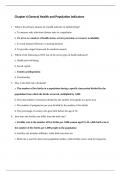
Chapter 6 General Health and Population Indicators
1. What is the primary purpose of a health indicator in epidemiology?
a. To measure only infectious disease rates in a population
b. To serve as a marker of health status, service provision, or resource availability
c. To track hospital efficiency in treating diseases
d. To provide a legal framework for medical research
2. Which of the following is NOT one of the seven types of health indicators?
a. Health and well-being
b. Social capital
c. Genetic predisposition
d. Functionality
3. How is the birth rate calculated?
a. The number of live births in a population during a specific time period divided by the
population from which the births occurred, multiplied by 1,000
b. The total number of newborns divided by the number of hospitals in a given area
c. The number of pregnancies per year divided by the number of live births
d. The percentage of women who give birth before the age of 30
4. How does the fertility rate differ from the birth rate?
a. Fertility rate is the number of live births per 1,000 women aged 15-44, while birth rate is
the number of live births per 1,000 people in the population
b. Fertility rate includes stillbirths, while birth rate does not
c. Birth rate is used for short-term population studies, while fertility rate is used for long-term
, studies
d. Birth rate accounts for infant mortality, while fertility rate does not
5. The infant mortality rate is calculated by:
a. Dividing the number of deaths among infants aged 0-1 years by the number of live births
in the same time period, multiplied by 1,000
b. Counting the number of babies born prematurely and dividing by the total birth count
c. Measuring the percentage of infants who receive vaccinations before their first birthday
d. Summing all neonatal deaths and multiplying by the total birth rate
6. The neonatal mortality rate refers to:
a. Infant deaths occurring between 6 months and 1 year of age
b. Deaths among infants younger than 28 days per 1,000 live births in the same period
c. The mortality rate for infants between 1 and 5 years old
d. Deaths related only to congenital defects
7. Postneonatal mortality rate is defined as:
a. The number of deaths among infants younger than 7 days
b. Deaths of infants aged 28 days to 1 year per 1,000 live births
c. Deaths of children between 1 and 5 years old
d. The total number of infant deaths within a five-year span
8. The International Classification of Disease (ICD) is primarily used for:
a. Standardized classification of mortality statistics across countries
b. Diagnosing and coding only infectious diseases
c. Recording only birth-related complications
d. Organizing hospital treatment plans
1. What is the primary purpose of a health indicator in epidemiology?
a. To measure only infectious disease rates in a population
b. To serve as a marker of health status, service provision, or resource availability
c. To track hospital efficiency in treating diseases
d. To provide a legal framework for medical research
2. Which of the following is NOT one of the seven types of health indicators?
a. Health and well-being
b. Social capital
c. Genetic predisposition
d. Functionality
3. How is the birth rate calculated?
a. The number of live births in a population during a specific time period divided by the
population from which the births occurred, multiplied by 1,000
b. The total number of newborns divided by the number of hospitals in a given area
c. The number of pregnancies per year divided by the number of live births
d. The percentage of women who give birth before the age of 30
4. How does the fertility rate differ from the birth rate?
a. Fertility rate is the number of live births per 1,000 women aged 15-44, while birth rate is
the number of live births per 1,000 people in the population
b. Fertility rate includes stillbirths, while birth rate does not
c. Birth rate is used for short-term population studies, while fertility rate is used for long-term
, studies
d. Birth rate accounts for infant mortality, while fertility rate does not
5. The infant mortality rate is calculated by:
a. Dividing the number of deaths among infants aged 0-1 years by the number of live births
in the same time period, multiplied by 1,000
b. Counting the number of babies born prematurely and dividing by the total birth count
c. Measuring the percentage of infants who receive vaccinations before their first birthday
d. Summing all neonatal deaths and multiplying by the total birth rate
6. The neonatal mortality rate refers to:
a. Infant deaths occurring between 6 months and 1 year of age
b. Deaths among infants younger than 28 days per 1,000 live births in the same period
c. The mortality rate for infants between 1 and 5 years old
d. Deaths related only to congenital defects
7. Postneonatal mortality rate is defined as:
a. The number of deaths among infants younger than 7 days
b. Deaths of infants aged 28 days to 1 year per 1,000 live births
c. Deaths of children between 1 and 5 years old
d. The total number of infant deaths within a five-year span
8. The International Classification of Disease (ICD) is primarily used for:
a. Standardized classification of mortality statistics across countries
b. Diagnosing and coding only infectious diseases
c. Recording only birth-related complications
d. Organizing hospital treatment plans