1.
a.
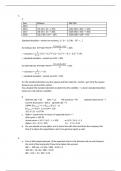
Year Orbison S&P 500
2015
2016 (15-10) / 10 = + 50% (440-400) / 400 = + 10%
2017 (18-15) / 15 = + 20% (528-440) / 440 = + 20%
2018 (16.2-18) / 18 = - 10% (528-528) / 528 = + 0%
Standard deviation = wortel van variance; 1 / (n – 1) [ (R1 – R) 2 + … ]
0.5+ 0.2−0.1
For Orbison the average return= = 20%
3
1 2 2 2
-> variance= [ ( 0.5−0.2 ) + ( 0.2−0.2 ) + (−0.1−0.2 ) ] = 9%
3−1
-> standard deviation = wortel van 0.09 = 30%
0.1+ 0.2+ 0.0
For S&P 500 the average return= = 10%
3
1
-> variance= ¿ = 1%
3−1
-> standard deviation = wortel van 0.01 = 10%
For the standard deviation you first square and then take the ~wortel~, get rid of the square,
because you want positive values.
You calculate the standard deviation to determine the volatility -> a lower standard deviation
means less risk and less volatility.
b.
Risk-free rate = 5% beta = 1.5 risk premium = 4% expected share price = ?
Current share price = $16.2 (growth rate = ?)
CAPM: E(rorbison) = rf + Borbison (E (rm) – rf)
E(rorbison) = 0.05 + 1.5 x 0.04 = 11%
16.2 x 1.11 = $17.98
c. Alpha = actual return in excess of expected return = ?
Share price = $24.30
Actual return = 24..2 – 1 = 50% or 24..2 = 1.5
Alpha = 0.5 – 0.11 = 39% 1.5 – 1.11 = 0.39
d. No, you should not use alpha, as it is not in line with the trend from the company, this
time it is above the expectations, but it can go lower again as well.
2.
a. Firm is fully equity financed the expected return is the discount rate as well, because
the costs of borrowing don’t have to be taken into account
IRR = - 100 mln + 12 mln / (IRR – 0.01) = 0
100 mln = 12 mln / (IRR – 0.01)
IRR – 0.01 = = 0.12
a.
Year Orbison S&P 500
2015
2016 (15-10) / 10 = + 50% (440-400) / 400 = + 10%
2017 (18-15) / 15 = + 20% (528-440) / 440 = + 20%
2018 (16.2-18) / 18 = - 10% (528-528) / 528 = + 0%
Standard deviation = wortel van variance; 1 / (n – 1) [ (R1 – R) 2 + … ]
0.5+ 0.2−0.1
For Orbison the average return= = 20%
3
1 2 2 2
-> variance= [ ( 0.5−0.2 ) + ( 0.2−0.2 ) + (−0.1−0.2 ) ] = 9%
3−1
-> standard deviation = wortel van 0.09 = 30%
0.1+ 0.2+ 0.0
For S&P 500 the average return= = 10%
3
1
-> variance= ¿ = 1%
3−1
-> standard deviation = wortel van 0.01 = 10%
For the standard deviation you first square and then take the ~wortel~, get rid of the square,
because you want positive values.
You calculate the standard deviation to determine the volatility -> a lower standard deviation
means less risk and less volatility.
b.
Risk-free rate = 5% beta = 1.5 risk premium = 4% expected share price = ?
Current share price = $16.2 (growth rate = ?)
CAPM: E(rorbison) = rf + Borbison (E (rm) – rf)
E(rorbison) = 0.05 + 1.5 x 0.04 = 11%
16.2 x 1.11 = $17.98
c. Alpha = actual return in excess of expected return = ?
Share price = $24.30
Actual return = 24..2 – 1 = 50% or 24..2 = 1.5
Alpha = 0.5 – 0.11 = 39% 1.5 – 1.11 = 0.39
d. No, you should not use alpha, as it is not in line with the trend from the company, this
time it is above the expectations, but it can go lower again as well.
2.
a. Firm is fully equity financed the expected return is the discount rate as well, because
the costs of borrowing don’t have to be taken into account
IRR = - 100 mln + 12 mln / (IRR – 0.01) = 0
100 mln = 12 mln / (IRR – 0.01)
IRR – 0.01 = = 0.12