Lecture 2
You cannot determine which decision will be made from a production function on its own, as it
depends on individual preferences.
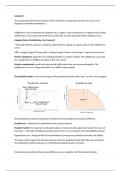
Indifference curves represent the preference(s), a higher curve corresponds to a higher level of utility.
Indifference curves slope downward due to trade-offs, also the slope gets flatter along the curve.
Marginal Rate of Substitution: the Trade-off
->the trade-off that a person is willing to make between 2 goods, at a given point on the indifference
curve.
MRS = change in good 1 (final grade) / change in good 2 (hours of free time) = slope of isocost curve.
Perfect substitutes: goods that are indistinguishable in use from another. The indifference curve will
be a straight line, the MRS is the slope of this curve (line).
Perfect complements: goods that only provide utility when they are consumed together. The
indifference curve is L-shaped and there is no MRS for these goods.
The feasible frontier is the mirror image of the production function (the ‘input’ on the x-axis changes)
All combinations under the production function are also possible but would be inefficient.
Feasible set: a collection of combinations that can be produced.
Feasible frontier: the maximum achievable output, it represents the opportunity cost (in this case of
free time, -> the trade-off between grade and free time). It is a constraint of the possibilities/choices.
Opportunity cost = Marginal Rate of Transformation (coming from production function; the ability)
The slope of the tangent line becomes steeper along the feasible frontier (the other way around for
the production function) because of a diminishing marginal product of labour.
To determine the optimal choice; put indifference curves together with the feasible frontier.
You cannot determine which decision will be made from a production function on its own, as it
depends on individual preferences.
Indifference curves represent the preference(s), a higher curve corresponds to a higher level of utility.
Indifference curves slope downward due to trade-offs, also the slope gets flatter along the curve.
Marginal Rate of Substitution: the Trade-off
->the trade-off that a person is willing to make between 2 goods, at a given point on the indifference
curve.
MRS = change in good 1 (final grade) / change in good 2 (hours of free time) = slope of isocost curve.
Perfect substitutes: goods that are indistinguishable in use from another. The indifference curve will
be a straight line, the MRS is the slope of this curve (line).
Perfect complements: goods that only provide utility when they are consumed together. The
indifference curve is L-shaped and there is no MRS for these goods.
The feasible frontier is the mirror image of the production function (the ‘input’ on the x-axis changes)
All combinations under the production function are also possible but would be inefficient.
Feasible set: a collection of combinations that can be produced.
Feasible frontier: the maximum achievable output, it represents the opportunity cost (in this case of
free time, -> the trade-off between grade and free time). It is a constraint of the possibilities/choices.
Opportunity cost = Marginal Rate of Transformation (coming from production function; the ability)
The slope of the tangent line becomes steeper along the feasible frontier (the other way around for
the production function) because of a diminishing marginal product of labour.
To determine the optimal choice; put indifference curves together with the feasible frontier.